

The three vice presidential candidates yesterday wrangled over foreign policy and the Constitution in a televised debate.
In her opening remarks, Democratic Progressive Party (DPP) vice presidential candidate Hsiao Bi-khim (蕭美琴) said Taiwan must strive to keep pace in a fast-changing world.
The Chinese Nationalist Party’s (KMT) plans, such as reintroducing the cross-strait service trade agreement and opening up Taiwan to large groups of Chinese university students, allowing them to seek jobs in the nation after obtaining degrees, are examples of its “old mindset,” Hsiao said.
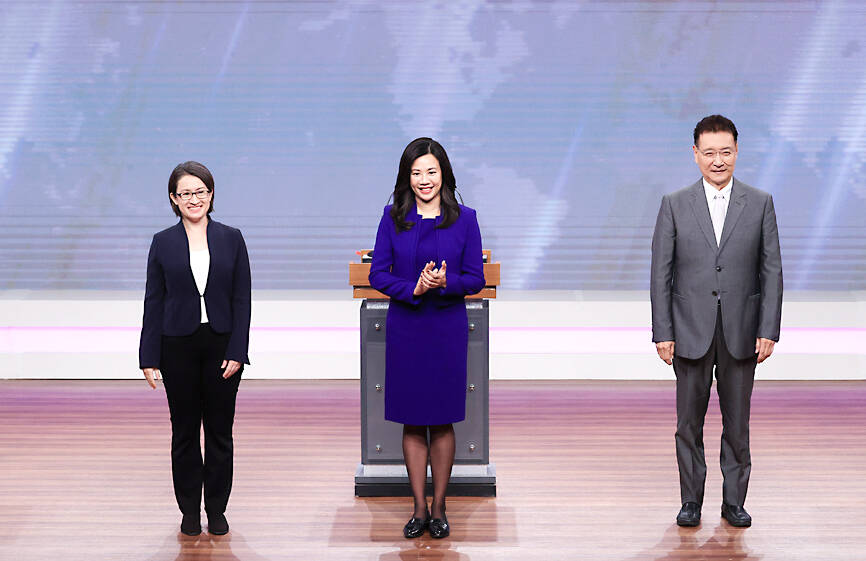
Photo: Joey Yu, EPA-EFE
The whole world can see that the Chinese Communist Party (CCP) is the main threat to regional insecurity, but the KMT always toes the line of China’s Taiwan Affairs Office in denigrating Taiwan and the DPP government, the former representative to the US said.
“They blame the victim,” she said, adding that Taiwan is facing isolation, coercion and unjust treatment by Beijing on the world stage.
The KMT’s vice presidential candidate, Broadcasting Corp of China (中廣) chairman Jaw Shaw-kong (趙少康), has blamed China’s increased military activity near Taiwan on then-US House of Representatives speaker Nancy Pelosi’s visit in August 2022, she said.
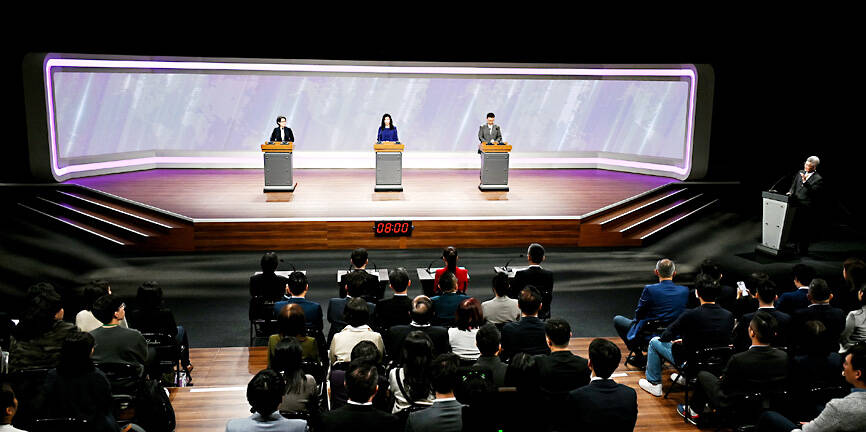
Photo courtesy of the Taipei Photojournalist Society
“But Pelosi stated clearly that her trip was to demonstrate her willingness to stand together with Taiwanese, not to challenge the status quo, and not to change the US’ ‘one China policy,’” she said.
Nevertheless, the KMT characterized her visit as a provocation to China, she said.
Hsiao said her experience in foreign affairs as envoy to the US would benefit Taiwan with her as vice president.
“We shall work to ensure Taiwan can break through the current international isolation, to find ways for the nation to participate in more international forums and organizations, by deepening relations with countries,” she said.
Although Taiwan has no diplomatic relations with the US, Taipei and Washington have collaborated on addressing “double taxation” to help Taiwanese businesses establish operations in the US, she said.
Taiwan would continue to engage with nations as a responsible member of the international community, she added.
Regarding the Constitution and the so-called “1992 consensus,” Hsiao reiterated that the DPP has always upheld the Constitution and the law when dealing with China over the past eight years.
However, the KMT has attempted to link the “1992 consensus” with the Constitution because China has never officially recognized the part of the “consensus” that says both sides are open to different interpretation of what “one China” means, she said.
Hsiao was referring to remarks by KMT presidential candidate New Taipei City Mayor Hou You-yi (侯友宜) that he supports a version of the “1992 consensus” that is in line with Taiwan’s laws and the Constitution, which he said provides a legal framework for relations with China.
The “1992 consensus,” a term former Mainland Affairs Council chairman Su Chi (蘇起) in 2006 admitted making up in 2000, refers to a tacit understanding between the KMT and the Chinese government that both sides of the Strait acknowledge there is “one China,” with each side having its own interpretation of what “China” means.
Taiwan has become more active on the world stage, rising from economic adversity and stagnation to play a pivotal role in the global supply chain, Hsiao said.
“More nations are choosing to stand with us, working together on programs to promote better security and more opportunities,” she added.
“This election is a choice between international collaboration to keep pace with economic growth or to withdraw from the world, to become a source of danger and regional instability,” she said.
Taiwan People’s Party (TPP) vice presidential candidate Legislator Cynthia Wu (吳欣盈) in her opening remarks said that the government should focus on the economy, instead of political infighting between the pan-blue and pan-green camps.
Citing her experience in the past two decades since returning from the UK, such as her work in charitable foundations, Wu said that informal or unofficial relations, such as between non-governmental organizations, can enable Taiwan to connect with the world.
“Taiwan’s industrial development is unbalanced. The high earners are in high-tech industries, while people in services and traditional manufacturing face low productivity and low income,” she said.
“Young people do not dare get married and have children, cannot afford to buy a house, and have no hope for the future. Should the KMT and the DPP not be held accountable?” Wu said.
She said that salaries in the service industry have not increased, because the Cross-Strait Service Trade Agreement had been blocked by the DPP.
Both the KMT and the DPP pledged that they would boost the economy and transform industries, but they have failed to improve people’s working conditions and elevate the nation’s competitiveness, she said.
As the artificial intelligence era would create job opportunities in quantum computing and big data, the nation needs a long-term vision for industrial transformation and personnel training, she said.
It also needs to improve personal data protection, such as the EU has done with its General Data Protection Regulation, she added.
“Only the TPP can rationally and practically face the nation’s problems and help Taiwanese break free from the KMT and DPP’s political infighting... We cannot let our country walk into conflict or let our economic problems worsen,” Wu said.
As Japan has gone through three decades of economic decline, while Taiwan has faced two decades, people should vote for the TPP in the election to make a big change, she said.
On China’s attempt to suppress Taiwan’s involvement in international organizations and how the government can make diplomatic breakthroughs, she said that Taiwan should focus on “track two diplomacy,” two-way trade agreements and exchanges, and work on legal interoperability, so that more foreign investors are willing to invest in Taiwan.
“As Taiwan Semiconductor Manufacturing Co (台積電) has been dubbed Taiwan’s ‘sacred mountain protecting the nation,’ we should form a number of sacred ‘mountains’ to improve our economy and protect the nation,” she said.
Regarding cross-strait relations, Wu said that the KMT chooses “cooperation” with China, while the DPP chooses “conflict,” but the TPP seeks “competition,” which means Taiwan must elevate its international competitiveness, starting with boosting the economy.
The two sides of the Strait should have more exchanges under TPP Chairman and presidential candidate Ko Wen-je’s (柯文哲) “five mutuals” proposal.
On national defense, she said she supports increasing the defense budget to 3 percent of GDP, but the military must improve its management, readjust the deployment plan for voluntary enlisted soldiers and compulsory conscripts if a war breaks out, and increase the salaries and benefits of military personnel and veterans.
On energy policy, Wu said she supports the development of renewable energy, but Taiwan must be practical in facing the nuclear power issue.
Taiwan is an island and relies heavily on the manufacturing industry, so it cannot abruptly stop using nuclear power and force the rapid development of renewable energy, she said.
The TPP proposes postponing the retirement of two nuclear power plants, while examining if the mothballed Fourth Nuclear Power Plant can be made operational, she said.
Wu also urged people not to be affected by those promoting “dump-save” voting, as they would be giving up their right to vote.
“Dump-save” encourages voters to strategically cast their ballot for someone other than their preferred candidate to prevent a disliked party from winning.
Taiwanese, unlike people in China, are lucky to be able to vote, so they should cast their ballots for the candidates they truly believe are most suitable, Wu said.
In his opening statement, Jaw wasted no time in attacking the DPP, accusing the party of creating geopolitical risks.
The DPP’s cross-strait policy has pushed the country to the brink of a cross-strait war and prevented Chinese tourists from visiting Taiwan, he said, adding that it was no wonder that 65 percent of the population said that they wanted the DPP out of office.
Jaw also announced in the debate that he would officially step down as Broadcasting Corp of China chairman, president and board member if elected.
He pledged to give up his salary and benefits as vice president, and use the official residence of the vice president as public housing for young people.
He also volunteered to pay for the building utility fees.
He denied DPP claims that he and Hou would move Taiwan closer to China and betray the country if elected.
“Hou’s father was a butcher in Chiayi. My paternal grandfather hung himself after being tortured in a Chinese Communist Party (CCP) prison and my maternal grandfather was executed by the communists in a shooting in prison. My father, who was twice held captive by the CCP, vowed to never return to China while the CCP is still there. He only returned after he was told to repair his ancestor’s tomb,” he said.
Taiwan lost nine allies over the past eight years and cannot enter the WHO, the World Meteorological Organization or the International Criminal Police Organization, because the DPP tried to alter the nation’s relations with China, which should guide the direction of diplomatic policy, Jaw said.
“The government allowed the importation of US pork containing ractopamine residue, as well as Japanese food from areas affected by the Fukushima Dai-ichi nuclear power plant disaster, but have we joined the Comprehensive and Progressive Agreement for Trans-Pacific Partnership or the Regional Comprehensive Economic Partnership? Have we signed a bilateral free-trade agreement with the US or Japan?” Jaw said.
The KMT would propose having a “diplomatic truce with China” once elected, he added.
However, he said he does not oppose an increase in defense spending, but added that no matter how much Taiwan spends on defense, China is much larger and would always spend more.
“But that does not mean we just give up,” he said, adding Taiwan’s defense budget should be spent wisely.
He also reiterated the KMT’s stance on enhancing the Taiwan military’s capabilities so as to be able to strike Chinese coastal areas as a better deterrent to invasion.
He and Hou have never accepted China’s “one China, two system” framework, nor have they agreed with the way the CCP treats Hong Kong, Jaw said.
As for the “1992 consensus,” the “consensus” could also be the recognition of differences, apart from agreeing on the same thing, he said.
“It is like you can call me by a different last name, but my last name is still Jaw... We recognize the Republic of China [ROC] Constitution, and we believe ‘one China’ in the ‘1992 consensus’ means the ROC,” he said.
Voters must choose between completely severing ties with China and trying to maintain relations, even a weak one, he said.
DPP presidential candidate Vice President William Lai’s ((賴清德) stance on Taiwanese independence “would cause 23 million people in this country to pay a high price. Our future and our children’s futures would be buried along with his political convictions,” he said.
The Constitution remains a lifesaving charm and would not give the CCP an excuse to attack Taiwan, he added.
Additional repoting by CNA
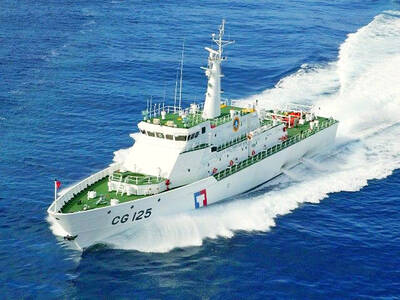
GEOPOLITICAL SIGNIFICANCE: The CGA’s nonmilitary role makes it a tool to avert diplomatic issues, an official said, while confirming the donation of a ship to Manila Coast Guard Administration (CGA) ships are scheduled to sail to the Philippines bearing the words “Taiwan Coast Guard” in a high-profile visit in October next year, the first such visit by a Taiwanese maritime law enforcement vessel to the Southeast Asian nation, the agency said yesterday. The CGA also confirmed that it had donated one of its decommissioned patrol vessels to the Philippines in a rare transfer of a retired ship to a nondiplomatic ally. The Republic of China (ROC) Navy last made such a visit in 1974, shortly before the Philippines switched diplomatic recognition to the People’s Republic of China in

‘GLOBAL WARNING’: The infiltration is not just a local problem, as Beijing has been deploying the same tactics worldwide against Western democracies, a report said Between 50,000 and 100,000 Chinese spies are operating in Taiwan, far more than the National Security Bureau’s previous estimate of 5,000, German journalist and author Jurgen Kremb said on Monday. Kremb presented his research, titled “The War of Spies: How China’s Intelligence Services Are Infiltrating Taiwan — and What Europe Must Learn from It,” at a joint event held by the Taiwan offices of the Friedrich Naumann Foundation and the European Values Center for Security Policy. The report was published in June in the Ministry of Justice Investigation Bureau’s Prospect & Exploration Monthly (展望與探索月刊). By spies, he said he was referring to informants,

PRICE STABILIZATION: The Ministry of Economic Affairs has urged the legislature to support the Cabinet’s supplementary budget for state-owned energy companies State-owned oil supplier CPC Corp, Taiwan (CPC, 台灣中油) on Saturday announced that it would raise domestic gasoline prices by NT$0.7 (US$0.02) per liter and diesel prices by NT$0.6 per liter this week after international crude oil prices rose above US$100 per barrel last week. Formosa Petrochemical Corp (台塑石化) yesterday said that it matched CPC’s price adjustments for this week. The decisions end a six-week period during which CPC and Formosa kept fuel prices in Taiwan unchanged. Retail gasoline prices this week would rise to NT$31.2, NT$32.7 and NT$34.7 per liter for 92, 95 and 98-octane unleaded gasoline respectively at CPC
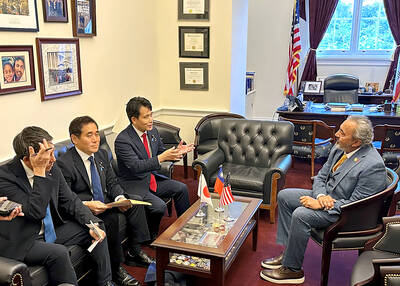
WASHINGTON MEETING: Japan’s Hirofumi Takinami said participants rejected the idea that the US should limit its defensive perimeter to the Second Island Chain US and Japanese lawmakers agree that the US must defend the First Island Chain, including Taiwan, and should not fall back to the Second Island Chain, while “a Taiwan contingency is a Japan contingency and therefore a US-Japan alliance contingency,” media reported after a meeting between officials of the two nations in Washington on Tuesday. A delegation of Japanese lawmakers from the Liberal Democratic Party met with US Senator Thom Tillis, co-chair of the Senate Taiwan Caucus, and US Representative Ami Bera, co-chair of the US Congressional Taiwan caucus, to discuss issues concerning East Asia and the Taiwan Strait. The Japanese and


 RSS
RSS