


Table tennis player Lin Yun-ju (林昀儒) on Sunday achieved a new milestone in his pro career by lifting his first-ever World Table Tennis (WTT) Champions trophy in Germany.
The 22-year-old Taiwanese upset 35-year-old Ma Long (馬龍) of China, widely regarded as one of the greatest players of all time, 4-1 in the WTT Champions Frankfurt men’s singles final.
Coming into the tourney as the eighth seed, Lin, the world No. 12, had a wild run before Sunday’s match as he dispatched fourth-seeded Tomolazu Harimoto of Japan in the quarter-finals and second-seeded Wang Chuqin (王楚欽) of China in the semifinals.

Photo: Screen grab from WTT’s Web site
Lin had fallen four straight times to the world No. 2 Wang before winning on Saturday.
In the nearly one-hour final at Infinity Arena, the Taiwanese “Silent Assassin” lost the first game to Ma 11-7, but bounced back to win the next game by the same score.
The two then went to deuce (10-10) in the next three games, but Lin showed the most poise and prevailed 13-11, 12-10, 12-10 to take the title.

Photo: Screen grab from Hylo Badminton Open’s Facebook page
“I think I had a good mindset because Ma Long is a super, super strong opponent. I played pretty well in the last four games and executed the tactics without hesitation,” Lin was quoted as saying on the WTT’s official Web site.
Lin said never in his “wildest dreams” did he ever think he wound win the Frankfurt title, attributing the victory to his adoption of a different approach.
“I tried out different tactics in this event against whomever I met and it worked out. So I will keep that going,” he said.
WTT Champions events are among the top events in professional table tennis and open to only the world’s best 30 men and women and two wild cards, with a maximum of four players per member association.
The victory was Lin’s second of the year, after winning the WTT Contender Almaty in Kazakhstan in early September.
The loss by the world No. 3 Ma, who is the only male tennis table player with two Olympic singles golds, extended his international title drought to 828 days, dating back to the Tokyo Olympic Games, the WTT said.
Separately, Taiwanese shuttler Chou Tien-chen (周天成) on Sunday clinched his fourth Hylo Open title after defeating Hong Kong’s Lee Cheuk-yiu (李卓耀) in the men’s singles final in Saarbrucken, Germany.
It took Chou 63 minutes to defeat Lee 21-23, 21-17, 21-10 at the Saarlandhalle arena.
Both players took the lead several times in the opener, with Chou and Lee leveling at 21-21 before Lee scored two consecutive points to win the first game.
They continued their back-and-forth in the second game, with Lee eventually establishing a two-point advantage at the interval.
Chou then clawed his way back to an 11-10 lead and held firm to give himself a 20-17 advantage before seeing out the second game 21-17. He established a wide lead to seal the third game 21-10 and clinch the title.
World No. 13 Chou extended his head-to-head record against Lee to 8-4.
Chou said he kept his mind on the game and tried to secure every point he could.
Sunday’s victory was Chou’s fourth Hylo Open title, having won the Badminton World Federation Super 300 tournament, then known as the Bitburger Open, three years in a row from 2012 to 2014.
It was also his first men’s singles title since winning the Taipei Open in July last year.

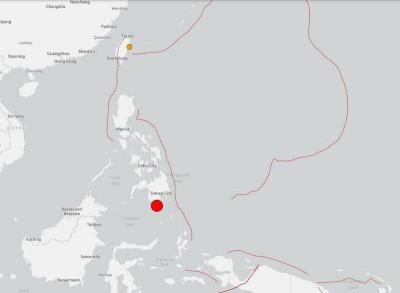
A magnitude 7.8 earthquake struck off the southern coast of Mindanao in the Philippines at 7:38am today, prompting the US Tsunami Warning System to issue an alert for neighboring countries, including Taiwan. The system issued a purple alert indicating a "tsunami threat." The potential threat zone includes Taiwan, the Philippines, Papua New Guinea, Yap and Palau. Philippine authorities were assessing the damage from the quake, with the office of civil defense seeking to verifying initial reports that 15 people had been killed and 129 injured in the region, mostly from falling debris. Arlene Hollero, disaster chief of Maasim town in the Philippines' Sarangani Province,
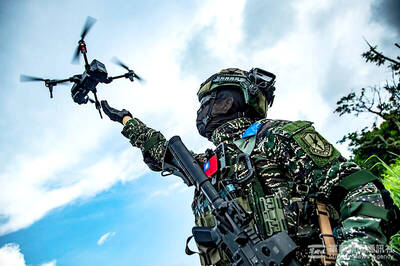
RESILIENCE: Taiwan plays a key role in semiconductors, energy, information infrastructure and advanced manufacturing, AIT Director Raymond Greene said Taiwan’s continued investment in deterrence and resilience remains vital, especially in uncrewed systems and other emerging technologies, American Institute in Taiwan (AIT) Director Raymond Greene said yesterday. Greene made the remarks at the annual National Strategic Summit on Supply Chain Resilience held by the Research Institute for Democracy, Society and Emerging Technology (DSET), a government-backed think tank. As Taiwan last year became the US’ fourth-largest trading partner and supply chain security is becoming more important, cooperation in emerging technologies continues to deepen between the two countries, he said. The US is committed to accelerating innovation, building key infrastructure, strengthening cooperation

The National Chungshan Institute of Science and Technology yesterday showcased its locally developed variants of the Vision 60 robotic patrol dog, which it plans to deploy on the nation’s outlying territories in the South China Sea. The variants were produced under the Joint Lab project — created by the institute and domestic companies — and assembled with domestically produced motors, lenses and artificial intelligence (AI) systems alongside licensed tech from the US, Missile and Rocket Systems Research Division deputy director Jen Kuo-kang (任國光) told the media event at a military base in Taipei’s Dazhi (大直) area. Taiwan has built up its strengths

RIGHT DIRECTION: Taiwan’s efforts to prevent forced labor include a proposal to ‘fully prohibit’ employers from withholding workers’ documents, an official said Taiwan is to establish a mechanism to restrict imports of goods linked to forced labor, the Executive Yuan said yesterday, after the US proposed imposing additional tariffs on Taiwanese goods over labor concerns. “The Ministry of Labor and the Ministry of Economic Affairs are to establish an interministerial review procedure,” Executive Yuan spokesperson Michelle Lee (李慧芝) said at a news briefing in Taipei. “The government is to use the Foreign Trade Act [貿易法] as the legal basis to restrict imports of goods produced with forced labor” and bring its supply chain governance more in line with international standards on human rights, resilience


 RSS
RSS