


Chinese warplane incursions into Taiwan’s air defense identification zone (ADIZ) increased by 79 percent annually last year as part of the Chinese People’s Liberation Army’s (PLA) efforts to amplify multipronged pressure against Taiwan, the US Department of Defense said in a report released on Thursday.
In its annual report to the US Congress on “Military and Security Developments Involving the People’s Republic of China,” the department said that Beijing had “amplified diplomatic, political and military pressure against Taiwan” throughout last year.
These included large-scale joint exercises aimed at deterring US and allied operations, focusing on combat realism, the report says.
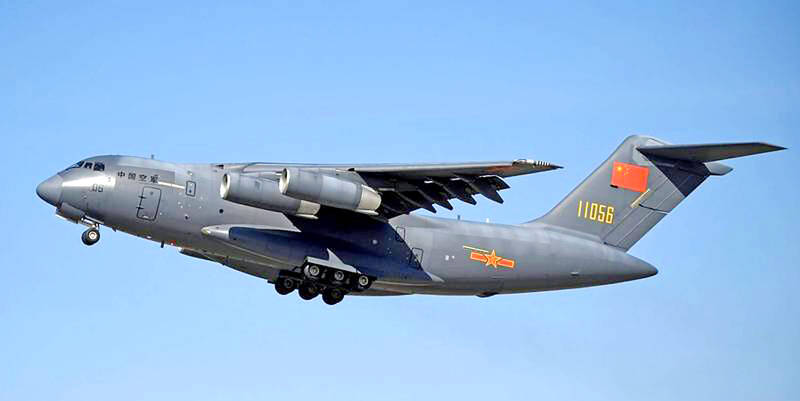
Photo courtesy of the Ministry of National Defense
Chinese warplane incursions into the ADIZ rose to 1,737 from 972 in 2021, an increase of 79 percent, it says.
The PLA has also diversified the type of aircraft used, with drones comprising about 10 percent of aircraft tracked since the Ministry of National Defense began releasing such data in September last year, it says.
The report makes special mention of the “several unprecedented actions” taken by the PLA following then-US House of Representatives speaker Nancy Pelosi’s visit to Taipei in August last year, including flying more than 250 fighters into the ADIZ, sailing 13 navy vessels around Taiwan, firing ballistic missiles into waters around Taiwan and the “first-seen instance” of at least four missiles flying over the nation.
Speaking to the media before reporting to the legislature yesterday, Minister of National Defense Chiu Kuo-cheng (邱國正) confirmed the increased Chinese military pressure, while vowing to continue working with other countries to bolster surveillance and defense.
Regarding reports that US President Joe Biden was yesterday to ask the US Congress for a US$100 billion supplemental budget to include aid to Taiwan, Israel and Ukraine, Chiu said the nation can only rely on itself for its own defense.
Although aid is certainly welcome, “we cannot hope for or expect it,” he said, adding that no Han Kuang military exercise has had foreign help.
The Pentagon report also commented on China’s efforts to modernize, diversify and expand its nuclear arsenal, with about 500 operational warheads today and more than 1,000 likely by 2030.
The department said it expects China to continue its expansion and modernization efforts through 2035 in service of Chinese President Xi Jinping’s (習近平) objective of achieving “world class” status for the country’s military by 2049.
China “probably will use its new fast-breeder reactors and reprocessing facilities to produce plutonium for its nuclear weapons program, despite publicly maintaining these technologies are intended for peaceful purposes,” the report says.
According to US estimates, China probably completed construction of three new solid-propellant silo fields — totaling at least 300 new intercontinental ballistic missile silos — last year, “and has loaded at least some” intercontinental ballistic missiles into the silos.
A senior Pentagon official, speaking to reporters on Wednesday on condition of anonymity, played down concerns that China has recently accelerated its nuclear buildup, saying that projections become less reliable and additional variables come into play as the years go by.
The US would continue to urge China to be more transparent about its nuclear capabilities, the official said, suggesting that its prior resistance to transparency might have been due to the numerical advantage held by the US and Russia.
The report also outlines the military options it foresees for Chinese action against Taiwan, each of which were practiced in August last year and in April.
An air and maritime blockade over weeks or months, in combination with missile strikes, potential seizure of outlying islands and cyberattacks, would seek to force Taiwan’s surrender, the report says.
It could also turn to limited force or coercive operations to stoke fear and degrade confidence in Taiwan’s leaders, or similarly attack important government and military targets through precision airstrikes, it says.
An amphibious landing would be “one of the most complicated and difficult military operations for the PLA,” making it a significant political and military risk for Beijing, even if successful, the report says.
Seizing smaller islands is within the PLA capabilities, and would show capability and resolve, but would also involve “significant, and possibly prohibitive, political risk” in stoking independence sentiment in Taiwan and international opposition, it adds.
Although the military gap continues to widen between China and Taiwan, Taiwan last year accelerated steps to improve its asymmetric and joint warfare capabilities, it says.
Chinese Ministry of Foreign Affairs spokeswoman Mao Ning (毛寧) yesterday told a regular news briefing in Beijing that the report was “filled with prejudice and distorts facts.”
“China is committed to peaceful development,” she said. “We have a stable and unique nuclear policy that is highly predictable.”
Additional reporting by CNA and Lin Hsin-han

‘NO SECURITY RISK’: The Railway Bureau reassured the public that the technicians’ activities were limited to technical guidance and did not involve sensitive systems The Railway Bureau yesterday said it had invited eight Chinese technicians to assist with an airport MRT construction project. The bureau issued the confirmation after an Internet user said Chinese nationals had entered the construction zone of Taiwan Taoyuan International Airport’s Terminal 3 project. They asked why “individuals from an enemy state” were allowed access to such a major national infrastructure project, which raised serious concerns over Taiwan’s industrial safety, sensitive systems and information security. The bureau’s Northern Region Engineering Branch Office said subcontractor Taiwan Handle Industrial Co (台灣手把工業) of the Taoyuan airport MRT’s “Contract No. CU05 Project A14 Station Civil, MEP &

A US uncrewed surface vessel (USV) encountered multiple Chinese warships during an autonomous transit of the Taiwan Strait, US defense company Seasats said in a statement on Wednesday. Seasats announced that a Lightfish USV had completed the first autonomous transit of the Taiwan Strait. Over five days, the USV traversed the entire length of the Strait while constantly monitoring surface vessel traffic, the company said. The Lightfish encountered multiple Chinese warships, one of which was a Chinese People’s Liberation Army Navy (PLAN) Type 056 corvette, it said. The Chinese vessels were operating “well within Taiwan’s exclusive economic zone without transmitting their identity via the
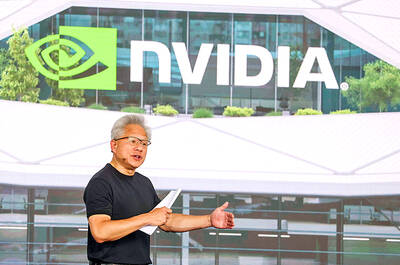
‘BOOMING’: ’ The number of partners we have here is incredible. You can see from their stock prices. They’re doing so well, they’re so happy,’ Jensen Huang said Nvidia Corp’s spending in Taiwan has ballooned to about US$150 billion a year, 10 times the US$10 billion to US$15 billion the company spent five years ago, Nvidia chief executive officer Jensen Huang (黃仁勳) said yesterday, suggesting Taiwan’s strategic importance in the global artificial intelligence (AI) supply chain. “Taiwan is the epicenter of the AI revolution. This is where the chips come, packaging comes. This is where the systems are made. This is where AI supercomputers were created,” Huang said at a meeting for the company’s employees in Beitou-Shilin Technology Park (北投士林科技園區) in Taipei, the planned site of Nvidia’s Taipei headquarters. “Taiwan
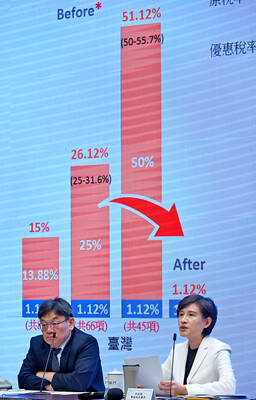
GREATER REACH? Auto parts and wood products would face tariffs of up to 15%, matching those targeting the EU, Japan and South Korea, Vice Premier said The US has announced that preferential tariff treatment for Taiwan’s non-semiconductor Section 232 goods would take effect retroactively from May 1, the Executive Yuan said yesterday. The US government yesterday posted a notice on the Federal Register’s public inspection Web site previewing tariff concessions for Taiwan under a memorandum of understanding (MOU) on Taiwan-US investment after two months of negotiations. The MOU signed on Jan. 15 stipulated three major preferential tariff arrangements: a 15 percent “reciprocal” tariff rate for Taiwan without stacking most-favored nation (MFN) rates; preferential Section 232 treatment for semiconductors and related products; and preferential Section 232 treatment for non-semiconductor


 RSS
RSS