


Norwegian writer Jon Fosse won the Nobel Prize in Literature yesterday, for plays and prose that “give voice to the unsayable,” the Swedish Academy said.
One of his country’s most-performed dramatists, Fosse, 64, has written about 40 plays as well as novels, short stories, children’s books, poetry and essays.
Nobel literature committee chair Anders Olsson said Fosse’s work is rooted “in the language and nature of his Norwegian background.”
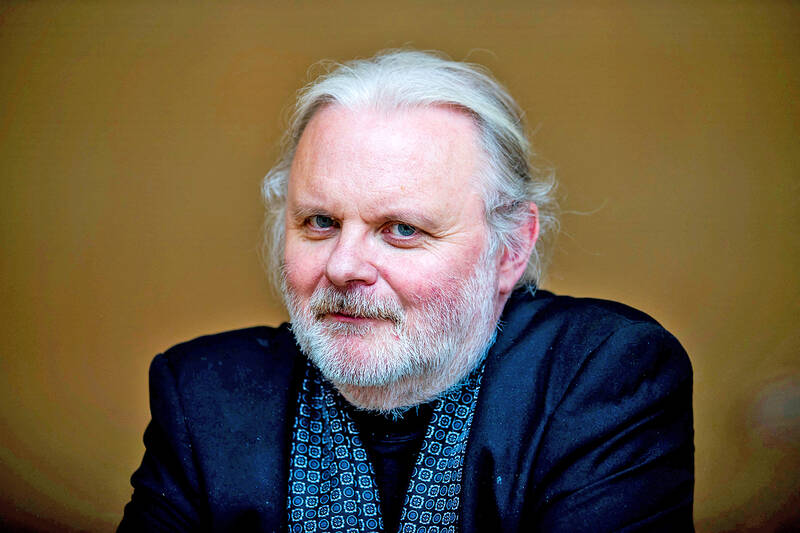
Photo:AFP
Swedish Academy permanent secretary Mats Malm, who announced the prize, reached Fosse by telephone to inform him of the win.
He said the writer was driving in the countryside and promised to drive home carefully.
Fosse is the fourth Norwegian writer to win the Nobel. Bjornstjerne Bjornson won it in 1903, Knut Hamsun was awarded it in 1920 and Sigrid Undset in 1928.
His work A New Name: Septology VI-VII — described by Olsson as Fosse’s “magnum opus” — was a finalist for the International Booker Prize last year.
The Nobel Prizes carry a cash award of 11 million kronor (US$998,080) from a bequest left by their creator, Swedish inventor Alfred Nobel. Winners also receive an 18-carat gold medal and diploma at the award ceremonies in December.
Last year, French author Annie Ernaux won the prize for what the prize-giving Swedish Academy called “the courage and clinical acuity” of books rooted in her small-town background in the Normandy region of northwest France.
Ernaux was just the 17th woman among the 119 Nobel literature laureates. The literature prize has long faced criticism that it is too focused on European and North American writers, as well as being too male-dominated.

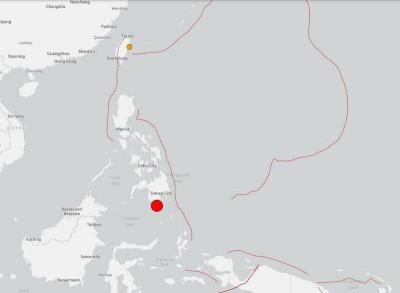
A magnitude 7.8 earthquake struck off the southern coast of Mindanao in the Philippines at 7:38am today, prompting the US Tsunami Warning System to issue an alert for neighboring countries, including Taiwan. The system issued a purple alert indicating a "tsunami threat." The potential threat zone includes Taiwan, the Philippines, Papua New Guinea, Yap and Palau. There were no immediate reports of major damage in the Philippines or Indonesia. The quake struck at a depth of 10km, said the German Research Centre for Geosciences, which had earlier pegged the earthquake at magnitude 8.2. Phivolcs, the Philippine agency, said the quake was magnitude 7 and
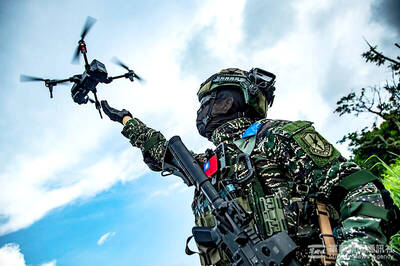
RESILIENCE: Taiwan plays a key role in semiconductors, energy, information infrastructure and advanced manufacturing, AIT Director Raymond Greene said Taiwan’s continued investment in deterrence and resilience remains vital, especially in uncrewed systems and other emerging technologies, American Institute in Taiwan (AIT) Director Raymond Greene said yesterday. Greene made the remarks at the annual National Strategic Summit on Supply Chain Resilience held by the Research Institute for Democracy, Society and Emerging Technology (DSET), a government-backed think tank. As Taiwan last year became the US’ fourth-largest trading partner and supply chain security is becoming more important, cooperation in emerging technologies continues to deepen between the two countries, he said. The US is committed to accelerating innovation, building key infrastructure, strengthening cooperation

The National Chungshan Institute of Science and Technology yesterday showcased its locally developed variants of the Vision 60 robotic patrol dog, which it plans to deploy on the nation’s outlying territories in the South China Sea. The variants were produced under the Joint Lab project — created by the institute and domestic companies — and assembled with domestically produced motors, lenses and artificial intelligence (AI) systems alongside licensed tech from the US, Missile and Rocket Systems Research Division deputy director Jen Kuo-kang (任國光) told the media event at a military base in Taipei’s Dazhi (大直) area. Taiwan has built up its strengths

RIGHT DIRECTION: Taiwan’s efforts to prevent forced labor include a proposal to ‘fully prohibit’ employers from withholding workers’ documents, an official said Taiwan is to establish a mechanism to restrict imports of goods linked to forced labor, the Executive Yuan said yesterday, after the US proposed imposing additional tariffs on Taiwanese goods over labor concerns. “The Ministry of Labor and the Ministry of Economic Affairs are to establish an interministerial review procedure,” Executive Yuan spokesperson Michelle Lee (李慧芝) said at a news briefing in Taipei. “The government is to use the Foreign Trade Act [貿易法] as the legal basis to restrict imports of goods produced with forced labor” and bring its supply chain governance more in line with international standards on human rights, resilience


 RSS
RSS