


Taiwan’s Ye Hong-wei and Lee Chia-hsin yesterday defeated compatriots Lee Fang-chih and Teng Chun-hsun in an all-Taiwanese mixed doubles badminton final to secure Taiwan’s 10th gold medal at the FISU World University Games in Chengdu, China.
The world No. 16-ranked pair took an early 9-4 advantage in the first game, a lead they never relinquished, maintaining a gap of at least four points as they coasted to a 21-15 victory.
In the second game, a string of unforced errors left Ye and Lee down 7-9, before they rallied with four straight points to go ahead 11-9.
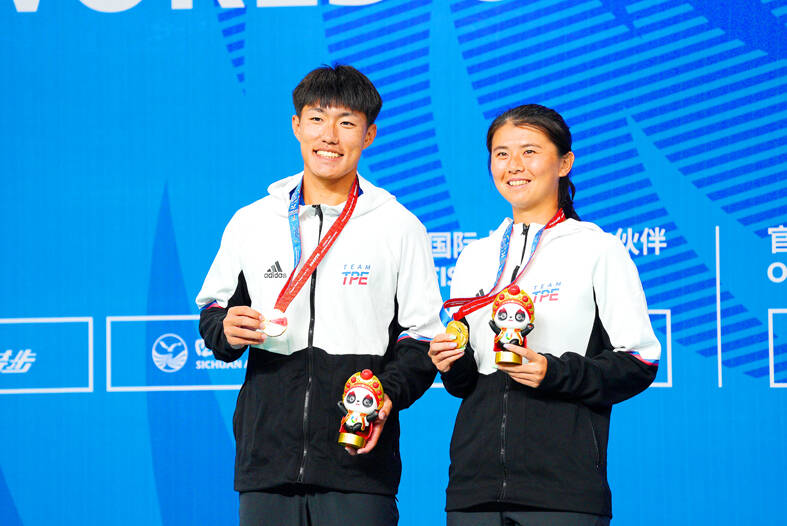
Photo courtesy of tennis coach Ho Kuo-lung
After Teng and Lee briefly tied the score at 11-11, Lee Chia-hsin dominated the final stretch of the game from the forecourt, running her opponents around and setting up shots for her partner.
The pair ultimately won the game 21-17, securing the gold medal.
On Sunday, Taiwanese tennis players won three golds, including in the mixed doubles, as well as the men’s and women’s team events.
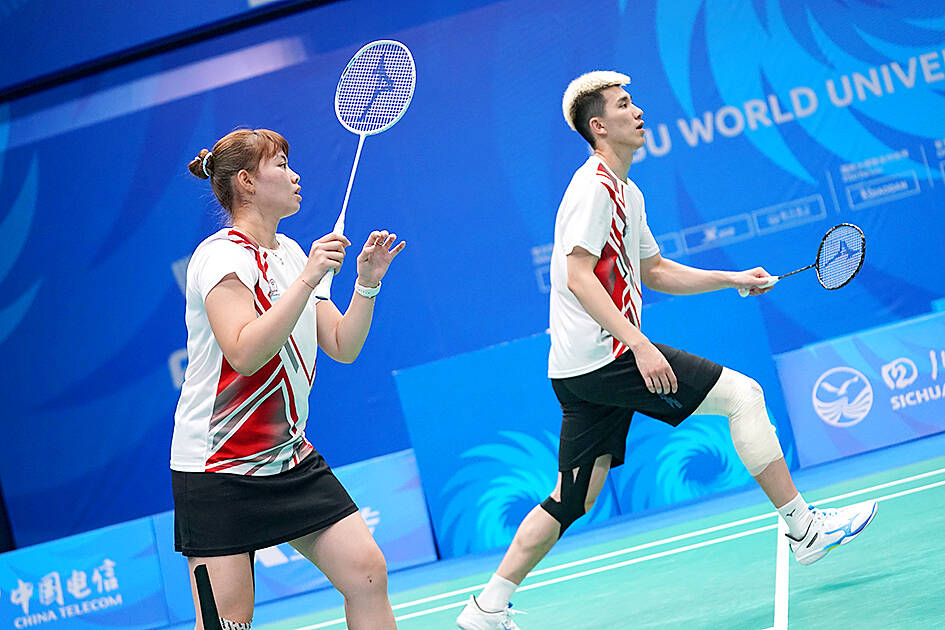
Photo courtesy of Chinese Taipei University Sports Federation
Mixed doubles pair Hsu Yu-hsiou and Wu Fang-hsien defeated Chinese duo Jin Yuquan and Tang Qianhui 7-6, 2-6, 10-6, a result that saw Wu burst into tears.
In the women’s singles, Yang Ya-yi took home silver, while Liang En-shuo won bronze.
Also on Sunday, Wen Hua-yu won silver in the men’s long jump, as Lin Chia-hsing secured the bronze in the same event.
Meanwhile, in the badminton there were bronze medals for Hsu Wen-chi in the women’s singles and for mixed doubles pairing Po Li-wei and Lee Fang-chih.
Taiwan’s total medal count at the Games rose to 44, while its 10 gold medals ranked eighth among the nations competing.


RESILIENCE: Taiwan plays a key role in semiconductors, energy, information infrastructure and advanced manufacturing, AIT Director Raymond Greene said Taiwan’s continued investment in deterrence and resilience remains vital, especially in uncrewed systems and other emerging technologies, American Institute in Taiwan (AIT) Director Raymond Greene said yesterday. Greene made the remarks at the annual National Strategic Summit on Supply Chain Resilience held by the Research Institute for Democracy, Society and Emerging Technology (DSET), a government-backed think tank. As Taiwan last year became the US’ fourth-largest trading partner and supply chain security is becoming more important, cooperation in emerging technologies continues to deepen between the two countries, he said. The US is committed to accelerating innovation, building key infrastructure, strengthening cooperation

The National Chungshan Institute of Science and Technology yesterday showcased its locally developed variants of the Vision 60 robotic patrol dog, which it plans to deploy on the nation’s outlying territories in the South China Sea. The variants were produced under the Joint Lab project — created by the institute and domestic companies — and assembled with domestically produced motors, lenses and artificial intelligence (AI) systems alongside licensed tech from the US, Missile and Rocket Systems Research Division deputy director Jen Kuo-kang (任國光) told the media event at a military base in Taipei’s Dazhi (大直) area. Taiwan has built up its strengths

RIGHT DIRECTION: Taiwan’s efforts to prevent forced labor include a proposal to ‘fully prohibit’ employers from withholding workers’ documents, an official said Taiwan is to establish a mechanism to restrict imports of goods linked to forced labor, the Executive Yuan said yesterday, after the US proposed imposing additional tariffs on Taiwanese goods over labor concerns. “The Ministry of Labor and the Ministry of Economic Affairs are to establish an interministerial review procedure,” Executive Yuan spokesperson Michelle Lee (李慧芝) said at a news briefing in Taipei. “The government is to use the Foreign Trade Act [貿易法] as the legal basis to restrict imports of goods produced with forced labor” and bring its supply chain governance more in line with international standards on human rights, resilience

NOT IMMEDIATE: Taiwan has a chance to appeal the proposed 10 percent tariff before it starts, while other countries face a 12.5 percent tariff from the trade office Taiwan is among 60 economies determined by the US to have failed to impose or enforce a ban on the importation of goods produced with forced labor, according to a notice released on Tuesday by the Office of the US Trade Representative (USTR), which proposed imposing an additional 10 percent or more tariff on them. The USTR in a statement said that following an investigation, it had determined under Section 301 of the Trade Act of 1974 that the failure of the 60 economies to impose and effectively enforce a prohibition on the importation of goods produced with forced labor is


 RSS
RSS