


Lisa Su (蘇姿丰), visiting CEO of IC design giant Advanced Micro Devices, Inc. (AMD), praised Taiwan as the center of the global semiconductor ecosystem when receiving an honorary doctorate from National Yang Ming Chiao Tung University in Hsinchu yesterday, citing the progress in semiconductors in Taiwan has been incredibly fast and extremely efficient.
Su, who was born in Tainan in 1969 and moved to the United States at the age of three. She was appointed AMD’s CEO in October 2014, which has achieved two milestones: the first female CEO of the American company and the first ethnic Chinese woman to hold a CEO position in the U.S. semiconductor industry.
She also has been called “the queen of semiconductors.”
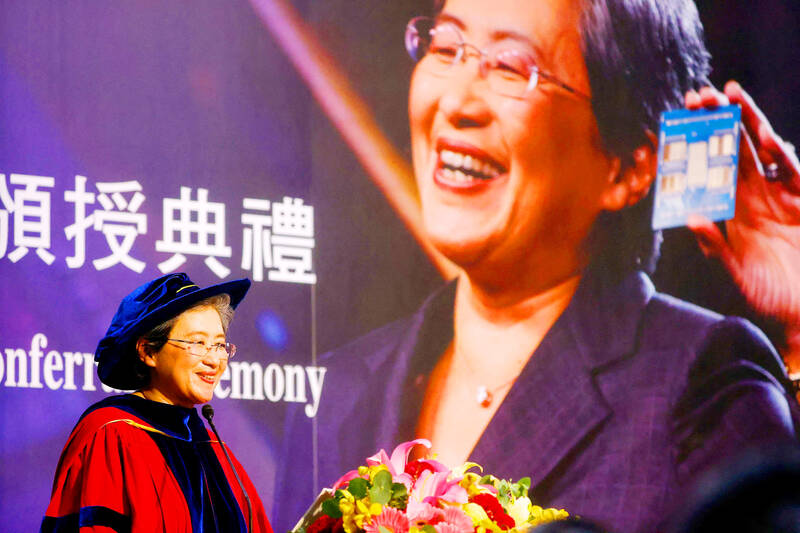
Photo: Ann Wang, Reuters
Being in Taiwan reminds her that this is truly the center of the global semiconductor ecosystem and that the Taiwan spirit is what makes the local semiconductor ecosystem so amazing, said the U.S.-based AMD chairperson when delivering her address at Yang Ming Chiao Tung University.
When asked about her thoughts on the future of the semiconductor industry in Taiwan, Su replied that throughout Taiwan, “you have so much talent and so many resources” and a wonderful culture for innovation.
Su noted that the future of semiconductors is the most essential field impacting every aspect of our lives, adding that the progress in semiconductors in Taiwan has been incredibly fast and extremely efficient.
“This is what makes the Taiwan ecosystem so important,” she said.
Addressing the issue of AI development, Su highlighted the transformative power of generative AI and noted that AI will be the “defining megatrend” for the next 10 years and more.
“Generative AI has really reshaped how we think about this, where we see that every product, every service, every business in the world will be impacted by AI. And the technology is actually evolving faster than anything that I’ve ever seen before,” she said.
Su emphasized that AI also requires all disciplines to come together, including hardware, software, systems, applications and even business models.
“It’s an incredibly exciting time for all of us in the technology industry and it’s also an opportunity for all of us to come together to drive the industry faster,’’ she stated.
Su arrived in Taiwan on Monday for a four day trip to visit the company’s local suppliers, including TSMC; hardware and component suppliers Pegatron Corp (和碩) and Quanta Computer Inc (廣達); and motherboard makers Micro-Star International Co (MSI, 微星) and Gigabyte Technology Co (技嘉), a source familiar with her itinerary said.
The planned meetings have sparked optimism over the potential for increased collaborations between AMD, a leading global semiconductor development company, and Taiwan’s semiconductor industry, as well as companies in the AI server supply chain, analysts said.

Conflict with Taiwan could leave China with “massive economic disruption, catastrophic military losses, significant social unrest, and devastating sanctions,” a US think tank said in a report released on Monday. The German Marshall Fund released a report titled If China Attacks Taiwan: The Consequences for China of “Minor Conflict” and “Major War” Scenarios. The report details the “massive” economic, military, social and international costs to China in the event of a minor conflict or major war with Taiwan, estimating that the Chinese People’s Liberation Army (PLA) could sustain losses of more than half of its active-duty ground forces, including 100,000 troops. Understanding Chinese
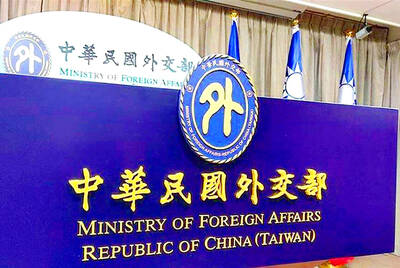
The Ministry of Foreign Affairs (MOFA) yesterday said it is closely monitoring developments in Venezuela, and would continue to cooperate with democratic allies and work together for regional and global security, stability, and prosperity. The remarks came after the US on Saturday launched a series of airstrikes in Venezuela and kidnapped Venezuelan President Nicolas Maduro, who was later flown to New York along with his wife. The pair face US charges related to drug trafficking and alleged cooperation with gangs designated as terrorist organizations. Maduro has denied the allegations. The ministry said that it is closely monitoring the political and economic situation

UNRELENTING: China attempted cyberattacks on Taiwan’s critical infrastructure 2.63 million times per day last year, up from 1.23 million in 2023, the NSB said China’s cyberarmy has long engaged in cyberattacks against Taiwan’s critical infrastructure, employing diverse and evolving tactics, the National Security Bureau (NSB) said yesterday, adding that cyberattacks on critical energy infrastructure last year increased 10-fold compared with the previous year. The NSB yesterday released a report titled Analysis on China’s Cyber Threats to Taiwan’s Critical Infrastructure in 2025, outlining the number of cyberattacks, major tactics and hacker groups. Taiwan’s national intelligence community identified a large number of cybersecurity incidents last year, the bureau said in a statement. China’s cyberarmy last year launched an average of 2.63 million intrusion attempts per day targeting Taiwan’s critical

AGING: As of last month, people aged 65 or older accounted for 20.06 percent of the total population and the number of couples who got married fell by 18,685 from 2024 Taiwan has surpassed South Korea as the country least willing to have children, with an annual crude birthrate of 4.62 per 1,000 people, Ministry of the Interior data showed yesterday. The nation was previously ranked the second-lowest country in terms of total fertility rate, or the average number of children a woman has in her lifetime. However, South Korea’s fertility rate began to recover from 2023, with total fertility rate rising from 0.72 and estimated to reach 0.82 to 0.85 by last year, and the crude birthrate projected at 6.7 per 1,000 people. Japan’s crude birthrate was projected to fall below six,


 RSS
RSS