


US Special Presidential Envoy for Climate John Kerry yesterday arrived in China for three days of talks that would test the ability of the world’s top two greenhouse gas emitters to collaborate in the fight against global warming despite deep discord over other issues.
Kerry’s visit is the latest front in a diplomatic push aimed at re-establishing connections between the superpowers that frayed amid tensions over export controls and human rights, as well as former US House of Representatives speaker Nancy Pelosi’s trip to Taiwan in August last year.
It would also mark the first protracted climate negotiations between the two countries in nearly a year, since Beijing severed consultation on that and other issues in the wake of Pelosi’s visit.
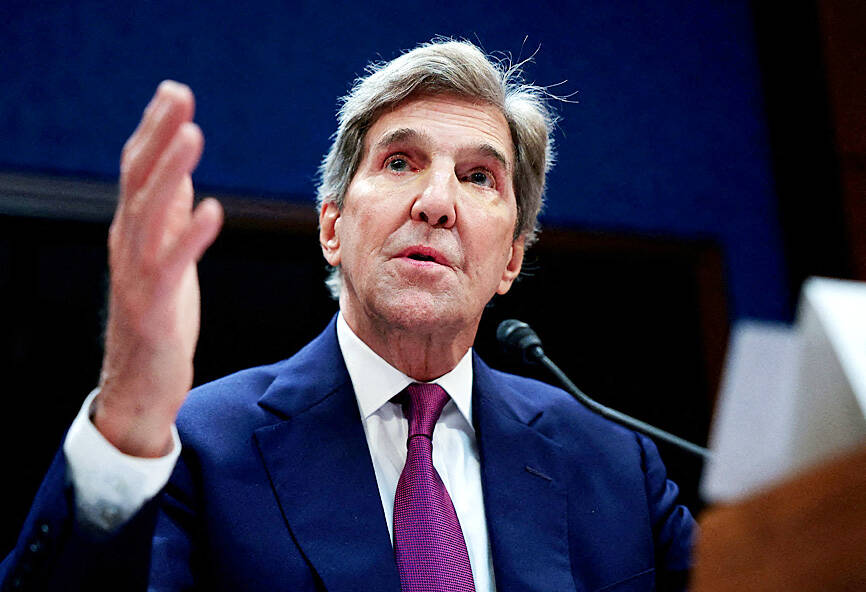
Photo: Reuters
Kerry, a former US secretary of state tapped to be special presidential envoy for climate two years ago, said he is seeking “candid conversations” with Chinese officials and hoping to forge progress in paring releases of potent greenhouse gas methane, while hastening a transition away from coal and deploying renewable power.
“What we want to do is find ways to see if China and the US can advance the cause together for the rest of the world by accelerating rates of doing things, by increasing the deployment of renewables, by improving grid management,” Kerry told a US House of Representatives hearing on Thursday. “If we can make some progress on that, we think we can tampen down this edgy sense of competition which could lead to a mistake which takes you to a place you didn’t mean to go to.”
From today, Kerry and Chinese Special Envoy on Climate Change Xie Zhenhua (解振華) are to have an “in-depth” exchange of views on cooperation to deal with climate change, China’s state broadcaster China Central Television reported, confirming Kerry’s plane had landed in Beijing.
Experts in climate diplomacy cautioned against expectations for any significant breakthrough.
“A critical thing to observe in this visit if there are further steps envisioned, what those steps are, and how explicit the steps will be laid out by both sides,” said Li Shuo (李碩), a policy adviser for Greenpeace East Asia.
The trip might not “resolve anything on paper immediately,” but it could lay a foundation for future statements or commitments, he said.
The restart of US-China climate talks comes on the heels of the hottest week on record globally, according to the World Meteorological Organization.
June was already the hottest ever logged, according to US and European agencies.
Additional reporting by AFP
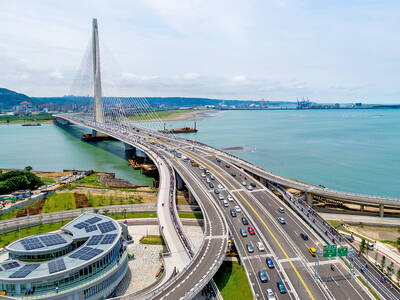
The Ministry of Transportation and Communications yesterday inaugurated the Danjiang Bridge across the Tamsui River in New Taipei City, saying that the structure would be an architectural icon and traffic artery for Taiwan. Feted as a major engineering achievement, the Danjiang Bridge is 920m long, 211m tall at the top of its pylon, and is the longest single-pylon asymmetric cable-stayed bridge in the world, the government’s Web site for the structure said. It was designed by late Iraqi-British architect Zaha Hadid. The structure, with a maximum deck of 70m, accommodates road and light rail traffic, and affords a 200m navigation channel for boats,
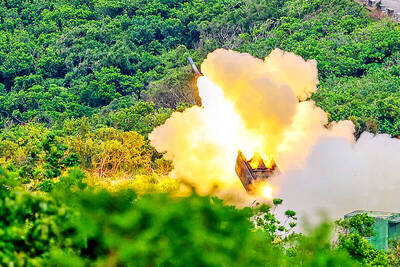
PRECISION STRIKES: The most significant reason to deploy HIMARS to outlying islands is to establish a ‘dead zone’ that the PLA would not dare enter, a source said A High Mobility Artillery Rocket System (HIMARS) would be deployed to Penghu County and Dongyin Island (東引) in Lienchiang County (Matsu) to force the Chinese military to retreat at least 100km from the coastline, a military source said yesterday. Taiwan has been procuring HIMARS and Army Tactical Missile Systems (ATACMS) from the US in batches. Once all batches have been delivered, Taiwan would possess 111 HIMARS units and 504 ATACMS, which have a range of 300km. Considering that “offense is the best defense,” the military plans to forward-deploy the systems to outlying islands such as Penghu and Dongyin so that

WHAT WAS ALL THAT FOR? Jaw Shaw-kong said that Cheng Li-wen had pushed for more drastic cuts and attacked him, just for the outcome to be nearly identical to his bill The legislature yesterday passed a supplementary budget bill to fund the purchase of separate packages of US military equipment, with the combined amount of spending capped at NT$780 billion (US$24.8 billion). The Chinese Nationalist Party (KMT) and Taiwan People’s Party (TPP) used their legislative majority to pass the bill, which runs until 2033 and has two main funding provisions. One was for NT$300 billion of arms sales already approved by the US for Taiwan on Dec. 17 last year, the other was for NT$480 billion for another arms package expected to be announced by Washington. The bill, which fell short of the NT$1.25

‘CLEAR MESSAGE’: The bill would set up an interagency ‘tiger team’ to review sanctions tools and other economic options to help deter any Chinese aggression toward Taiwan US Representative Young Kim has introduced a bill to deter Chinese aggression against Taiwan, calling for an interagency “tiger team” to preplan coordinated sanctions and economic measures in response to possible Chinese military or political action against Taiwan. “[Chinese President] Xi Jinping [習近平] has directed the People’s Liberation Army to be ready to invade Taiwan by 2027. China has a plan. America should have one too,” Kim said in a news release on Thursday last week. She introduced the “Deter PRC [People’s Republic of China] aggression against Taiwan act” to “ensure the US has a coordinated sanctions strategy ready should


 RSS
RSS