


Gas appeared to be the cause of a blast at a Chiayi City temple that injured 28 people, the Chiayi Fire Bureau said yesterday, ruling out the possibility that explosives were involved.
At about 9:56pm on Saturday, an explosion went off in front of a stage set up at the intersection of Jinshan Road and Yongle Street for a festival honoring the Tiger God.
As of 9am yesterday, 28 people had been reported injured, four of whom had relatively serious injuries, the Chiayi City Government said.
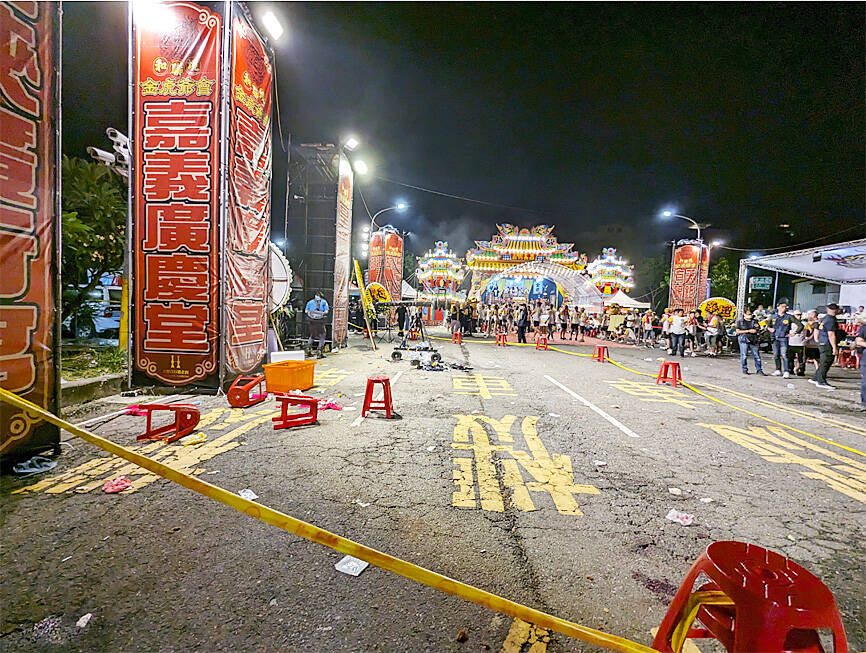
Photo: Wang Shan-yan, Taipei Times
Seven were still in hospital receiving treatment for glass lacerations or burns, it added.
Initial investigations have ruled out explosives as the cause of the blast, which exhibited the characteristics of a gas explosion, bureau Director Su Yao-hsing (蘇耀星) said.
Further investigation is required to determine the exact cause, he added.
Forensic investigators found trash bags and gravel at the site of the explosion, Chiayi First Precinct deputy chief Yin Chia-hung (殷嘉宏) said, adding that a team has been set up to investigate the cause.
Eyewitnesses said the blast originated from a trash can, which did not have any firecrackers or other explosives inside, the event organizer said.
Representatives from the city yesterday morning visited the injured in hospital to provide assistance, Chiayi Mayor Huang Min-hui (黃敏惠) said, adding that the official cause of the incident would be announced once the investigation is finished.
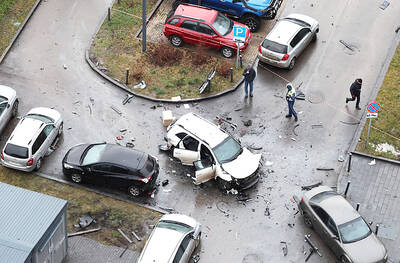
A car bomb killed a senior Russian general in southern Moscow yesterday morning, the latest high-profile army figure to be blown up in a blast that came just hours after Russian and Ukrainian delegates held separate talks in Miami on a plan to end the war. Kyiv has not commented on the incident, but Russian investigators said they were probing whether the blast was “linked” to “Ukrainian special forces.” The attack was similar to other assassinations of generals and pro-war figures that have either been claimed, or are widely believed to have been orchestrated, by Ukraine. Russian Lieutenant General Fanil Sarvarov, 56, head
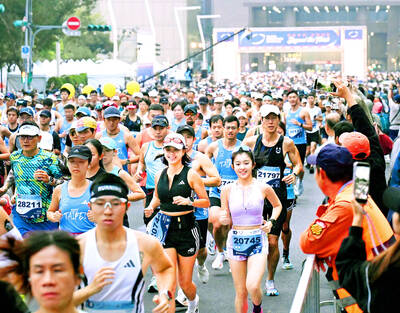
SAFETY FIRST: Double the number of police were deployed at the Taipei Marathon, while other cities released plans to bolster public event safety Authorities across Taiwan have stepped up security measures ahead of Christmas and New Year events, following a knife and smoke bomb attack in Taipei on Friday that left four people dead and 11 injured. In a bid to prevent potential copycat incidents, police deployments have been expanded for large gatherings, transport hubs, and other crowded public spaces, according to official statements from police and city authorities. Taipei Mayor Chiang Wan-an (蔣萬安) said the city has “comprehensively raised security readiness” in crowded areas, increased police deployments with armed officers, and intensified patrols during weekends and nighttime hours. For large-scale events, security checkpoints and explosives
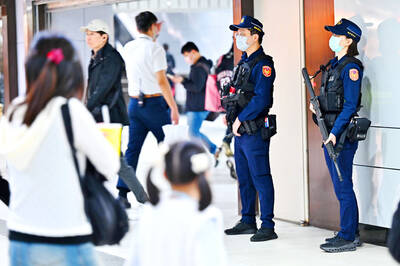
PUBLIC SAFETY: The premier said that security would be tightened in transport hubs, while President Lai commended the public for their bravery The government is to deploy more police, including rapid response units, in crowded public areas to ensure a swift response to any threats, President William Lai (賴清德) said yesterday after a knife attack killed three people and injured 11 in Taipei the previous day. Lai made the remarks following a briefing by the National Police Agency on the progress of the investigation, saying that the attack underscored the importance of cooperation in public security between the central and local governments. The attack unfolded in the early evening on Friday around Taipei Main Station’s M7 exit and later near the Taipei MRT’s Zhongshan
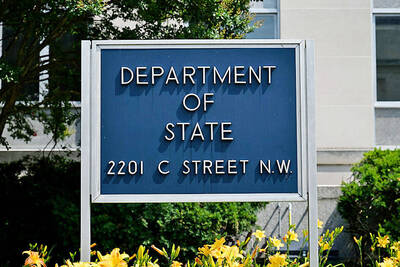
REBUFFED: In response to Chinese criticism over recent arms sales, Washington urged Beijing to engage in meaningful dialogue instead of threats and intimidation Washington’s long-term commitment to Taiwan would not change, the US Department of State said yesterday, urging Beijing to stop pressuring Taiwan and engage in meaningful bilateral dialogues. The remarks came in response to a backlash from Beijing about Washington’s latest approval of arms sales to Taiwan. The US Defense Security Cooperation Agency said in a statement on Wednesday that the Taipei Economic and Cultural Representative Office in the US has asked to purchase an arms package, including Tactical Mission Network Software; AH-1W helicopter spare and repair parts; M109A7 self-propelled howitzers; HIMARS long range precision strike systems; tube-launched, optically tracked, wire-guided missiles; Javelin


 RSS
RSS