


High-tech methods should be used in investigations into Chinese spying to help solidify cases, a criminal law expert said on Friday.
National Taiwan University professor of law Lin Yu-hsiung (林鈺雄) told a seminar at the Mainland Affairs Council in Taipei that punishments for people convicted in espionage cases are often perceived as being too lenient.
Advances in technology have expanded the range of threats Beijing poses to Taiwan’s democracy and social order, including its spy groups in Taiwan, attempts to acquire state secrets and critical technologies, cyberattacks, misinformation and attempts to sabotage essential infrastructure, Lin said.

Photo: Reuters
However, people charged with spying for China usually only face indictment for contravening the National Security Act (國家安全法) — ie, a foreign agent “attempting to establish local organizations” — rather than facing more severe penalties stipulated in the Criminal Code for being an actor of foreign aggression, he said.
The court verdicts are often considered light because of this, he said.
The government should increase the penalties for spying and enhance investigations with high-tech methods when cases affect national security, especially when there are difficulties collecting evidence and dealing with statutes of limitation, he said.
Mainland Affairs Council Minister Chiu Tai-san (邱太三) said that the Chinese Communist Party has long taken advantage of Taiwan’s democratic and open society to insert spies to spread its “united front” rhetoric, infiltrate the government and sow dissent.
The government is aware of the tactics and has taken measures to counter Beijing’s insidious infiltration, Chiu said.
“We will continue to make amendments as necessary to safeguard our national security,” he said.
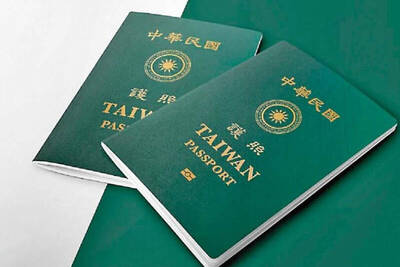
The Taiwanese passport ranked 33rd in a global listing of passports by convenience this month, rising three places from last month’s ranking, but matching its position in January last year. The Henley Passport Index, an international ranking of passports by the number of designations its holder can travel to without a visa, showed that the Taiwan passport enables holders to travel to 139 countries and territories without a visa. Singapore’s passport was ranked the most powerful with visa-free access to 192 destinations out of 227, according to the index published on Tuesday by UK-based migration investment consultancy firm Henley and Partners. Japan’s and

NATIONAL SECURITY THREAT: An official said that Guan Guan’s comments had gone beyond the threshold of free speech, as she advocated for the destruction of the ROC China-born media influencer Guan Guan’s (關關) residency permit has been revoked for repeatedly posting pro-China content that threatens national security, the National Immigration Agency said yesterday. Guan Guan has said many controversial things in her videos posted to Douyin (抖音), including “the red flag will soon be painted all over Taiwan” and “Taiwan is an inseparable part of China,” while expressing hope for expedited “reunification.” The agency received multiple reports alleging that Guan Guan had advocated for armed reunification last year. After investigating, the agency last month issued a notice requiring her to appear and account for her actions. Guan Guan appeared as required,

Japan and the Philippines yesterday signed a defense pact that would allow the tax-free provision of ammunition, fuel, food and other necessities when their forces stage joint training to boost deterrence against China’s growing aggression in the region and to bolster their preparation for natural disasters. Japan has faced increasing political, trade and security tensions with China, which was angered by Japanese Prime Minister Sanae Takaichi’s remark that a Chinese attack on Taiwan would be a survival-threatening situation for Japan, triggering a military response. Japan and the Philippines have also had separate territorial conflicts with Beijing in the East and South China
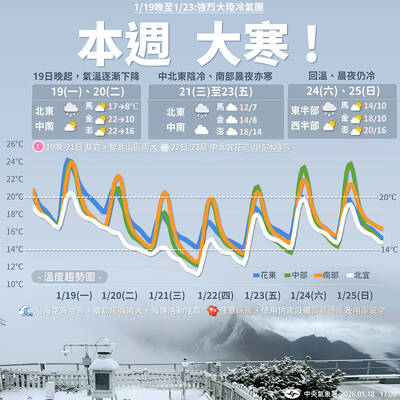
A strong cold air mass is expected to arrive tonight, bringing a change in weather and a drop in temperature, the Central Weather Administration (CWA) said. The coldest time would be early on Thursday morning, with temperatures in some areas dipping as low as 8°C, it said. Daytime highs yesterday were 22°C to 24°C in northern and eastern Taiwan, and about 25°C to 28°C in the central and southern regions, it said. However, nighttime lows would dip to about 15°C to 16°C in central and northern Taiwan as well as the northeast, and 17°C to 19°C elsewhere, it said. Tropical Storm Nokaen, currently


 RSS
RSS