


Hong Kong must guard against “destructive forces engaging in soft resistance,” Hong Kong Chief Executive John Lee (李家超) said yesterday, as the territory marked the 26th anniversary of its handover from British to Chinese rule.
Britain ceded the long-time colony to China in 1997 under a 50-year governance model known as “one country, two systems,” which guaranteed key freedoms and a measure of autonomy. These rights — such as the freedom of assembly — set Hong Kong apart from the mainland, and July 1 was once a day of demonstrations for the territory’s outspoken civil society.
However, following huge and sometimes violent democracy protests in 2019, China imposed a sweeping National Security Law that — when combined with legal changes putting “patriots” in charge — effectively stamped out most forms of dissent from Hong Kong life.
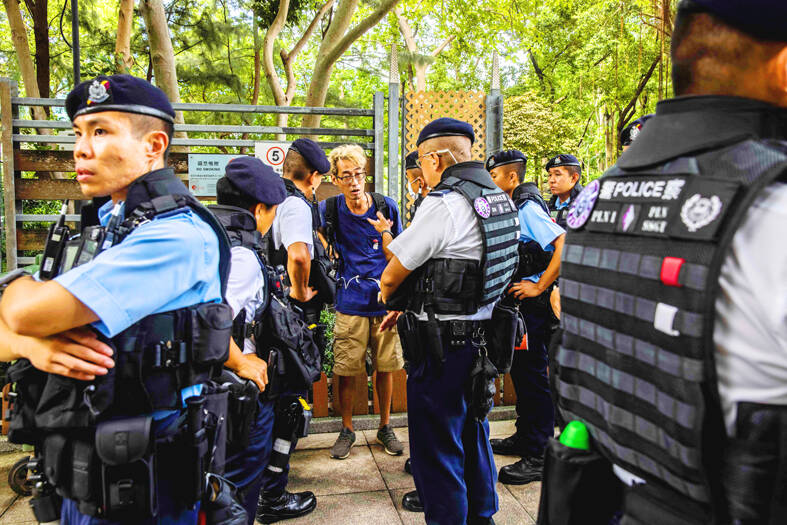
Photo: AFP
Ex-security chief turned leader Lee said that Hong Kong was “largely stable” now, but was still being targeted by countries that oppose China’s rise.
“There are also destructive forces engaging in soft resistance hidden within Hong Kong,” he said during a speech at an event marking the anniversary. “Therefore, we must remain alert and take the initiative ourselves to protect national security.”
The quiet streets of Hong Kong yesterday were a far cry from previous years, when hundreds of thousands of residents would march to air their political and social grievances.
Police said they received no applications for public processions for yesterday.
Local media reported that more than 6,000 police officers were deployed around the territory to ensure order.
Five activists said that they were “reminded” by authorities not to stage any protests yesterday or in the lead-up to the anniversary.
An elderly man who held a placard in the Causeway Bay shopping district calling for the release of political prisoners was quickly surrounded by police and escorted away yesterday afternoon.
“I would feel uncomfortable if I hadn’t come out” to protest, he told reporters.
A Japanese journalist was barred from entering Hong Kong without a clear reason and was sent back to his country, the English-language Japan Times reported on Friday.
The newspaper said that a freelance journalist was taken by officials to a room after arriving at the territory’s airport on Thursday evening.
Yoshiaki Ogawa, known for his coverage in Hong Kong, was later interviewed for about an hour, it said.
Ogawa said officials only told him that he could not be granted permission to stay in Hong Kong and was sent back to Tokyo on Friday, the report said.
It “truly made me feel how Hong Kong has changed ... this would have been unthinkable before,” Ogawa was quoted as saying in the report.
Additional reporting by AP
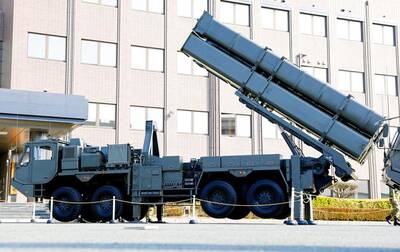
Japan has deployed long-range missiles in a southwestern region near China, the Japanese defense minister said yesterday, at a time when ties with Beijing are at their lowest in recent years. The missiles were installed in Kumamoto in the southern region of Kyushu, as Japan is attempting to shore up its military capacity as China steps up naval activity in the East China Sea. “Standoff defense capabilities enable us to counter the threat of enemy forces attempting to invade our country ... while ensuring the safety of our personnel,” Japanese Minister of Defense Shinjiro Koizumi said. “This is an extremely important initiative for
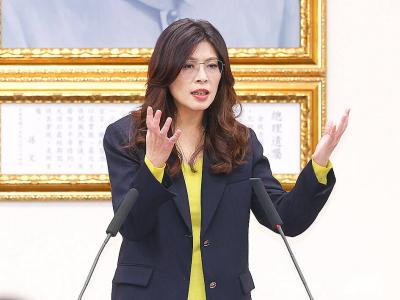
Chinese Nationalist Party (KMT) Chairwoman Cheng Li-wun (鄭麗文) today accepted an invitation from Chinese President Xi Jinping (習近平) to lead a delegation to China next month, saying she hopes to promote the peaceful development of cross-strait relations and bring stability to the Taiwan Strait. “I am grateful and happy to accept this invitation,” Cheng said in a statement from the KMT chairperson’s office. Cheng said she hopes both sides can work together to promote the peaceful development of cross-strait relations, enhance exchange and cooperation, bring stability to the Taiwan Strait and improve people’s livelihoods. At today's news conference, Cheng said any efforts to
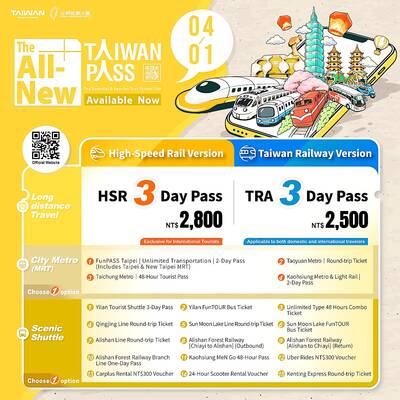
MORE POPULAR: Taiwan Pass sales increased by 59 percent during the first quarter compared with the same period last year, the Tourism Administration said The Tourism Administration yesterday said that it has streamlined the Taiwan Pass, with two versions available for purchase beginning today. The tourism agency has made the pass available to international tourists since 2024, allowing them to access the high-speed rail, Taiwan Railway Corp services, four MRT systems and four Taiwan Tourist Shuttles. Previously, five types of Taiwan Pass were available, but some tourists have said that the offerings were too complicated. The agency said only two types of Taiwan Pass would be available, starting from a three-day pass with the high-speed rail and a three-day pass with Taiwan Railway Corp. The former costs NT$2,800

The nation’s fastest supercomputer, Nano 4 (晶創26), is scheduled to be launched in the third quarter, and would be used to train large language models in finance and national defense sectors, the National Center for High-Performance Computing (NCHC) said. The supercomputer, which would operate at about 86.05 petaflops, is being tested at a new cloud computing center in the Southern Taiwan Science Park in Tainan. The exterior of the server cabinet features chip circuitry patterns overlaid with a map of Taiwan, highlighting the nation’s central position in the semiconductor industry. The center also houses Taiwania 2, Taiwania 3, Forerunner 1 and


 RSS
RSS