


Minister of Foreign Affairs Joseph Wu (吳釗燮) on Saturday met with two Italian lawmakers in an unannounced visit to Milan, local media reports said.
In separate posts on Facebook, Paolo Formentini, vice president of the Chamber of Deputies Foreign Affairs Committee, called the meeting “an honor,” while Italian lawmaker Igor Iezzi wrote that he is “always on the side of freedom.”
“It was an opportunity to reiterate that the status quo in the Taiwan Strait must remain the current one and that freedom of navigation must always be defended,” Formentini told the Italian news site Le Formiche on Saturday.
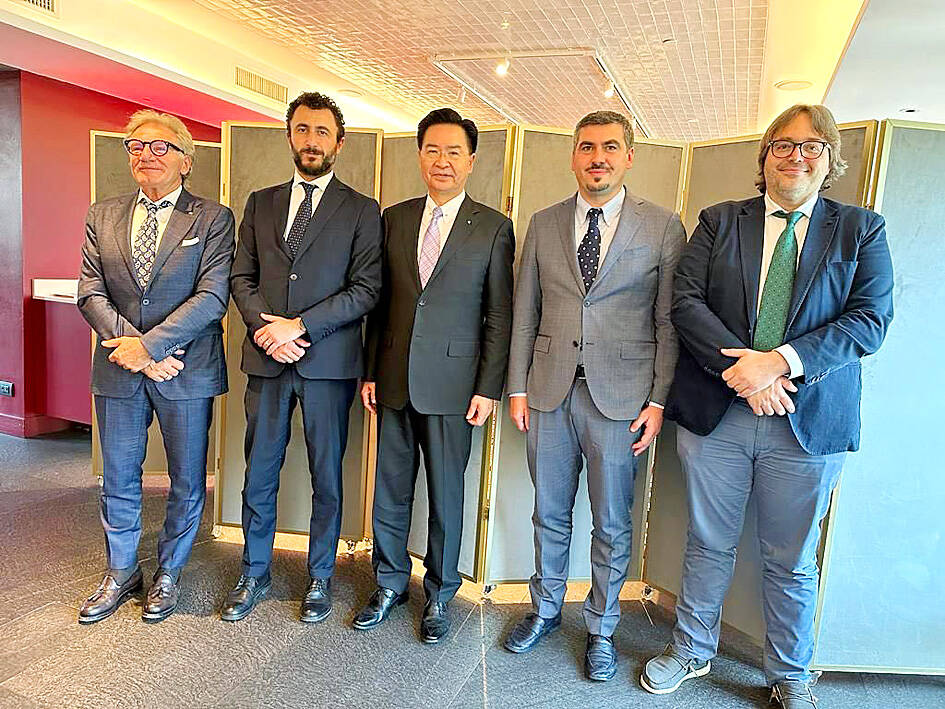
Photo: Screen grab from Igor Iezzi’s Facebook page
The visit was also important as Taiwan prepares to set up a representative office in Milan, its second in Italy, the site said.
In Taipei, the Ministry of Foreign Affairs said it had no comment on the reported meeting in Milan.
As Italy does not formally recognize the Republic of China, meetings between serving Italian lawmakers and Taiwanese officials are rare.
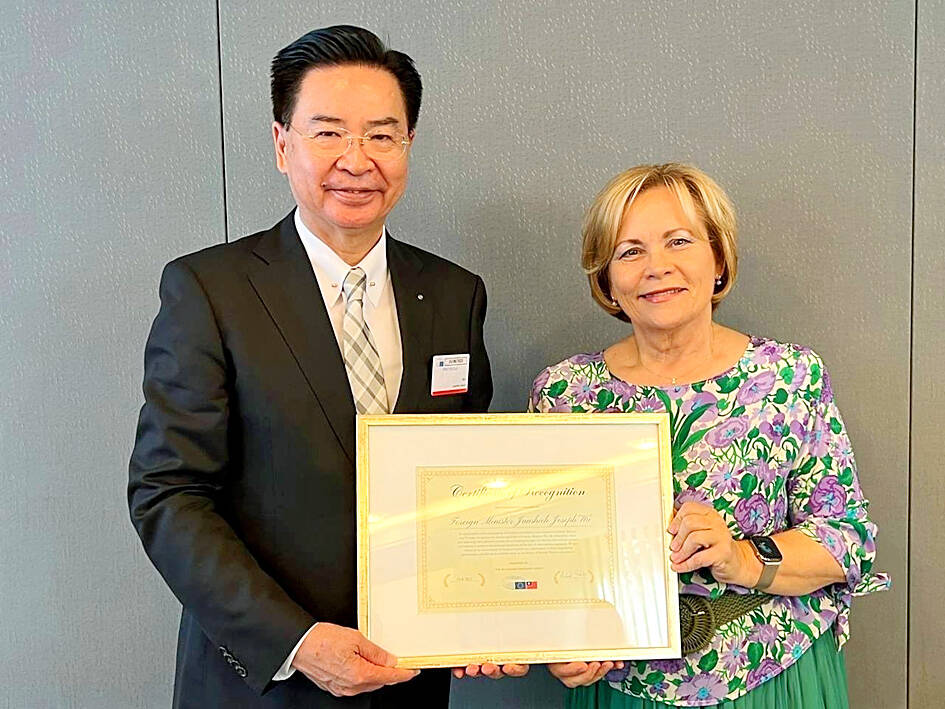
Photo courtesy of the Ministry of Foreign Affairs via CNA
Wu on Monday last week departed on a trip to Europe, during which he visited the Warsaw School of Economics, and met with Czech Senate President Milos Vystrcil in Prague on Tuesday and European Parliament Vice President Nicola Beer in Brussels on Friday.
Wu also met with 12 lawmakers at the European Parliament, including European Parliament Subcommittee on Security and Defence Vice Chair Rasa Jukneviciene, Belgium-Taiwan Friendship Group copresident Georges Dallemagne, Luxembourgian lawmaker Claude Wiseler and member of the British House of Lords Sal Brinton, the ministry said in a news release yesterday.
The European Parliament-Taiwan Friendship Group and the Belgium-Taiwan Friendship Group each issued a certificate of appreciation and a joint letter of appreciation to Wu in recognition of his contributions to deepening the partnership between Taiwan, and the EU and Belgium, it said.
The European lawmakers and Wu exchanged opinions on cooperation between Taiwan and Europe, the situation in the Taiwan Strait and Russia’s invasion of Ukraine, it said.
Jukneviciene, who was Lithuanian minister of defense from 2008 to 2012, was quoted by the ministry as saying that Taiwan had demonstrated its courage in safeguarding democracy and freedom in the face of China’s ambition to expand.
Enhancing Taiwan-EU relations has become the consensus of cross-party members of the European Parliament, she added.
Dallemagne called on Europe to continue its firm support for Taiwan’s freedom, democracy and international participation, the ministry said.
He presented to Wu a letter of appreciation signed by the six copresidents of the Belgium-Taiwan Friendship Group, it said.
Wiseler thanked Taiwan for donating urgently needed masks to Luxembourg and other European countries in the early stages of the COVID-19 pandemic, and affirmed Taiwan’s contribution to global public health, it said.
Brinton urged Europe to unite with Taiwan to take on challenges posed by authoritarian countries and expressed appreciation for the Taiwanese government and Taiwanese providing aid to Ukraine, it said.
Wu thanked the lawmakers for supporting cross-strait peace and stability, closer Taiwan-Europe cooperation and Taiwan’s participation in international organizations, the ministry said.
The high-level reception received by the minister underlined the importance the European Parliament attaches to Taiwan and the actions it takes to bolster cooperative partnerships, it said.
Additional reporting by CNA
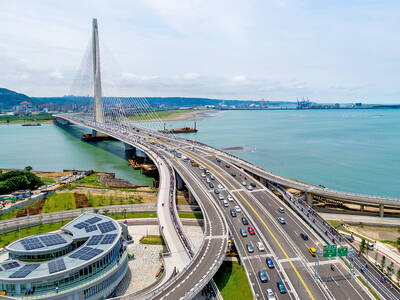
The Ministry of Transportation and Communications yesterday inaugurated the Danjiang Bridge across the Tamsui River in New Taipei City, saying that the structure would be an architectural icon and traffic artery for Taiwan. Feted as a major engineering achievement, the Danjiang Bridge is 920m long, 211m tall at the top of its pylon, and is the longest single-pylon asymmetric cable-stayed bridge in the world, the government’s Web site for the structure said. It was designed by late Iraqi-British architect Zaha Hadid. The structure, with a maximum deck of 70m, accommodates road and light rail traffic, and affords a 200m navigation channel for boats,
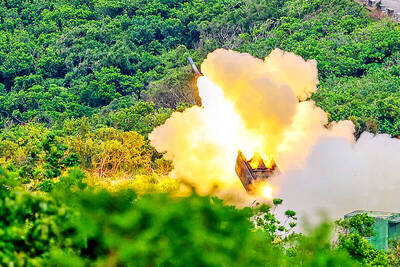
PRECISION STRIKES: The most significant reason to deploy HIMARS to outlying islands is to establish a ‘dead zone’ that the PLA would not dare enter, a source said A High Mobility Artillery Rocket System (HIMARS) would be deployed to Penghu County and Dongyin Island (東引) in Lienchiang County (Matsu) to force the Chinese military to retreat at least 100km from the coastline, a military source said yesterday. Taiwan has been procuring HIMARS and Army Tactical Missile Systems (ATACMS) from the US in batches. Once all batches have been delivered, Taiwan would possess 111 HIMARS units and 504 ATACMS, which have a range of 300km. Considering that “offense is the best defense,” the military plans to forward-deploy the systems to outlying islands such as Penghu and Dongyin so that

Taiwan Semiconductor Manufacturing Co (TSMC, 台積電), the world’s largest foundry service provider, yesterday said that global semiconductor revenue is projected to hit US$1.5 trillion in 2030, after the figure exceeds US$1 trillion this year, as artificial intelligence (AI) demand boosts consumption of token and compute power. “We are still at the beginning of the AI revolution, but we already see a significant impact across the whole semiconductor ecosystem,” TSMC deputy cochief operating officer Kevin Zhang (張曉強) said at the company’s annual technology symposium in Hsinchu City. “It is fair to say that in the past decade, smartphones and other mobile devices were
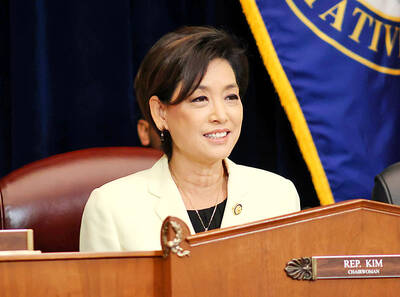
‘CLEAR MESSAGE’: The bill would set up an interagency ‘tiger team’ to review sanctions tools and other economic options to help deter any Chinese aggression toward Taiwan US Representative Young Kim has introduced a bill to deter Chinese aggression against Taiwan, calling for an interagency “tiger team” to preplan coordinated sanctions and economic measures in response to possible Chinese military or political action against Taiwan. “[Chinese President] Xi Jinping [習近平] has directed the People’s Liberation Army to be ready to invade Taiwan by 2027. China has a plan. America should have one too,” Kim said in a news release on Thursday last week. She introduced the “Deter PRC [People’s Republic of China] aggression against Taiwan act” to “ensure the US has a coordinated sanctions strategy ready should


 RSS
RSS