

Hong Kong police yesterday detained several pro-democracy figures on the 34th anniversary of the Tiananmen Square Massacre, including the leader of a key opposition party.
Chan Po-ying (陳寶瑩), a veteran activist and head of the League of Social Democrats, was in Hong Kong’s Causeway Bay shopping district — an area that for years was the site of commemorations of the bloody June 4, 1989, crackdown in China. Holding a small LED candle — a common sight during the annual vigil — and two flowers, Chan was immediately seized by police and hauled into a van.
Earlier yesterday, Alexandra Wong (王鳳瑤), a prominent democracy activist better known as “Grandma Wong,” was also taken away. The 67-year-old was carrying flowers at the time.
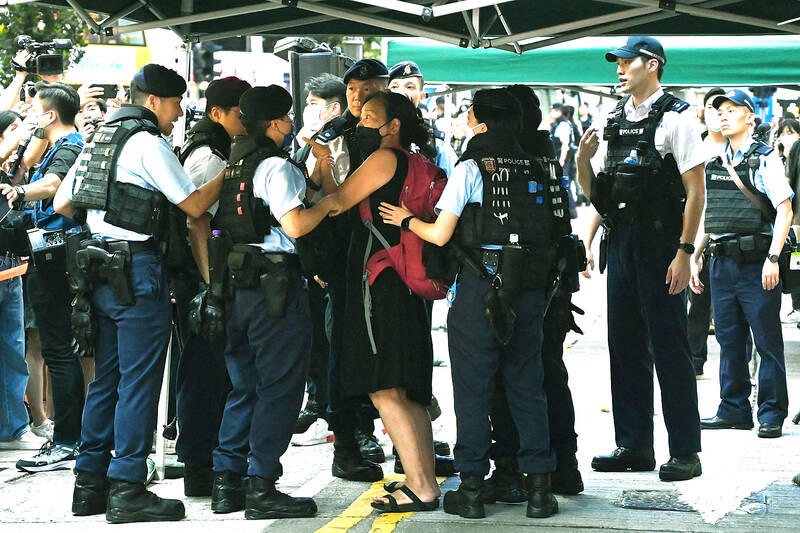
Photo: AFP
Veteran journalist Mak Yin-ting (麥燕庭), the former chairwoman of the Hong Kong Journalists Association, was also detained at Causeway Bay.
In total, Agence France-Presse reporters saw at least 10 people detained yesterday in the commercial district.
One of them was a woman who shouted: “Raise candles, mourn 64” — shorthand for the sensitive date. Another was a young man dressed in black who carried a book titled “35th of May,” another way to express the four days after May 31 in China.
One woman who was briefly questioned, searched and then released, shrugged and told a reporter: “Everyone knows what day is today.”
Police arrested four people on Saturday for “seditious” acts and “disorderly conduct,” and another four were detained on suspicion of breaching the peace.
By late afternoon yesterday, police had set up a tent in the middle of the busy shopping district where they questioned people out of direct sight of the public.

Taiwan, which accounts for more than half of the global outsourced semiconductor assembly and testing market, is well-positioned to develop copackaged optics (CPO) and manufacture precision silicon photonics chips, the Ministry of Economic Affairs said yesterday. Silicon photonics are emerging as a mainstream optical communications technology and is seen as key to overcoming bottlenecks in AI computing power. The technology is a key project under the government’s New 10 Major AI Infrastructure Projects, with industry, government, academia and research institutions working to overcome critical technological hurdles and build a self-reliant silicon photonics supply chain, the ministry said. Nvidia Corp in March invested US$4
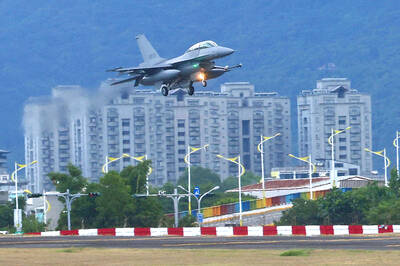
The air force plans to build 26 more hardened aircraft shelters as the number of F-16Vs stationed along Taiwan’s east coast is expected to reach 120 when the final shipment of 66 jets procured from the US arrives. The incoming jets would be stationed at Chihhang Air Base in Taitung County, augmenting the F-16V Block 20s operated by the 5th Tactical Fighter Wing in Hualien County, officials said yesterday. The air force plans to allocate more than NT$6.88 billion (US$218.1 million) from next year to 2031 to build the shelters in Hualien and Taitung as part of the implementation of a “one
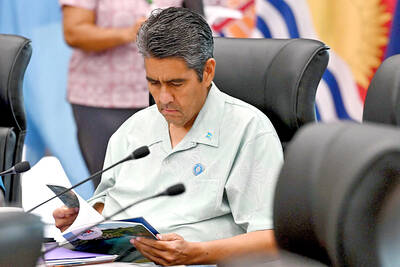
Palau’s president yesterday called for a “unified” Pacific response to a missile test by China in July, while Taiwan and its Pacific allies a day earlier at the Pacific Islands Forum (PIF) reaffirmed their commitment to peace, stability and prosperity. China gave only a handful of nations short notice before test-firing an intercontinental ballistic missile in July, sparking condemnation from several Pacific leaders. The 18-member PIF being held in Palau was expected to release a communique after press time last night, with a formal response to the test possibly included. Palau, which invited Taiwan to attend sideline events as an aid partner, urged

NO LIMITS: More legislation expanding Beijing’s control over the movement of people, money and information raises risks for Taiwanese travelers and businesses, officials said China is set to implement several laws in the coming months that expand the definition of national security, creating greater risks for Taiwanese traveling to or doing business in China, Taiwanese officials said yesterday. Beijing’s Ethnic Unity and Progress Promotion Law took effect on July 1, while a draft “Internet Information Service Management Measures” finished its public consultation on Aug. 2, but has yet to be adopted. China’s Regulations of the State Council on Exit and Entry Administration are to take effect on Tuesday next week, while amendments to its National Defense Mobilization Law and the Ministry of Public Security’s Measures


 RSS
RSS