


COVID-19 is to be reclassified as a Category 4 notifiable communicable disease on Monday next week and the Central Epidemic Command Center (CECC) is to be disbanded on the same day, the CECC said yesterday.
After the center is disbanded, the Ministry of Health and Welfare is to carry out COVID-19-related response operations, it said.
Deputy Minister of Health and Welfare Victor Wang (王必勝), who heads the center, said that after Premier Chen Chien-jen (陳建仁) visited the CECC yesterday afternoon, he has agreed to reclassify COVID-19 and allow the center to be disbanded on Monday next week.
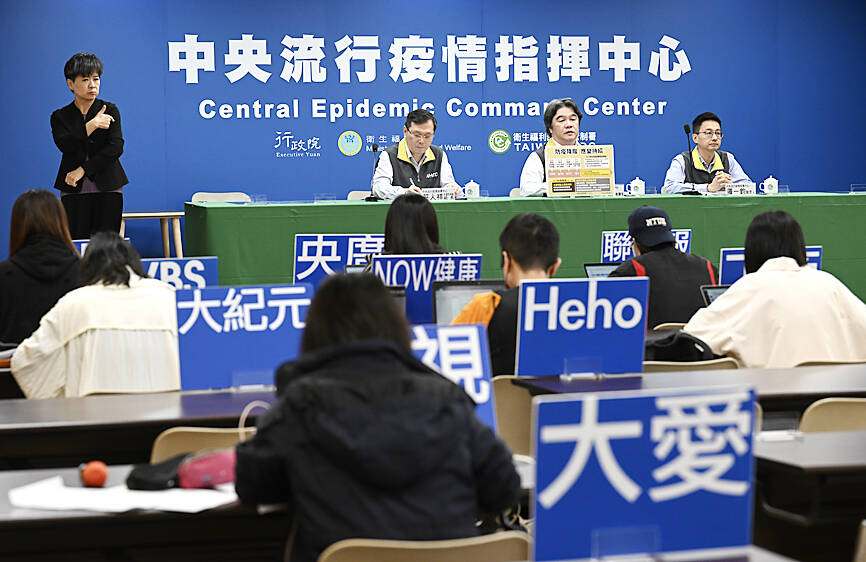
Photo: Lo Pei-de, Taipei Times
Monday next week marks the 1,197th day the center has been in operation, it said.
COVID-19 has become a flu-like illness, in terms of decreased rates of incidence, serious complications and deaths, so border control measures and restrictions have gradually been removed since last year, Wang said.
As its key operations have become normalized, the center suggested the disbandment, he said.
The ministry is to set up a COVID-19 supervisory task force to carry out follow-up prevention and response measures, form a specialist advisory panel and continue to work with related ministries in response to new emerging threats, he added.
Centers for Disease Control (CDC) Deputy Director-General Philip Lo (羅一鈞), who is the CECC spokesman, said the four main tasks of the supervisory task force and specialist advisory panel would include “disease surveillance,” providing government-funded vaccinations, maintaining government-funded antivirals for vulnerable groups with mild symptoms, COVID-19 recovery clinics and hospitalized treatment for moderate-to-severe cases.
Other “response measures” include maintenance and storage of personal protective equipment, and opening designated wards or quarantine centers if hospitalization rates increase, Lo said.
Since the rationing scheme for rapid COVID-19 test kits began on April 28 last year, selling more than 75.25 million kits as of April 13, sales have significantly dropped and there is sufficient supply in the market, so the rationing scheme would end on Sunday, he said.
People can still buy rapid test kits at pharmacies, cosmetics stores, convenience stores or supermarkets from Monday next week, he added.
As emergency use authorizations for COVID-19-related products would be terminated along with the CECC’s disbandment, Lo said only 51 types of COVID-19 examination devices or kits have a deadline on the disbandment date, while vaccines, antivirals and 223 other types of examination devices or kits would not be affected.
CDC Director-General Chuang Jen-hsiang (莊人祥) said that vaccinations would continue to be provided at contracted healthcare facilities and vaccination stations, but starting from Monday next week, healthcare facilities could charge a registration fee.
The masking restrictions at healthcare and long-term care facilities and in ambulances would continue until May 30, but could be extended, Chuang said.
People can access COVID-19-related information on the CDC’s Web site, Facebook page, Line account, the social distancing mobile app and the 1922 hotline, he said.
The final CECC news conference is to be held tomorrow afternoon, Wang said.
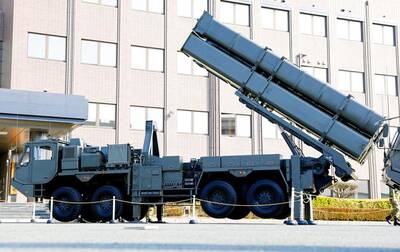
Japan has deployed long-range missiles in a southwestern region near China, the Japanese defense minister said yesterday, at a time when ties with Beijing are at their lowest in recent years. The missiles were installed in Kumamoto in the southern region of Kyushu, as Japan is attempting to shore up its military capacity as China steps up naval activity in the East China Sea. “Standoff defense capabilities enable us to counter the threat of enemy forces attempting to invade our country ... while ensuring the safety of our personnel,” Japanese Minister of Defense Shinjiro Koizumi said. “This is an extremely important initiative for
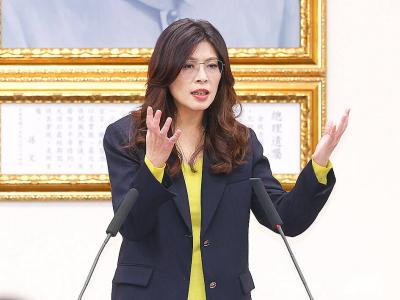
Chinese Nationalist Party (KMT) Chairwoman Cheng Li-wun (鄭麗文) today accepted an invitation from Chinese President Xi Jinping (習近平) to lead a delegation to China next month, saying she hopes to promote the peaceful development of cross-strait relations and bring stability to the Taiwan Strait. “I am grateful and happy to accept this invitation,” Cheng said in a statement from the KMT chairperson’s office. Cheng said she hopes both sides can work together to promote the peaceful development of cross-strait relations, enhance exchange and cooperation, bring stability to the Taiwan Strait and improve people’s livelihoods. At today's news conference, Cheng said any efforts to
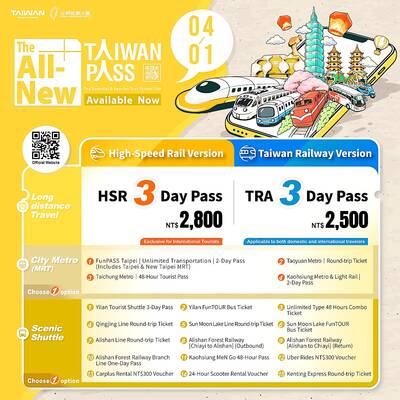
MORE POPULAR: Taiwan Pass sales increased by 59 percent during the first quarter compared with the same period last year, the Tourism Administration said The Tourism Administration yesterday said that it has streamlined the Taiwan Pass, with two versions available for purchase beginning today. The tourism agency has made the pass available to international tourists since 2024, allowing them to access the high-speed rail, Taiwan Railway Corp services, four MRT systems and four Taiwan Tourist Shuttles. Previously, five types of Taiwan Pass were available, but some tourists have said that the offerings were too complicated. The agency said only two types of Taiwan Pass would be available, starting from a three-day pass with the high-speed rail and a three-day pass with Taiwan Railway Corp. The former costs NT$2,800

The nation’s fastest supercomputer, Nano 4 (晶創26), is scheduled to be launched in the third quarter, and would be used to train large language models in finance and national defense sectors, the National Center for High-Performance Computing (NCHC) said. The supercomputer, which would operate at about 86.05 petaflops, is being tested at a new cloud computing center in the Southern Taiwan Science Park in Tainan. The exterior of the server cabinet features chip circuitry patterns overlaid with a map of Taiwan, highlighting the nation’s central position in the semiconductor industry. The center also houses Taiwania 2, Taiwania 3, Forerunner 1 and


 RSS
RSS