


Eel production in Taiwan has slipped behind that of other East Asian nations over the past few years, leaving producers looking for alternatives to the formerly lucrative export market.
Once the regional leader in eel production, Taiwan’s release of fry into farming ponds has fallen far behind Japan, China and South Korea.
Taiwan leads off eel harvest season in East Asia, which typically runs from Nov. 1 to the end of February the following year.
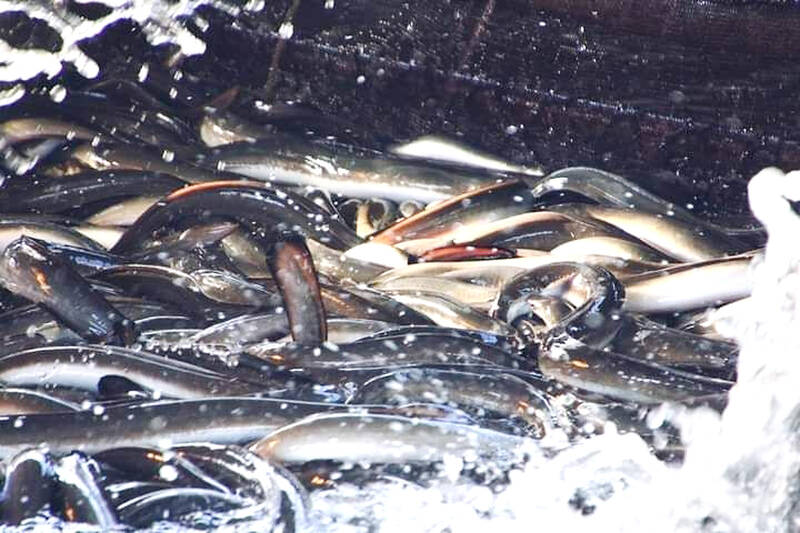
Photo : Tsai Tsung-hsun, Taipei Times
To supply Japan for “unagi day” in midsummer, eel fry must be released before the middle of January, making Taiwan the best place to supply its neighbor during the high season.
However, Japanese producers have in recent years begun purchasing eel fry from Taiwan at high prices to supply their domestic market, driving down Taiwan’s eel exports and breeding industry.
As a result, the market share of Taiwanese eel in Japan and the amount of fry released into farming ponds has been falling rapidly.
Taiwan only accounted for 1.2 percent of eel fry released in East Asia, at 320kg, the Nihon Yoshoku Shimbun, a Japanese trade journal focusing on the eel industry, reported on April 7.
Japan led the industry at 49.3 percent (13,553kg), followed by China at 32.7 percent (9,000kg) and South Korea at 16.9 percent (4,639kg).
Owing to China’s recent success in the industry, South Korea has begun importing significant quantities of fry from China and Hong Kong to boost its numbers, making Taiwan’s market share likely to fall below 1 percent, the publication said.
Taiwan’s eel exports had already begun to slide before the COVID-19 pandemic. Exports fell each year between 2018 and last year, from 2,396 tonnes to 1,654 tonnes during the period.
July was the most productive month each year, ranging from 182 tonnes in 2020 to 410 tonnes in 2018.
The worst hit to fry rearing came over the past two years, from 8,143.8kg in 2020 to 4,430.49kg in 2021, and only 877.33kg last year.
This year, only 320kg has been released.
Eel farming in Taiwan is being depressed by high fry prices and dwindling exports, Taiwan Association of Eel and Shrimp Production Cooperatives chairman Tang Ching-tsung (唐慶宗) said.
As the risk is high, farmers are reducing their stock, making their exports less competitive and continuing the downward cycle, Tang said.
The way to correct the problem is to keep harvested fry in Taiwan to replenish domestic farming ponds in preparation for Japan’s “unagi day,” he said.
Farmer Kuo Hung-yu (郭紘瑜) said that he used to frequently send large eel orders to Japan, but now only sends one or two containers at lower prices.
Most eel producers are waiting to see what might happen, Kuo said, adding that his strategy is to stabilize revenue by actively pursuing domestic buyers before seeking more export opportunities.
Farmer Tang Hsin-yuan (唐昕遠), who is newer to the business, agreed that fry are expensive and exporting to Japan is not cost-effective.
He is only rearing enough this year to satisfy domestic demand and is converting idle ponds to more competitive species.
Tang said that if he stuck with only rearing eel, there is a good chance he would lose money despite the great effort required.

NATIONAL SECURITY: Authorities are working to confirm the identities of the military personnel involved and investigating possible illegal conduct and regulatory violations Authorities are probing possible national security implications after Kinmen police and immigration officers on Sunday found a Chinese woman allegedly posing as a tourist while engaging in prostitution involving more than 10 military personnel. The woman, surnamed Chen (陳), has since been deported, authorities said, adding that investigators are still working to confirm the identities of those implicated, as the records only listed code names and aliases. The case stemmed from a report received by the Kinmen District Prosecutors’ Office on Friday last week from the Jinhu Precinct of the Kinmen County Police Bureau. On Sunday, police, along with the National Immigration

GLOBALGIVING: ‘ Caving to external pressure is not acceptable for an organization that has cultivated justice reform and human rights for 30 years,’ one NGO said A slew of non-government organizations (NGOs) have withdrawn from the GlobalGiving fundraising platform after it announced it would use “Chinese Taipei” instead of “Taiwan” from next month. The Taiwan Good Rice Association wrote on Facebook on Friday that it was informed on April 28 via a teleconference call of the change, which was made because the platform wanted to operate in China. Taiwan Good Rice is to terminate all cooperative relationships with GlobalGiving in response to the platform’s “unilateral and non-negotiable” decision to remove references to Taiwan, the NGO said. “Taiwan is in the official name of Taiwan Good Rice Association and the

HEAVY WEATHER: Typhoon Jangmi is due to crash straight into the Ryukyus as airlines look to shift flights to larger aircraft or cancel flights to Okinawa entirely Taiwan’s international air carriers announced flight adjustments over the weekend as Typhoon Jangmi is forecast to hit the Ryukyu Islands today and tomorrow. The Central Weather Administration (CWA) upgraded Jangmi from a tropical storm to a typhoon at 8am yesterday, with the eye located 580km south of Naha city. It was moving north at 19kph. Today, China Airlines’ CI-120, CI-121, CI-122 and CI-123 flights between Taoyuan and Naha, Okinawa, have been canceled as well as CI-132 and CI-133 between Kaohsiung and Naha. EVA Air’s BR-112, BR-113, BR-186 and BR-185 flights between Taoyuan and Naha are also canceled. Low-cost carrier Tigerair Taiwan canceled IT-230,

REASONS FOR TRAVEL: An assistant professor said that proposed amendments to penalize drivers if they used drugs overseas would not deter people from traveling People who operate a motor vehicle under the influence of marijuana would have their driver’s license revoked, even if they used the substance while overseas, the Ministry of Transportation and Communications said yesterday, citing proposed amendments to the Road Traffic Management and Penalty Act (道路交通管理處罰條例). The amendments would also authorize the government to revoke the licenses of people determined to have used Category 1 or Category 2 narcotics, even if they were not operating a vehicle while under the influence of drugs, as well as ban them from taking the license test for three years, the ministry said. People aged 18 or


 RSS
RSS