

Taiwan has a system in place to protect the public from radioactive ocean contamination, the Atomic Energy Council (AEC) said, as Japan moves closer to dumping wastewater from the derelict Fukushima Dai-ichi nuclear power plant.
The Japanese government in January said that it would in the spring or summer discharge 1.47 million tonnes of water that was contaminated by tritium following a partial meltdown at the plant in 2011.
Although Tokyo said the wastewater had been rendered safe, other countries in the region have protested the decision, citing fears that radioactive contamination could harm fisheries.
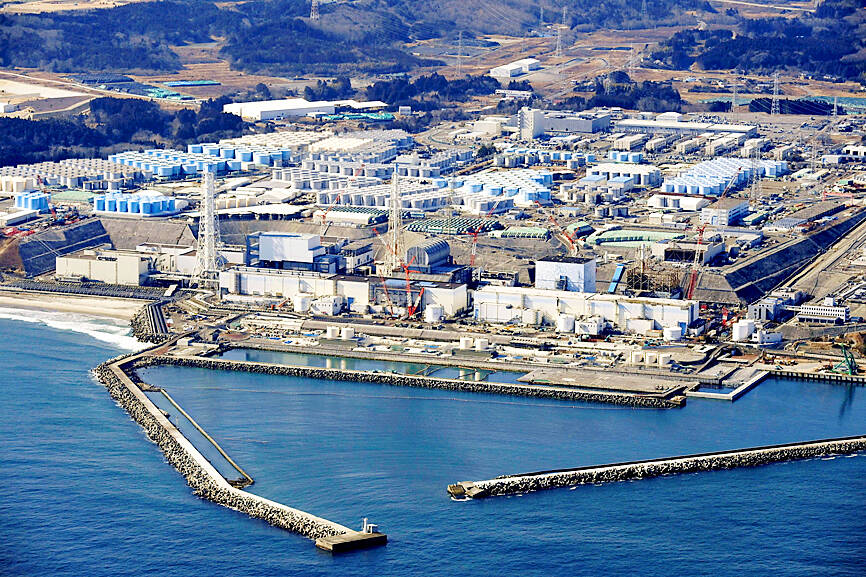
Photo: Reuters
The AEC on Saturday said that it has been tracking radioactive particles in seafood and the ocean since 2011, when a multiagency program was launched to protect the public from tritium pollution.
The council examined sand and water samples from Taiwan’s surrounding seas semi-annually or seasonally, while catches of fish were inspected to establish a baseline for the substance in living organisms, it said.
The potential spread of tritium was simulated by models created at other agencies, it said.
Participation from the coast guard and fishers is helping the program reach its aim of collecting 352 seawater samples, 240 catches and 100 imported seafood shipments this year, it added.
The measurements would help develop a color-coded scheme for marine radioactive risk, said Lin Chen-hsuan (林貞絢), a senior technical specialist at the council’s Radiation Protection Department.
The council’s safety limit for tritium in seawater — 1,000 becquerel per liter — is 10 times lower than the international standard for potable water, she said.
Computer simulations have shown that the bulk of the tritium would likely drift away from Taiwanese waters, Central Weather Bureau researcher Deng Ren-hsin (鄧仁星) said.
The models show that 86.9 percent of the substance would be carried east by marine currents and 12.82 percent would move south, while about 0.28 percent would settle in waters surrounding Taiwan, he said.
Northeastern seasonal winds that prevail from October to April are likely to create tritium-bearing surface currents that would arrive in Taiwan within 12 to 18 months following the discharge, he said.
The Fisheries Agency is implementing a system to measure tritium levels in select species of fish in different parts of the sea to safeguard consumers, the agency said.
Tritium is not a substance currently being measured due to the technical difficulties involved in its detection, said Liao Chia-ding, chief of the Food Division at the Food and Drug Administration.
The agency has inspected 220,000 imported food items from Japan and found minor traces of radiation in only 248 items, which were destroyed or returned, he said.
The AEC “deserves credit” for using a stricter tritium standard than the rest of the world, Citizen of the Earth, Taiwan CEO Tsai Chung-yueh (蔡中岳) said.
However, fishing operations in severely affected areas should be ceased altogether, he said.
Additional reporting by Chen Hsin-yu and Yang Yuan-ting

Taiwan, which accounts for more than half of the global outsourced semiconductor assembly and testing market, is well-positioned to develop copackaged optics (CPO) and manufacture precision silicon photonics chips, the Ministry of Economic Affairs said yesterday. Silicon photonics are emerging as a mainstream optical communications technology and is seen as key to overcoming bottlenecks in AI computing power. The technology is a key project under the government’s New 10 Major AI Infrastructure Projects, with industry, government, academia and research institutions working to overcome critical technological hurdles and build a self-reliant silicon photonics supply chain, the ministry said. Nvidia Corp in March invested US$4
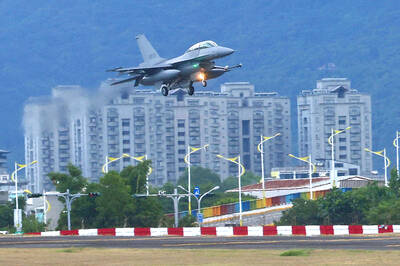
The air force plans to build 26 more hardened aircraft shelters as the number of F-16Vs stationed along Taiwan’s east coast is expected to reach 120 when the final shipment of 66 jets procured from the US arrives. The incoming jets would be stationed at Chihhang Air Base in Taitung County, augmenting the F-16V Block 20s operated by the 5th Tactical Fighter Wing in Hualien County, officials said yesterday. The air force plans to allocate more than NT$6.88 billion (US$218.1 million) from next year to 2031 to build the shelters in Hualien and Taitung as part of the implementation of a “one
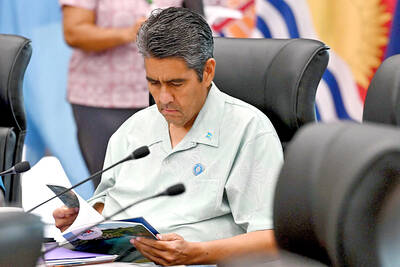
Palau’s president yesterday called for a “unified” Pacific response to a missile test by China in July, while Taiwan and its Pacific allies a day earlier at the Pacific Islands Forum (PIF) reaffirmed their commitment to peace, stability and prosperity. China gave only a handful of nations short notice before test-firing an intercontinental ballistic missile in July, sparking condemnation from several Pacific leaders. The 18-member PIF being held in Palau was expected to release a communique after press time last night, with a formal response to the test possibly included. Palau, which invited Taiwan to attend sideline events as an aid partner, urged
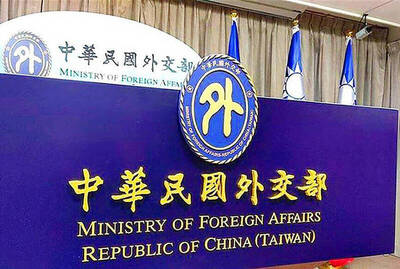
China’s continued efforts to inject geopolitical rivalry into the region and disrupt Pacific nations’ discussions of regional issues warrant greater international attention, a foreign affairs official said yesterday. Minister of Foreign Affairs Lin Chia-lung (林佳龍) last week led a delegation to diplomatic ally Palau to attend events related to the 55th Pacific Islands Forum (PIF) summit. However, the absence of some member-state leaders has been interpreted by some people as a sign of fracturing in Pacific unity. Thirteen PIF members were represented by their heads of state or government, while Fiji, New Caledonia, Vanuatu and Samoa sent ministerial-level representatives, a diplomatic official


 RSS
RSS