


US Joint Chiefs of Staff Chairman General Mark Milley has said people need to “lower the rhetoric” about a war with China, as the US is not on the brink of a conflict with Beijing, but the discussion is becoming “overheated.”
Milley made the remarks during an interview with Defense One published on Friday.
He said he has doubts about China’s chances of “conquering” Taiwan, but added that “the United States should continue to quicken arms shipments to the self-governing nation and its own military capabilities, just in case.”

Photo: AP
Milley said a war with China would be possible if there is an incident or a trigger event that leads to uncontrolled escalation, although he at this point does not think that it is likely.
However, he said that “the rhetoric itself can overheat the environment.”
He said he agrees with calls for the US to send arms to Taiwan as quickly as possible, because Chinese President Xi Jinping (習近平) wants the Chinese People’s Liberation Army armed and capable of taking Taiwan by force by 2027, which is only four years away.
The US has three to four years to get Taiwan in a position where Chinese decisionmakers would believe that the costs of attacking Taiwan exceed the benefits, he said, adding that Taiwan needs air defenses, anti-ship cruise missiles and anti-ship mines.
Milley said Taiwan’s 170,000 active-duty military personnel and about 1 million to 2 million reserves, coupled with China’s lack of experience, make a takeover unlikely.
“It would be a very difficult island to capture,” Defense One quoted Milley as saying.
Milley also said that fears of a China-Russia alliance are also premature, but the US should take a geostrategic approach that does not drive the two nations into each other’s arms to form an actual military alliance.
“I think it’s incumbent upon us, the United States, to make sure that we have an incredibly powerful military that is capable,” that China knows it and that China believes the US will use it if necessary, he said.
Milley said he prefers to back a proverb used by former US president Theodore Roosevelt: “Speak softly and carry a big stick — you will go far.”
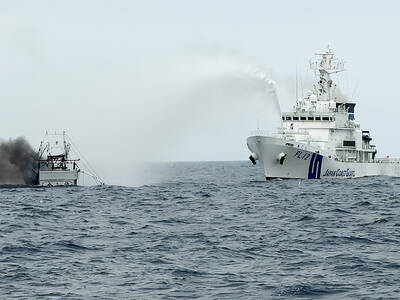
CREDIT-GRABBER: China said its coast guard rescued the crew of a fishing vessel that caught fire, who were actually rescued by a nearby Taiwanese boat and the CGA Maritime search and rescue operations do not have borders, and China should not use a shipwreck to infringe upon Taiwanese sovereignty, the Coast Guard Administration (CGA) said yesterday. The coast guard made the statement in response to the China Coast Guard (CCG) saying it saved a Taiwanese fishing boat. The Chuan Yu No. 6 (全漁6號), a fishing vessel registered in Keelung, on Thursday caught fire and sank in waters northeast of Diaoyutai Islands (釣魚台). The vessel left Keelung’s Badouzih Fishing Harbor (八斗子漁港) at 3:35pm on Sunday last week, with seven people on board — a 62-year-old Taiwanese captain surnamed Chang (張) and six
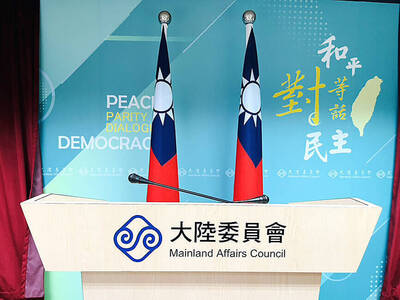
RISKY BUSINESS: The ‘incentives’ include initiatives that get suspended for no reason, creating uncertainty and resulting in considerable losses for Taiwanese, the MAC said China’s “incentives” failed to sway sentiment in Taiwan, as willingness to work in China hit a record low of 1.6 percent, a Ministry of Labor survey showed. The Directorate-General of Budget, Accounting and Statistics (DGBAS) also reported that the number of Taiwanese workers in China has nearly halved from a peak of 430,000 in 2012 to an estimated 231,000 in 2024. That marked a new low in the proportion of Taiwanese going abroad to work. The ministry’s annual survey on “Labor Life and Employment Status” includes questions respondents’ willingness to seek employment overseas. Willingness to work in China has steadily declined from

The Legislative Yuan’s Finance Committee yesterday approved proposed amendments to the Amusement Tax Act (娛樂稅法) that would abolish taxes on films, cultural activities and competitive sporting events, retaining the fee only for dance halls and golf courses. The proposed changes would set the maximum tax rate for dance halls and golf courses at 50 and 20 percent respectively, with local governments authorized to suspend the levies. Article 2 of the act says that “amusement tax shall be levied on tickets sold or fees charged by amusement places, facilities or activities” in six categories: “Cinema; professional singing, story-telling, dancing, circus, magic show, acrobatics
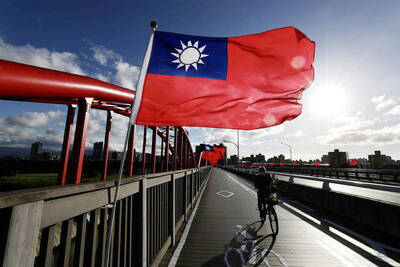
INFLATION UP? The IMF said CPI would increase to 1.5 percent this year, while the DGBAS projected it would rise to 1.68 percent, with GDP per capita of US$44,181 The IMF projected Taiwan’s real GDP would grow 5.2 percent this year, up from its 2.1 percent outlook in January, despite fears of global economic disruptions sparked by the US-Iran conflict. Taiwan’s consumer price index (CPI) is projected to increase to 1.5 percent, while unemployment would be 3.4 percent, roughly in line with estimates for Asia as a whole, the international body wrote in its Global Economic Outlook Report published in the US on Monday. The figures are comparatively better than the IMF outlook for the rest of the world, which pegged real GDP growth at 3.1 percent, down from 3.3 percent


 RSS
RSS