


The Mainland Affairs Council (MAC) yesterday expressed regret, saying former president Ma Ying-jeou (馬英九) has harmed the nation’s sovereignty and dignity by echoing the “one China” principle advocated by the Chinese Communist Party (CCP), which seeks to annex Taiwan.
In a speech at China’s Hunan University yesterday, Ma said “it is a clear fact” that the constitution of the People’s Republic of China (PRC), adopted in 1982, stipulates that “Taiwan is part of the sacred territory of the People’s Republic of China.”
Ma said “our country” amended the constitution, so that “our country was divided into two parts — one is the Taiwan Area, and the other is the Mainland Area — both are [parts of] our Republic of China [ROC], both are [parts of] China.”
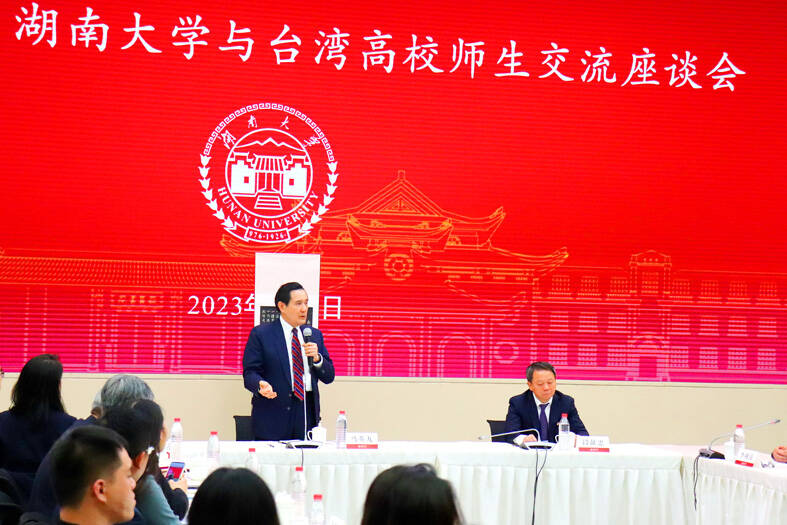
Photo: CNA
According to Article 2 of the Act Governing Relations Between the People of the Taiwan Area and the Mainland Area (臺灣地區與大陸地區人民關係條例), “Taiwan Area” refers to Taiwan, Penghu, Kinmen and Matsu, while the “Mainland Area” refers to ROC territory outside the Taiwan Area, Ma said.
Therefore, based on the ROC Constitution, Taiwan and the mainland belong to one China, he said.
“We are the Taiwan Area, and you are the Mainland Area,” Ma said.
He said he was aware that “the Preamble of the 1982 Constitution on the mainland also mentions ‘Taiwan is part of the sacred territory of the PRC,’” and “this is a clear fact.”
By mentioning the PRC Constitution, which claims that “Taiwan is part of the sacred territory of the PRC,” and the ROC Constitution in the same breath, and saying that people on both sides of the Taiwan Strait adhere to the “one China principle,” Ma has harmed the nation’s sovereignty and dignity, the council said, adding that he seriously deviated from the fact that Taiwan has never been a part of the PRC.
The cross-strait “status quo,” and the consensus among Taiwan’s ruling and opposition parties, as well as the 23 million Taiwanese, is that “the ROC and the PRC are not subordinate to each other,” it said.
“The ROC is a sovereign nation, not part of the PRC,” the council said, adding that it hopes former presidents who visit China defend Taiwan’s sovereignty, dignity and interests, and meet the public’s expectations.
Cross-Strait Policy Association researcher Wu Se-chih (吳瑟致) said the ROC Constitution refers to “existing national boundaries,” but Ma deliberately cited the PRC constitution.
To some extent, Ma was also echoing the concept of “one China with respective interpretations,” attempting to put a spin on the Chinese Nationalist Party’s (KMT) so-called “1992 consensus.”
The “1992 consensus” is a term former Mainland Affairs Council chairman Su Chi (蘇起) in 2006 admitted making up in 2000, which refers to a tacit understanding between the KMT and the Chinese government that both sides of the Taiwan Strait acknowledge there is “one China,” with each side having its own interpretation of what “China” means.
Wu said it was “very inappropriate” for Ma, as a former president, to use the constitutions of both sides of the Taiwan Strait to deal with the “one China” issue.
Ma’s trip to China did not highlight the fact that the ROC exists, but instead echoed the CPP’s claim that “Taiwan is an inseparable part of Chinese territory,” he said.
Ma’s statements do not match the reality of the international situation and the fact that the ROC has sovereignty, Wu said, adding that Ma did not request the CPP to recognize the ROC.
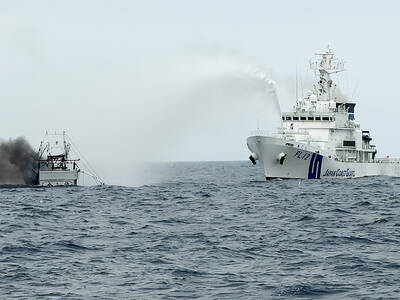
CREDIT-GRABBER: China said its coast guard rescued the crew of a fishing vessel that caught fire, who were actually rescued by a nearby Taiwanese boat and the CGA Maritime search and rescue operations do not have borders, and China should not use a shipwreck to infringe upon Taiwanese sovereignty, the Coast Guard Administration (CGA) said yesterday. The coast guard made the statement in response to the China Coast Guard (CCG) saying it saved a Taiwanese fishing boat. The Chuan Yu No. 6 (全漁6號), a fishing vessel registered in Keelung, on Thursday caught fire and sank in waters northeast of Diaoyutai Islands (釣魚台). The vessel left Keelung’s Badouzih Fishing Harbor (八斗子漁港) at 3:35pm on Sunday last week, with seven people on board — a 62-year-old Taiwanese captain surnamed Chang (張) and six
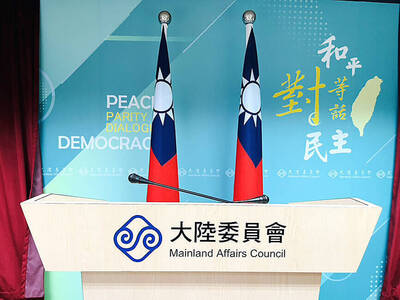
RISKY BUSINESS: The ‘incentives’ include initiatives that get suspended for no reason, creating uncertainty and resulting in considerable losses for Taiwanese, the MAC said China’s “incentives” failed to sway sentiment in Taiwan, as willingness to work in China hit a record low of 1.6 percent, a Ministry of Labor survey showed. The Directorate-General of Budget, Accounting and Statistics (DGBAS) also reported that the number of Taiwanese workers in China has nearly halved from a peak of 430,000 in 2012 to an estimated 231,000 in 2024. That marked a new low in the proportion of Taiwanese going abroad to work. The ministry’s annual survey on “Labor Life and Employment Status” includes questions respondents’ willingness to seek employment overseas. Willingness to work in China has steadily declined from
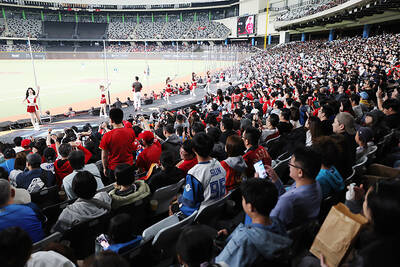
The Legislative Yuan’s Finance Committee yesterday approved proposed amendments to the Amusement Tax Act (娛樂稅法) that would abolish taxes on films, cultural activities and competitive sporting events, retaining the fee only for dance halls and golf courses. The proposed changes would set the maximum tax rate for dance halls and golf courses at 50 and 20 percent respectively, with local governments authorized to suspend the levies. Article 2 of the act says that “amusement tax shall be levied on tickets sold or fees charged by amusement places, facilities or activities” in six categories: “Cinema; professional singing, story-telling, dancing, circus, magic show, acrobatics
INFLATION UP? The IMF said CPI would increase to 1.5 percent this year, while the DGBAS projected it would rise to 1.68 percent, with GDP per capita of US$44,181 The IMF projected Taiwan’s real GDP would grow 5.2 percent this year, up from its 2.1 percent outlook in January, despite fears of global economic disruptions sparked by the US-Iran conflict. Taiwan’s consumer price index (CPI) is projected to increase to 1.5 percent, while unemployment would be 3.4 percent, roughly in line with estimates for Asia as a whole, the international body wrote in its Global Economic Outlook Report published in the US on Monday. The figures are comparatively better than the IMF outlook for the rest of the world, which pegged real GDP growth at 3.1 percent, down from 3.3 percent


 RSS
RSS