


Taiwanese are determined to defend their homeland and its sovereignty, and are willing to invest more in regional peace with like-minded partners, President Tsai Ing-wen (蔡英文) told a delegation of US representatives yesterday.
US Representative Ken Calvert, who chairs the US House of Representatives Defense Appropriations Subcommittee, is leading the delegation to Taiwan on a two-day visit.
The other members are fellow Republican US representatives Tom Cole, Dave Joyce and Mike Garcia, as well as Democratic US Representative Ed Case, all of whom are on the House Committee on Appropriations.
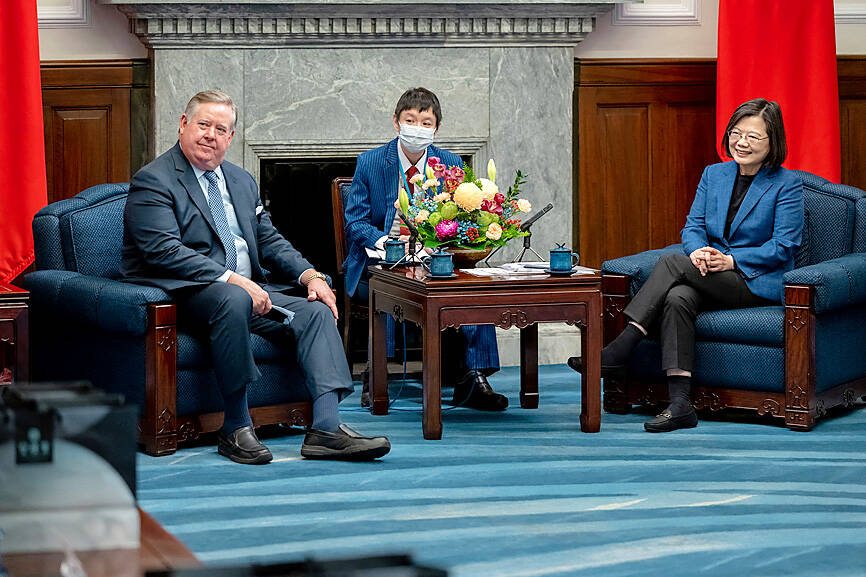
Photo provided by Taiwan Presidential Office
Calvert is on his second visit to Taiwan following a trip in 1995, while Cole visited the nation more than 40 years ago, and the others are on their first visit to Taiwan, Tsai said.
The representatives have significant influence on US government expenditures, including for defense resources, Tsai said, adding that their visit demonstrates the importance they attach to Taiwan’s security and Taiwan-US relations.
Highlighting her administration’s efforts to bolster defense resilience and restructure the military, Tsai reiterated the resolve of Taiwanese to defend themselves.
“We are willing and able to fortify cooperation with the US and like-minded partners,” she said. “Together, we can invest even more effort toward regional peace and stability, and democratic resilience across the globe.”
She also thanked the US Congress for its “unwavering bipartisan support,” in particular the Taiwan-friendly portions of the National Defense Authorization Act for Fiscal Year 2023.
On trade, Tsai mentioned the second round of Taiwan-US Initiative on 21st-Century Trade negotiations in January, expressing hope that the two sides could reach an agreement on trade facilitation, labor rights and digital trade.
This agreement could hopefully become a basis for signing a comprehensive bilateral trade agreement, she added.
Calvert thanked Tsai for her welcome, saying that delegation members have seen many “positive changes” in Taiwan since their previous visits.
He also said they look forward to discussing regional security, trade and investment, among other areas of mutual interest.
The delegation is in Taiwan to build on decades of peace and prosperity in the region and strengthen ties between Taiwan and the US, he added.

PROVOCATIVE: Chinese Deputy Ambassador to the UN Sun Lei accused Japan of sending military vessels to deliberately provoke tensions in the Taiwan Strait China denounced remarks by Japan and the EU about the South China Sea at a UN Security Council meeting on Monday, and accused Tokyo of provocative behavior in the Taiwan Strait and planning military expansion. Ayano Kunimitsu, a Japanese vice foreign minister, told the Council meeting on maritime security that Tokyo was seriously concerned about the situation in the East China and South China seas, and reiterated Japan’s opposition to any attempt to change the “status quo” by force, and obstruction of freedom of navigation and overflight. Stavros Lambrinidis, head of the EU delegation to the UN, also highlighted South China Sea

SILENCING CRITICS: In addition to blocking Taiwan, China aimed to prevent rights activists from speaking out against authoritarian states, a Cabinet department said The Ministry of Foreign Affairs (MOFA) yesterday condemned transnational repression by Beijing after RightsCon, a major digital human rights conference scheduled to be held in Zambia this week, was abruptly canceled due to Chinese pressure over Taiwanese participation. This year’s RightsCon, the world’s largest conference discussing issues “at the intersection of human rights and technology,” was scheduled to take place from tomorrow to Friday in Lusaka, and expected to draw 2,600 in-person attendees from 150 countries, along with 1,100 online participants. However, organizers were forced to cancel the event due to behind-the-scenes pressure from China, the ministry said, expressing its “strongest condemnation”
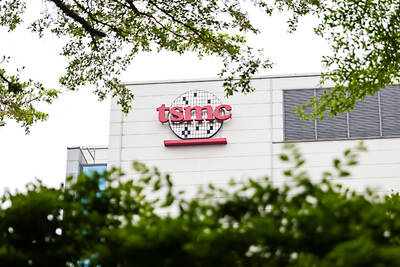
Taiwan Semiconductor Manufacturing Co (TSMC, 台積電), the world’s largest contract chipmaker, said it expects its 2-nanometer (2nm) chip capacity to grow at a compound annual rate of 70 percent from this year to 2028. The projection comes as five fabs begin volume production of 2-nanometer chips this year — two in Hsinchu and three in Kaohsiung — TSMC senior vice president and deputy cochief operating officer Cliff Hou (侯永清) said at the company’s annual technology symposium in Silicon Valley, California, last week. Output in the first year of 2-nanometer production, which began in the fourth quarter of last year, is expected to
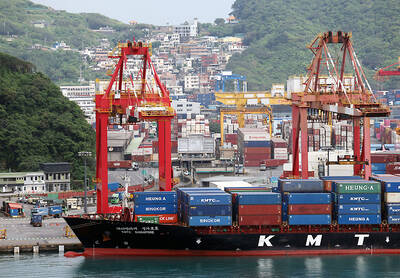
Taiwan’s economy grew far faster than expected in the first quarter, as booming demand for artificial intelligence (AI) applications drove a surge in exports, spilling over into investment and consumption, the Directorate-General of Budget, Accounting and Statistics (DGBAS) said yesterday. GDP growth was 13.69 percent year-on-year during the January-to-March period, beating the DGBAS’ February forecast by 2.23 percentage points and marking the most robust growth in nearly four decades, DGBAS senior official Chiang Hsin-yi (江心怡) told a news conference in Taipei. The result was powered by exports, which remain the backbone of Taiwan’s economy, Chiang said. Outbound shipments jumped 51.12 percent year-on-year to


 RSS
RSS