


Police yesterday appeared to have given up an attempt to arrest former Pakistani prime minister Imran Khan, ending a siege of his residence after violent clashes with hundreds of his supporters.
Agence France-Presse correspondents and witnesses near Khan’s home in the Zaman Park suburb of Lahore said that police and paramilitary rangers had retreated after abandoning a series of roadblocks and checkpoints.
“The police and rangers sent to harm Imran Khan were pushed back by the people,” his Pakistan Tehreek-e-Insaf (PTI) party wrote on Twitter, along with a video of supporters celebrating outside his house.
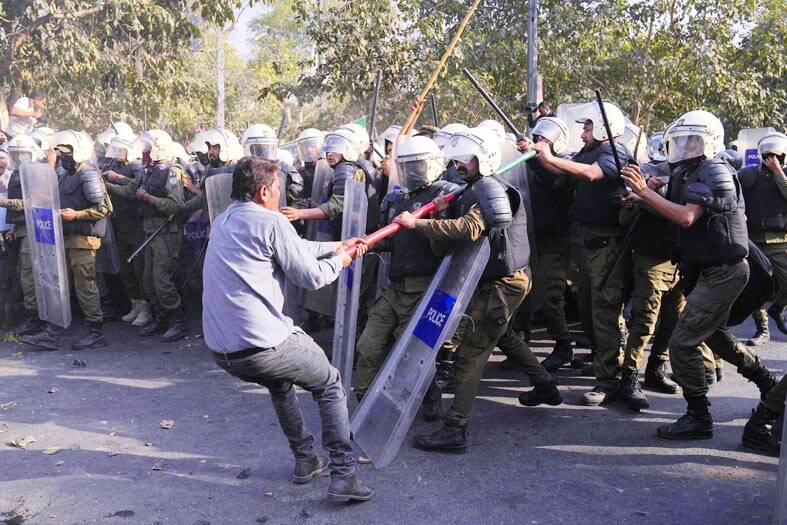
Photo: AP
“More people are coming to Zaman Park and will never let the evil intentions of this imported government succeed, God willing,” it wrote in Urdu.
Police had fought pitched battles with Khan’s supporters throughout the night, firing fusillades of teargas and dodging rocks thrown by crowds.
Groups of police were seen running from the direction of the house yesterday afternoon.
Khan was ousted from office by a no-confidence vote last year and has been snarled in dozens of legal cases as he campaigns for early elections and a return to office.
PTI social media accounts showed videos of Khan greeting dozens of people inside his garden and supporters celebrating outside.
Police say they have a warrant to arrest Khan following his failure to appear before an Islamabad court on graft charges, but the former leader and his lawyers say he has been granted bail on the charge.
“The PTI leader does not have protective bail for this particular case,” Islamabad police spokesman Muhammad Taqi Jawad said.
He said the arrest warrant would stand and denied that police had retreated.
“Our actions will strictly adhere to the law and we are committed to fulfilling our duty,” he said.
Earlier Khan issued a video sitting in front of Pakistan and PTI flags at a desk decorated with spent teargas canisters.
“They will teargas our people and do other such things, but you should know that they have no justification to do so,” he said.
A PTI official wrote on Twitter that there was “an urgent need” for first aid kits at the Zaman Park neighborhood.
The CIA has a message for Chinese government officials worried about their place in Chinese President Xi Jinping’s (習近平) government: Come work with us. The agency released two Mandarin-language videos on social media on Thursday inviting disgruntled officials to contact the CIA. The recruitment videos posted on YouTube and X racked up more than 5 million views combined in their first day. The outreach comes as CIA Director John Ratcliffe has vowed to boost the agency’s use of intelligence from human sources and its focus on China, which has recently targeted US officials with its own espionage operations. The videos are “aimed at
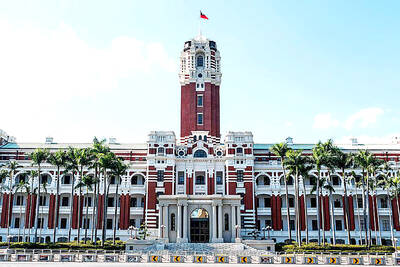
STEADFAST FRIEND: The bills encourage increased Taiwan-US engagement and address China’s distortion of UN Resolution 2758 to isolate Taiwan internationally The Presidential Office yesterday thanked the US House of Representatives for unanimously passing two Taiwan-related bills highlighting its solid support for Taiwan’s democracy and global participation, and for deepening bilateral relations. One of the bills, the Taiwan Assurance Implementation Act, requires the US Department of State to periodically review its guidelines for engagement with Taiwan, and report to the US Congress on the guidelines and plans to lift self-imposed limitations on US-Taiwan engagement. The other bill is the Taiwan International Solidarity Act, which clarifies that UN Resolution 2758 does not address the issue of the representation of Taiwan or its people in
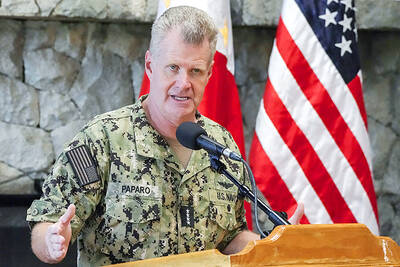
US Indo-Pacific Commander Admiral Samuel Paparo on Friday expressed concern over the rate at which China is diversifying its military exercises, the Financial Times (FT) reported on Saturday. “The rates of change on the depth and breadth of their exercises is the one non-linear effect that I’ve seen in the last year that wakes me up at night or keeps me up at night,” Paparo was quoted by FT as saying while attending the annual Sedona Forum at the McCain Institute in Arizona. Paparo also expressed concern over the speed with which China was expanding its military. While the US

DEFENDING DEMOCRACY: Taiwan shares the same values as those that fought in WWII, and nations must unite to halt the expansion of a new authoritarian bloc, Lai said The government yesterday held a commemoration ceremony for Victory in Europe (V-E) Day, joining the rest of the world for the first time to mark the anniversary of the end of World War II in Europe. Taiwan honoring V-E Day signifies “our growing connections with the international community,” President William Lai (賴清德) said at a reception in Taipei on the 80th anniversary of V-E Day. One of the major lessons of World War II is that “authoritarianism and aggression lead only to slaughter, tragedy and greater inequality,” Lai said. Even more importantly, the war also taught people that “those who cherish peace cannot


 RSS
RSS