


Lawmakers yesterday passed revisions aimed at curbing speculation in the property market, including the introduction of a repeatable NT$50 million (US$1.64 million) fine for market manipulators, in a bid to bring down the nation’s high house prices.
The amendments to the Equalization of Land Rights Act (平均地權條例) were passed with all lawmakers present voting in favor of the revisions.
One of the key revisions prohibits the reselling or transfer of purchase agreements for presale or newly constructed residential units to third parties, long considered a loophole that encourages speculation.
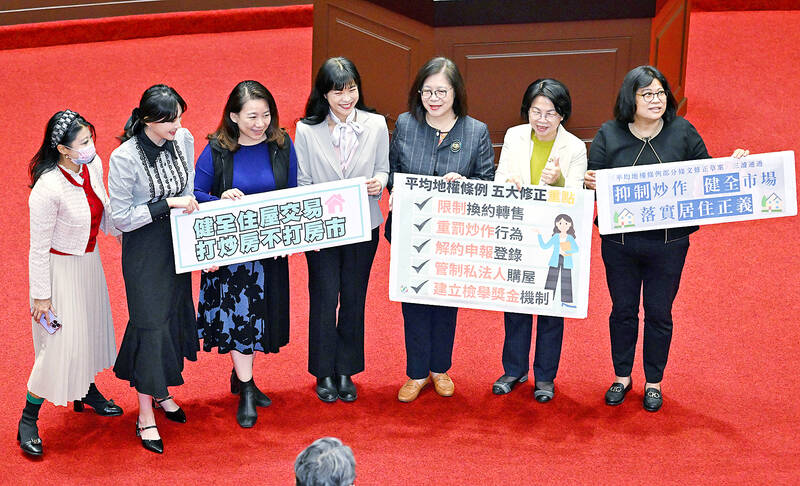
Photo: Liao Cheng-hui, Taipei Times
In presale residential housing developments it is common practice for interested buyers to reserve the right to purchase a housing unit by placing a deposit and receiving a “purchase order” that includes an agreed-upon price.
The purchase agreements can then be “flipped” to other buyers when the price of the units go up as the presale process proceeds, a tactic speculators have used to make sizeable profits.
Under the amendments, the practice is prohibited unless the purchase agreement is transferred to a person’s spouse or first or second-degree relative, or in situations to be defined by the Ministry of the Interior.
People who breach the rule would be subject to a fine of NT$500,000 to NT$3 million, with the penalty also applying to realtors who help people resell or transfer purchase agreements.
In situations where a purchase agreement for a presale house is dissolved, the property developer is required to report the cancelation within 30 days or face a fine of NT$30,000 to NT$150,000 per unit.
The revisions also set specific penalties for people who manipulate the real-estate market or earn a profit by spreading false information about house prices, collude with others to fake transactions, overstate the number of houses sold or engage in illegal transactions.
Those who engage in such behavior would be subject to a fine of between NT$1 million and NT$50 million depending on the number of transactions, and the fine can be repeated.
Another key revision prohibits private entities from reselling, transferring or appointing a future receiver of a property within five years of purchasing it.
Private entities also need to present a proposal for property use to their respective governing authority and gain its approval before they can purchase a residential unit.
The amendments also establish a reward mechanism for people who report illegal transactions or actual transaction prices that have not been accurately registered, paying informants a certain share of the fines collected.
Also adopted was a motion sponsored by the Democratic Progressive Party caucus to simplify the application process to have buildings included in urban renewal projects or for private entities when they purchase houses to be used as dormitories. Under the motion, reviews of such applications shall not, in principle, exceed seven working days.
The amended act also revises the makeup of land evaluation committees at the local government level, raising the representation of experts and members of civil groups to at least 50 percent while eliminating the presence of elected local officials and “other types of impartial individuals.”
The amendments are to be sent to President Tsai Ing-wen (蔡英文) to be signed into law.
The number of houses purchased by private entities increased from 10,219 in 2019 to 17,779 in 2021, which sparked concern about people engaging in house flipping through private entities, which previously did not face any restrictions when buying properties.
Acting Minister of the Interior Hua Ching-chun (花敬群) said in a statement that the amendments were aimed at deterring house flipping and bringing order to the housing market.

DRONE CENTRAL: Taiwan aims to become Asia’s democratic hub for drones, with most exports focused on high-quality military-grade models, an official said Taiwan’s drone industry is expected to expand significantly by 2030, producing 100,000 units per month and exporting half of them, the Ministry of Economic Affairs said yesterday. Current drone production capacity is about 15,000 units per month, but the industry can quickly scale up as demand increases, Industrial Development Administration Director-General Chiou Chyou-huey (邱求慧) told a news conference in Taipei. Taiwan’s drone output grew 2.5-fold last year to NT$12.9 billion (US$408.3 million) under a government program to develop the uncrewed vehicle sector, he said. The Executive Yuan in October last year approved plans to invest NT$44.2 billion into domestic production of uncrewed aerial
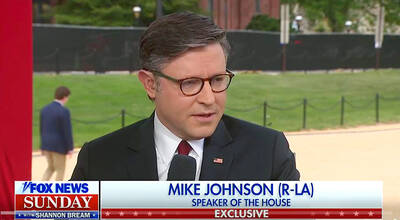
RESOLUTE BACKING: Two Republican senators are planning to introduce legislation that would impose immediate sanctions on China if it attempts to invade Taiwan US House of Representatives Speaker Mike Johnson on Sunday reaffirmed US congressional support for Taiwan, saying the US and “all freedom-loving people” have a stake in preventing China from seizing Taiwan by force. Johnson made the remarks in an interview with Fox News Sunday on US President Donald Trump’s summit with Chinese President Xi Jinping (習近平) last week. In an interview that aired on Friday on Fox News, just as Trump wrapped up a high-stakes visit to China, he said he has yet to green-light a new US$14 billion arms package to Taiwan and that it “depends on China.” “It’s a very good
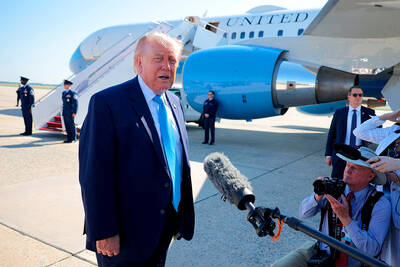
US President Donald Trump yesterday said he would speak to President William Lai (賴清德) as his administration considers whether to move ahead with a US$14 billion weapons sale to Taiwan — a potential arms deal that has drawn criticism from China. “Well, I’ll speak to him. I speak to everybody,” Trump told reporters yesterday when asked if he had any plans to call his counterpart, although he did not offer a time frame for when such a conversation could take place. Trump previously said he would speak to the person “that’s running Taiwan,” without specifying who he meant. “We have that situation very

WARNING: China should stop engaging in actions that undermine regional peace and stability, as it would only build resentment among people across the Strait, the CGA said China has deployed more than 100 navy, coast guard and other vessels in waters from the Yellow Sea to the South China Sea and the western Pacific since US President Donald Trump and Chinese President Xi Jinping (習近平) met in Beijing, National Security Council Secretary-General Joseph Wu (吳釗燮) said yesterday. “In this part of the world, #China is the one & only PROBLEM wrecking the #StatusQuo & threatening regional peace & stability,” Wu wrote on X. In a separate post, he said Beijing was coercing Taiwan’s maritime domain, calling it illegal and provocative, after the Coast Guard Administration (CGA) expelled a


 RSS
RSS