

Taiwan and Japan’s friendship should be expanded in many aspects, the policy chief of Japan’s ruling Liberal Democratic Party (LDP) said in Taipei yesterday, while expressing the hope that Taiwan would be able to join the Comprehensive and Progressive Agreement for Trans-Pacific Partnership (CPTPP).
The LDP’s Policy Research Council chairman Koichi Hagiuda made the remarks during his opening speech at the Japan Taiwan Relationship Sustainability Forum at the Grand Hotel, cohosted by the Ministry of Foreign Affairs’ Taiwan-Japan Relations Association and the Japan-Taiwan Exchange Association.
Hagiuda first thanked the many Taiwanese who paid tribute to late Japanese prime minister Shinzo Abe.
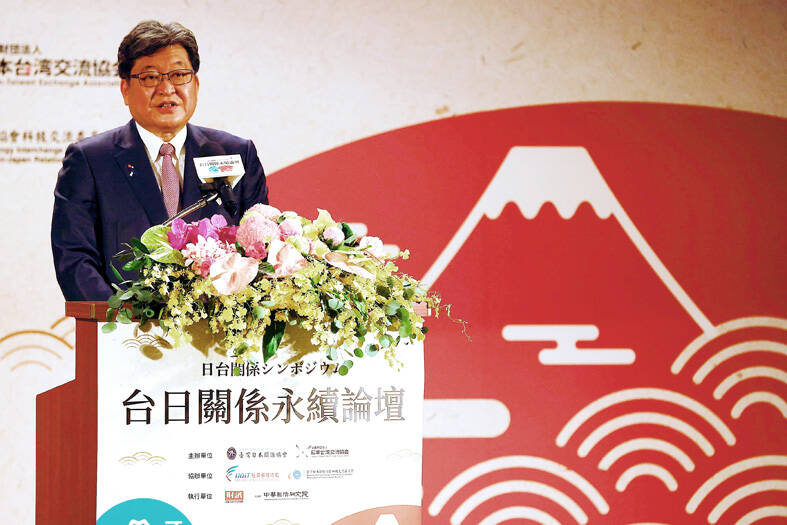
Photo: Ann Wang, Reuters
Taiwan quickly came to Japan’s aid after the 2011 earthquake and tsunami, and Japan sent rescue teams after a big earthquake hit eastern Taiwan in 2018, proving that “a friend in need is a friend indeed,” he said, adding that hopefully that friendship could be deepened and broadened.
On achieving economic security, he said that Japan places importance on establishing free and fair trade, with the CPTPP as the core, so Japan would insist on expanding it globally.
Hagiuda said he supports Taiwan joining the trade bloc.
“We do not want to work with those trading partners that we cannot put our trust in,” he said, adding that this is not the case with Taiwan, as it is a trustworthy trade partner with which Japan shares deep connections.
As the world is striving for net zero emissions, energy supply cooperation would also become an important task, Hagiuda said.
However, solar and wind power are relatively unstable depending on the weather, so Japan is developing hydrogenic energy generation, he said, adding that Japan is the first country to have transported liquid hydrogen in bulk across continents.
Hopefully, Taiwan could become a partner in a global hydrogen supply chain, he said.
Taiwan Semiconductor Manufacturing Co (TSMC, 台積電) provides about 70 percent of the chips for automobiles and other world-leading consumer electronics, so its semiconductor supply chain must not be disrupted and its production should be diversified, Hagiuda said.
A good example of cooperation was the establishment of TSMC’s joint venture Japan Advanced Semiconductor Manufacturing Inc in Japan’s Kumamoto, he said.
The Japanese government has also increased funding for research and innovation in artificial intelligence and quantum technologies, Hagiuda said.
Due to heated global competition for technological hegemony, Japan can only share its most advanced technologies with countries that also value freedom, democracy and human rights, so Taiwan is a trusted partner of Japan, he said.
A new challenge is economic strength being weaponized in diplomacy and security, which would be discussed at the G7 summit in Japan next year, as using economic strength in ways that contravene international rules cannot be tolerated, Hagiuda said.
Regarding the “shared-value island chain” in the western Pacific, Taiwan is closest to China, so peace and stability in the Taiwan Strait is crucial to maintaining a free and open Indo-Pacific region, he added.
LDP Vice President Taro Aso was the last LDP policy chief to visit Taiwan when he held the position in 2003.
Japanese Ambassador to China Sakutaro Tanino, as well as Japanese lawmakers and academics, also attended the forum.
Additional reporting by CNA
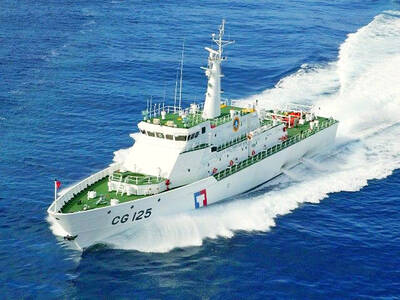
GEOPOLITICAL SIGNIFICANCE: The CGA’s nonmilitary role makes it a tool to avert diplomatic issues, an official said, while confirming the donation of a ship to Manila Coast Guard Administration (CGA) ships are scheduled to sail to the Philippines bearing the words “Taiwan Coast Guard” in a high-profile visit in October next year, the first such visit by a Taiwanese maritime law enforcement vessel to the Southeast Asian nation, the agency said yesterday. The CGA also confirmed that it had donated one of its decommissioned patrol vessels to the Philippines in a rare transfer of a retired ship to a nondiplomatic ally. The Republic of China (ROC) Navy last made such a visit in 1974, shortly before the Philippines switched diplomatic recognition to the People’s Republic of China in

‘GLOBAL WARNING’: The infiltration is not just a local problem, as Beijing has been deploying the same tactics worldwide against Western democracies, a report said Between 50,000 and 100,000 Chinese spies are operating in Taiwan, far more than the National Security Bureau’s previous estimate of 5,000, German journalist and author Jurgen Kremb said on Monday. Kremb presented his research, titled “The War of Spies: How China’s Intelligence Services Are Infiltrating Taiwan — and What Europe Must Learn from It,” at a joint event held by the Taiwan offices of the Friedrich Naumann Foundation and the European Values Center for Security Policy. The report was published in June in the Ministry of Justice Investigation Bureau’s Prospect & Exploration Monthly (展望與探索月刊). By spies, he said he was referring to informants,

PRICE STABILIZATION: The Ministry of Economic Affairs has urged the legislature to support the Cabinet’s supplementary budget for state-owned energy companies State-owned oil supplier CPC Corp, Taiwan (CPC, 台灣中油) on Saturday announced that it would raise domestic gasoline prices by NT$0.7 (US$0.02) per liter and diesel prices by NT$0.6 per liter this week after international crude oil prices rose above US$100 per barrel last week. Formosa Petrochemical Corp (台塑石化) yesterday said that it matched CPC’s price adjustments for this week. The decisions end a six-week period during which CPC and Formosa kept fuel prices in Taiwan unchanged. Retail gasoline prices this week would rise to NT$31.2, NT$32.7 and NT$34.7 per liter for 92, 95 and 98-octane unleaded gasoline respectively at CPC
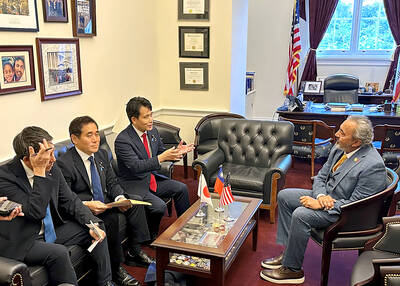
WASHINGTON MEETING: Japan’s Hirofumi Takinami said participants rejected the idea that the US should limit its defensive perimeter to the Second Island Chain US and Japanese lawmakers agree that the US must defend the First Island Chain, including Taiwan, and should not fall back to the Second Island Chain, while “a Taiwan contingency is a Japan contingency and therefore a US-Japan alliance contingency,” media reported after a meeting between officials of the two nations in Washington on Tuesday. A delegation of Japanese lawmakers from the Liberal Democratic Party met with US Senator Thom Tillis, co-chair of the Senate Taiwan Caucus, and US Representative Ami Bera, co-chair of the US Congressional Taiwan caucus, to discuss issues concerning East Asia and the Taiwan Strait. The Japanese and


 RSS
RSS