


Democratic Progressive Party (DPP) Legislator Lo Chih-cheng (羅致政) yesterday proposed a draft amendment to the Civil Servants Election and Recall Act (公職人員選舉罷免法) that would bar people who have been convicted of security breaches from running in national or local elections.
People convicted of offenses relating to organized crime, money laundering, firearms or drugs would be barred from election to civil servant positions if the amendments pass, Lo said on Monday, when the amendments were being drafted.
Since then, further restrictions were added barring candidacies of those who have been found guilty of security breaches under the Anti-infiltration Act (反滲透法), the National Security Act (國家安全法), the Classified National Security Information Protection Act (國家機密保護法) and the National Intelligence Services Act (國家情報工作法).
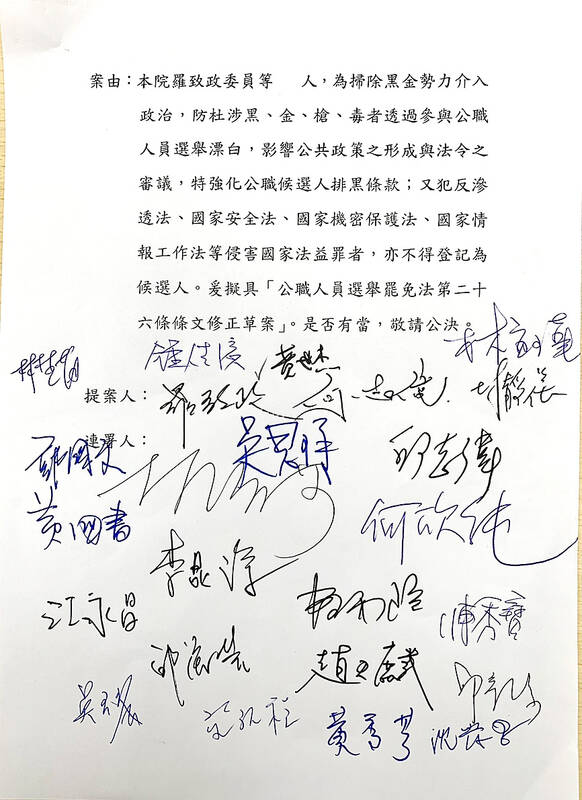
Photo courtesy of Lo Chih-cheng’s office
It is hoped that the amendments can be passed in the next legislative session, to begin in February, and promulgated before the 2024 legislative and presidential elections, he said.
The DPP caucus is waiting to examine similar proposed amendments that are expected from other lawmakers and the Executive Yuan, and would consider integrating their ideas before introducing its own amendment to the legislature, he added.
Lo’s draft is to be submitted to a preliminary committee review rather than undergo procedures for a second reading, as the amendments would have far-reaching effects and require a careful review, he said.
Separately yesterday, Premier Su Tseng-chang (蘇貞昌) instructed the Cabinet to submit its version of the draft amendments by Thursday next week, Executive Yuan spokesman Lo Ping-cheng (羅秉成) said, adding that the Cabinet version is to include input from additional stakeholders.
Lo Ping-cheng said Su has instructed him to supervise and direct the Ministry of Justice and the Ministry of the Interior to submit and pass the draft amendments “as an active response to public expectations” that people with such criminal records would be barred from the next national election.
The proposal is not meant to discriminate against former convicts, but to apply higher standards to those who would have public power and control public resources, the spokesman added.
Additional reporting by Chung Li-hua

‘NO SECURITY RISK’: The Railway Bureau reassured the public that the technicians’ activities were limited to technical guidance and did not involve sensitive systems The Railway Bureau yesterday said it had invited eight Chinese technicians to assist with an airport MRT construction project. The bureau issued the confirmation after an Internet user said Chinese nationals had entered the construction zone of Taiwan Taoyuan International Airport’s Terminal 3 project. They asked why “individuals from an enemy state” were allowed access to such a major national infrastructure project, which raised serious concerns over Taiwan’s industrial safety, sensitive systems and information security. The bureau’s Northern Region Engineering Branch Office said subcontractor Taiwan Handle Industrial Co (台灣手把工業) of the Taoyuan airport MRT’s “Contract No. CU05 Project A14 Station Civil, MEP &

The National Chungshan Institute of Science and Technology yesterday showcased its locally developed variants of the Vision 60 robotic patrol dog, which it plans to deploy on the nation’s outlying territories in the South China Sea. The variants were produced under the Joint Lab project — created by the institute and domestic companies — and assembled with domestically produced motors, lenses and artificial intelligence (AI) systems alongside licensed tech from the US, Missile and Rocket Systems Research Division deputy director Jen Kuo-kang (任國光) told the media event at a military base in Taipei’s Dazhi (大直) area. Taiwan has built up its strengths

NOT IMMEDIATE: Taiwan has a chance to appeal the proposed 10 percent tariff before it starts, while other countries face a 12.5 percent tariff from the trade office Taiwan is among 60 economies determined by the US to have failed to impose or enforce a ban on the importation of goods produced with forced labor, according to a notice released on Tuesday by the Office of the US Trade Representative (USTR), which proposed imposing an additional 10 percent or more tariff on them. The USTR in a statement said that following an investigation, it had determined under Section 301 of the Trade Act of 1974 that the failure of the 60 economies to impose and effectively enforce a prohibition on the importation of goods produced with forced labor is

TIT-FOR-TAT: The US allegedly revoked the visa of a Chinese national working at Xinhua News Agency in the US in response to Beijing’s expulsion of Vivian Wang The Presidential Office yesterday condemned China for expelling a New York Times correspondent from Beijing following the newspaper’s interview with President William Lai (賴清德), saying the move highlighted Beijing’s suppression of press freedom and its threat to international news media. Taiwan has noted a series of recent incidents in which Beijing used similar tactics to “threaten and pressure international media outlets and journalists,” Presidential Office spokeswoman Karen Kuo (郭雅慧) said in a statement. “This concerns not only press freedom and freedom of expression, but also the safety of journalists, and Taiwan and relevant partners are paying close attention to the situation,” she


 RSS
RSS