


The mask mandate for outdoor settings is to lifted on Thursday, and the weekly cap on international inbound travelers is to be removed on Dec. 10, the Central Epidemic Command Center (CECC) said at its regular news conference yesterday.
The center also announced that starting from Friday, children aged five to 11 can receive a COVID-19 vaccine booster, and that rules for visiting hospital patients are to be partially eased from Dec. 10.
While wearing a mask will no longer be mandatory outdoors, Deputy Minister of Health and Welfare Victor Wang (王必勝) reminded the public that it would still be required for indoor spaces, including public transportation, but with two minor changes made.
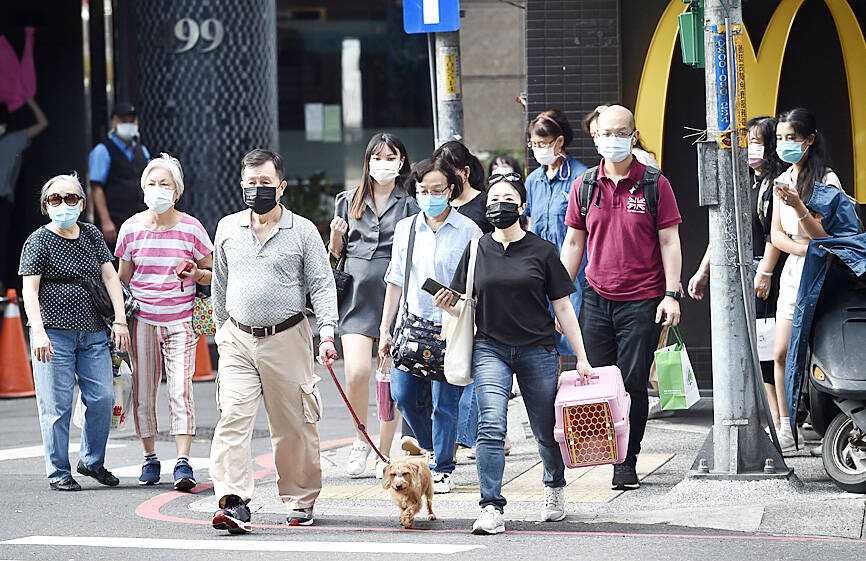
Photo: Peter Lo, Taipei Times
People can remove their masks when singing or giving toasts while making rounds during a banquet, which were temporarily banned because of the COVID-19 outbreak, the CECC head said.
Asked whether masks would be required for outdoor New Year’s events, Wang said that the center would continue to monitor the local COVID-19 situation and announce special rules for certain events, if necessary.
Wearing a mask is recommended when people are in crowded places or for people with allergies, chronic illnesses, a fever or respiratory problems to prevent COVID-19 and other infectious diseases, he said, adding that Thursday would mark the 555th day since the mask mandate was implemented.
Starting from Dec. 10, the cap on international inbound travelers is to be removed, as the local outbreak has slowed and imported cases have dropped, which should give people time to make plans for the upcoming holidays, he said.
Centers for Disease Control (CDC) Deputy Director-General Chuang Jen-hsiang (莊人祥) said that starting on Friday, children aged six to 11 who have received the primary series (two doses) of the Moderna or Pfizer-BioNTech vaccines can get Moderna’s Omicron BA.4/BA.5-adapted bivalent COVID-19 vaccine as a booster dose.
Children aged five can receive the Pfizer-BioNTech vaccine for children as a booster dose, which must be at least 84 days after their last dose of the primary series, the CECC spokesman said.
The center is working with local education and health departments to arrange for vaccinations on school campuses for five to 11 year olds, he said.
CDC Deputy Director-General Philip Lo (羅一鈞), deputy head of the CECC’s medical response division, said that from Dec. 10, visits to all hospital departments would be allowed.
Visits are currently limited to certain departments, such as intensive care units and hospice wards.
However, they would only be able to visit once a day within a set period and only two visitors would be allowed each time.
Exceptions would be made if they are visiting a patient who is to undergo surgery, an invasive exam or treatment or needs a signed consent or to be accompanied, the CECC said.
Visitors will have to present a negative COVID-19 rapid test result, wear a mask and practice hand hygience, Lo said.
Visitors who have been diagnosed with COVID-19 within three months can be exempt from showing a negative test result, but they should make the visit at least 15 days from their last diagnosis, Lo said, adding that people who are practicing self-disease prevention should avoid visiting, unless they test negative and are granted permission by the hospital.

‘NO SECURITY RISK’: The Railway Bureau reassured the public that the technicians’ activities were limited to technical guidance and did not involve sensitive systems The Railway Bureau yesterday said it had invited eight Chinese technicians to assist with an airport MRT construction project. The bureau issued the confirmation after an Internet user said Chinese nationals had entered the construction zone of Taiwan Taoyuan International Airport’s Terminal 3 project. They asked why “individuals from an enemy state” were allowed access to such a major national infrastructure project, which raised serious concerns over Taiwan’s industrial safety, sensitive systems and information security. The bureau’s Northern Region Engineering Branch Office said subcontractor Taiwan Handle Industrial Co (台灣手把工業) of the Taoyuan airport MRT’s “Contract No. CU05 Project A14 Station Civil, MEP &

The National Chungshan Institute of Science and Technology yesterday showcased its locally developed variants of the Vision 60 robotic patrol dog, which it plans to deploy on the nation’s outlying territories in the South China Sea. The variants were produced under the Joint Lab project — created by the institute and domestic companies — and assembled with domestically produced motors, lenses and artificial intelligence (AI) systems alongside licensed tech from the US, Missile and Rocket Systems Research Division deputy director Jen Kuo-kang (任國光) told the media event at a military base in Taipei’s Dazhi (大直) area. Taiwan has built up its strengths

NOT IMMEDIATE: Taiwan has a chance to appeal the proposed 10 percent tariff before it starts, while other countries face a 12.5 percent tariff from the trade office Taiwan is among 60 economies determined by the US to have failed to impose or enforce a ban on the importation of goods produced with forced labor, according to a notice released on Tuesday by the Office of the US Trade Representative (USTR), which proposed imposing an additional 10 percent or more tariff on them. The USTR in a statement said that following an investigation, it had determined under Section 301 of the Trade Act of 1974 that the failure of the 60 economies to impose and effectively enforce a prohibition on the importation of goods produced with forced labor is

RIGHT DIRECTION: Taiwan’s efforts to prevent forced labor include a proposal to ‘fully prohibit’ employers from withholding workers’ documents, an official said Taiwan is to establish a mechanism to restrict imports of goods linked to forced labor, the Executive Yuan said yesterday, after the US proposed imposing additional tariffs on Taiwanese goods over labor concerns. “The Ministry of Labor and the Ministry of Economic Affairs are to establish an interministerial review procedure,” Executive Yuan spokesperson Michelle Lee (李慧芝) said at a news briefing in Taipei. “The government is to use the Foreign Trade Act [貿易法] as the legal basis to restrict imports of goods produced with forced labor” and bring its supply chain governance more in line with international standards on human rights, resilience


 RSS
RSS