


Candidates for local office yesterday held rallies and canvassed the streets to garner last-minute support ahead of today’s nine-in-one local elections.
On the ballot are more than 22,000 seats for local government posts, including city mayors, county commissioners, city and county councilors, township mayors and borough and village wardens.
A referendum to amend the Constitution to lower the voting age from 20 to 18 is also to be voted on, requiring a majority of eligible voters — or 9.65 million people — to pass.
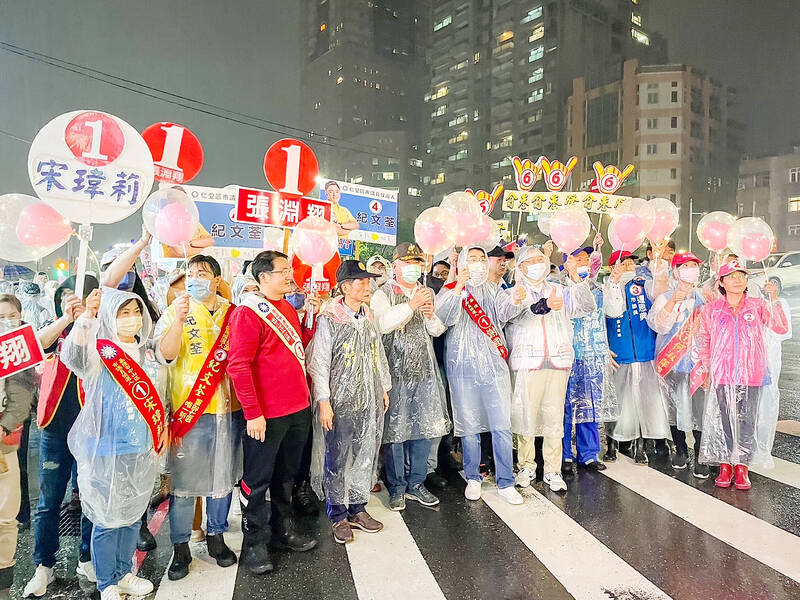
Photo provided by Hsieh Kuo-liang’s campaign
About 19.13 million people — or more than 82 percent of the population — are eligible to participate in the elections, while 19.24 million are eligible to vote in the referendum. About 760,000 are for the first time eligible to cast their ballots.
Polling stations are open from 8am to 4pm, with the Central Election Commission saying it hopes to count all votes by the evening.
Local election results are to be counted before the referendum.
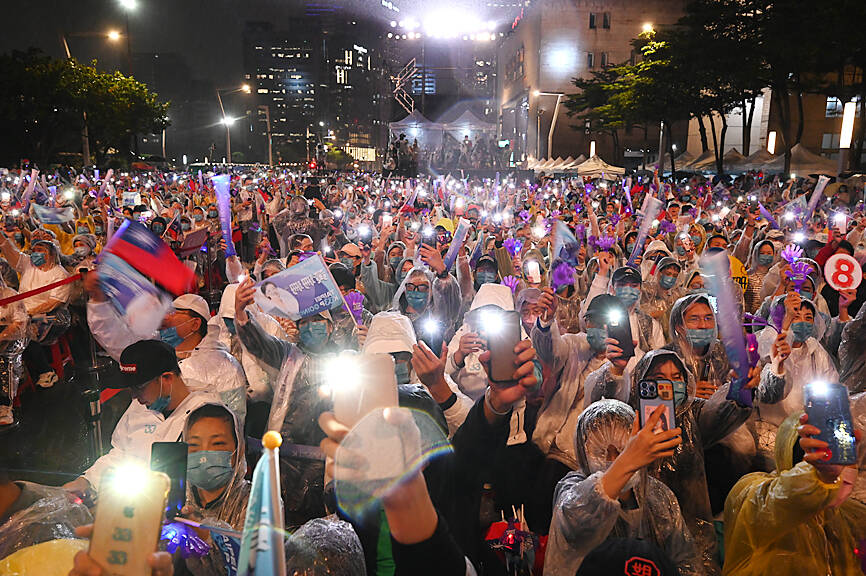
Photo: Tien Su-hua, Taipei Times
The hottest contests are in northern Taiwan, with top party figures rallying last night in Taipei, New Taipei City, Taoyuan, Keelung and Hsinchu.
The Democratic Progressive Party (DPP) is hoping to eke out a win in Taipei with mayoral candidate Chen Shih-chung (陳時中), who led the nation’s COVID-19 response as minister of health and welfare, and maintain control of the top roles in Taoyuan, Tainan, Kaohsiung, Keelung, Hsinchu, Pingtung County and Chiayi County.
Meanwhile, the Chinese Nationalist Party (KMT) is looking to hold on to its 14 mayoral seats and flip those in Taoyuan and Taipei, where its candidate is Chiang Wan-an (蔣萬安).
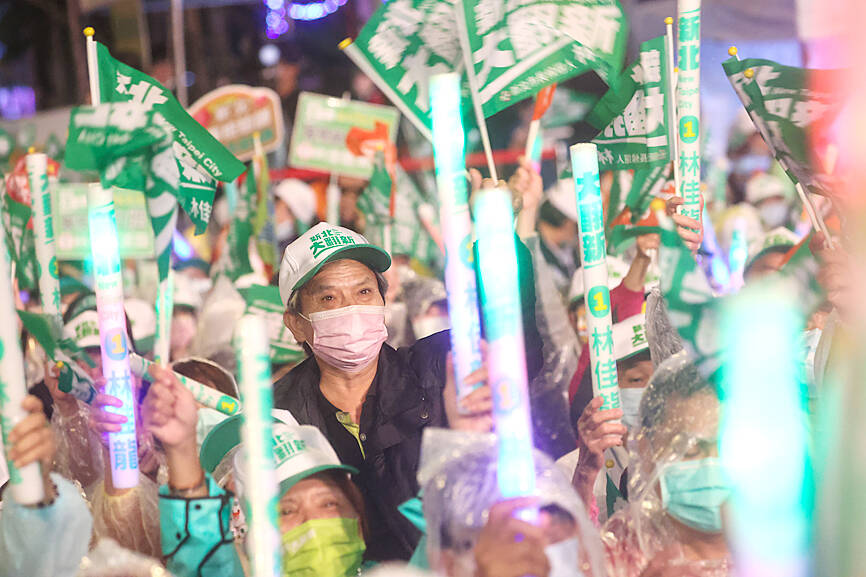
Photo: CNA
The Taiwan People’s Party (TPP) was focusing on mayoral races in Hsinchu and Taipei, where its leadership endorsed independent candidate Vivian Huang (黃珊珊).
President Tsai Ing-wen (蔡英文) lent her presence on stage to consolidate pan-green camp supporters for party candidates Lin Chia-lung (林佳龍) in New Taipei City and Chen in Taipei.
“Lin is the best candidate and deserves your vote, and he has good policies to make changes to improve this city,” she said. “When every one of you goes to cast your ballot tomorrow, we can have victory and see a complete transformation for New Taipei City,” Tsai said.
The rain did not dampen the enthusiasm of the crowds, with organizers estimating at least 20,000 at Lin’s event in New Taipei City’s Banciao District (板橋) and about 35,000 at Chen’s rally near DPP headquarters in Taipei.
After Tsai’s departure for the Taipei rally, Vice President William Lai (賴清德) followed up with a speech also calling to support DPP city councilor candidates in Taipei and elsewhere.
At the KMT rally at the Taiwan Cement Songshan property on Keelung Road in Taipei last night, organizers said that 25,000 people came to support Chiang.
KMT Chairman Eric Chu (朱立倫) and former president Ma Ying-jeou (馬英九) spent the day stumping in Taipei, Keelung, Hsinchu County and Taoyuan.
The party has also funneled considerable attention to KMT mayoral candidate Hsieh Kuo-liang (謝國樑) in Keelung, an electoral battleground since the 1990s that saw the KMT and the DPP alternatively carrying the mayoral seat.
Taoyuan was another former pan-blue camp stronghold that the KMT governed from 2001 through 2009. With DPP Mayor Cheng Wen-tsan (鄭文燦) reaching his term limit, KMT candidate and former premier Simon Chang (張善政) has an opening to recapture the jurisdiction.
Taipei Mayor and TPP Chairman Ko Wen-je (柯文哲) for the past two days canvassed for Huang, his former deputy.
Yesterday, Ko first went to Hsinchu to attend the final rally of TPP mayoral candidate Ann Kao (高虹安) before making his way back to Taipei to support Huang at her final campaign rally.
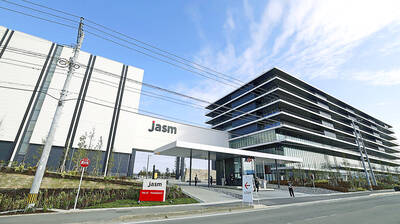
The subsidiary of Taiwan Semiconductor Manufacturing Co (TSMC, 台積電) in Kumamoto, Japan, turned a profit in the first quarter of this year, marking the first time the first fab of the unit has become profitable since mass production started at the end of 2024. According to the contract chipmaker’s financial statement released on Friday, Japan Advanced Semiconductor Manufacturing Inc (JASM), a joint venture running the fab in Kumamoto, posted NT$951 million (US$30.19 million) in profit in the January-to-March period, compared with a loss of NT$1.39 billion in the previous quarter, and a loss of NT$3.25 billion in the first quarter of

DRONE CENTRAL: Taiwan aims to become Asia’s democratic hub for drones, with most exports focused on high-quality military-grade models, an official said Taiwan’s drone industry is expected to expand significantly by 2030, producing 100,000 units per month and exporting half of them, the Ministry of Economic Affairs said yesterday. Current drone production capacity is about 15,000 units per month, but the industry can quickly scale up as demand increases, Industrial Development Administration Director-General Chiou Chyou-huey (邱求慧) told a news conference in Taipei. Taiwan’s drone output grew 2.5-fold last year to NT$12.9 billion (US$408.3 million) under a government program to develop the uncrewed vehicle sector, he said. The Executive Yuan in October last year approved plans to invest NT$44.2 billion into domestic production of uncrewed aerial
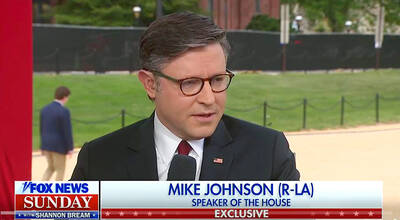
RESOLUTE BACKING: Two Republican senators are planning to introduce legislation that would impose immediate sanctions on China if it attempts to invade Taiwan US House of Representatives Speaker Mike Johnson on Sunday reaffirmed US congressional support for Taiwan, saying the US and “all freedom-loving people” have a stake in preventing China from seizing Taiwan by force. Johnson made the remarks in an interview with Fox News Sunday on US President Donald Trump’s summit with Chinese President Xi Jinping (習近平) last week. In an interview that aired on Friday on Fox News, just as Trump wrapped up a high-stakes visit to China, he said he has yet to green-light a new US$14 billion arms package to Taiwan and that it “depends on China.” “It’s a very good
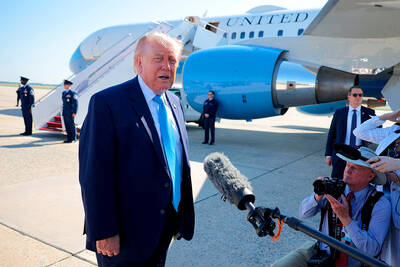
US President Donald Trump yesterday said he would speak to President William Lai (賴清德) as his administration considers whether to move ahead with a US$14 billion weapons sale to Taiwan — a potential arms deal that has drawn criticism from China. “Well, I’ll speak to him. I speak to everybody,” Trump told reporters yesterday when asked if he had any plans to call his counterpart, although he did not offer a time frame for when such a conversation could take place. Trump previously said he would speak to the person “that’s running Taiwan,” without specifying who he meant. “We have that situation very


 RSS
RSS