


The navy’s La Fayette-class frigates are to undergo NT$43.15 billion (US$1.35 billion) in combat systems upgrades over nine years to bolster their anti-surface capabilities, a military source said yesterday.
The project is also a first attempt to integrate Taiwan-based weaponry with French combat systems, the source said on condition of anonymity.
The first of six La Fayette ships was delivered to Taiwan and began service in 1996. Some of the existing systems on the ships would not be able to take on the threat facing Taiwan in the 21st century, the source said, adding that the navy has been making a series of upgrades to various ship systems to help prolong their service life.
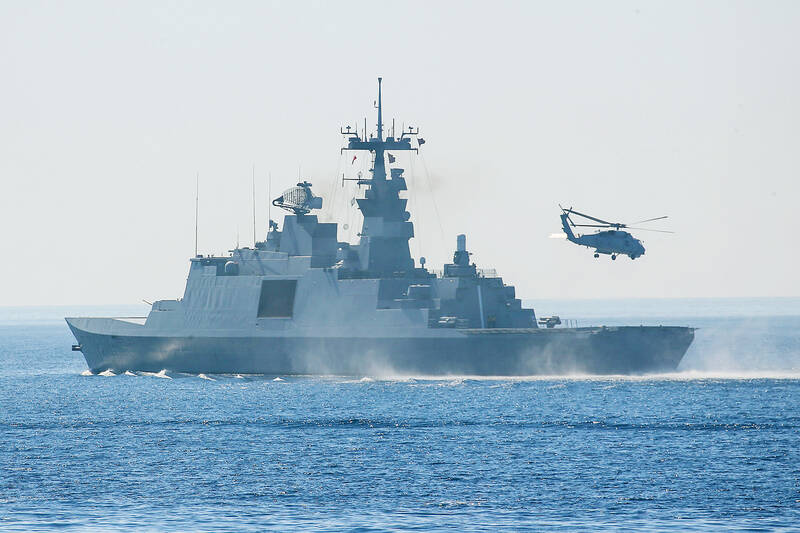
Photo: CNA
The proposed combat system upgrades would swap out aging combat and radar systems, as well as anti-air missiles, the source said.
The RIM-72C Sea Chapparal missiles that the ships came with would be replaced with medium-range naval variants of the Tian Jian-II (“Sky Sword,” 天劍) missile developed by the Chungshan Institute of Science and Technology, the person said.
The missiles would be launched using a vertical launch system, which would be installed below deck at the ship’s prow, the source said, adding that the navy expects the refitting to be completed by 2030.
The first phase of the frigate project has been budgeted at NT$9.73 billion for next year, the source said.
The navy is to select one of the six ships and introduce new hardware from Naval Group, the French defense company that built the ships, and use the new system to issue orders to Sky Sword and Hsiung Feng-III (“Brave Wind,” 雄風) anti-ship missiles, the source said.
The navy anticipates some difficulties in integrating multiple systems and would give the project an assessment period of three years, the person said.
Should the trial prove successful and the results align with the navy’s combat needs, the navy would begin upgrading the rest of the fleet of La Fayette ships, the person added.
The navy confirmed that it was conducting upgrades of the La Fayette ships.
All six ships have undergone communications and engineering upgrades, and four ships that have completed the upgrades have been tested, while the other two are expected to be finished by the end of this year, the navy said.
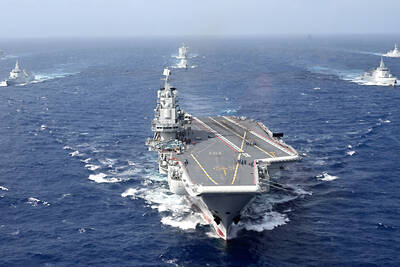
PROVOCATIVE: Chinese Deputy Ambassador to the UN Sun Lei accused Japan of sending military vessels to deliberately provoke tensions in the Taiwan Strait China denounced remarks by Japan and the EU about the South China Sea at a UN Security Council meeting on Monday, and accused Tokyo of provocative behavior in the Taiwan Strait and planning military expansion. Ayano Kunimitsu, a Japanese vice foreign minister, told the Council meeting on maritime security that Tokyo was seriously concerned about the situation in the East China and South China seas, and reiterated Japan’s opposition to any attempt to change the “status quo” by force, and obstruction of freedom of navigation and overflight. Stavros Lambrinidis, head of the EU delegation to the UN, also highlighted South China Sea
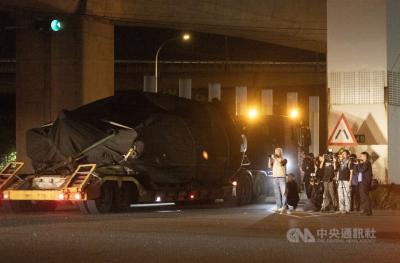
The final batch of 28 M1A2T Abrams tanks purchased from the US arrived at Taipei Port last night and were transported to the Armor Training Command in Hsinchu County’s Hukou Township (湖口), completing the military’s multi-year procurement of 108 of the tanks. Starting at 12:10am today, reporters observed more than a dozen civilian flatbed trailers departing from Taipei Port, each carrying an M1A2T tank covered with black waterproof tarps. Escorted by military vehicles, the convoy traveled via the West Coast Expressway to the Armor Training Command, with police implementing traffic control. The army operates about 1,000 tanks, including CM-11 Brave Tiger
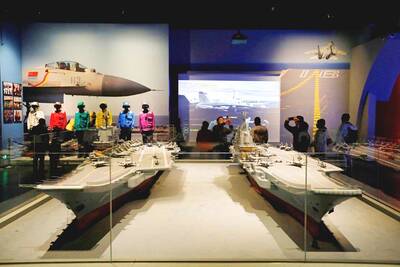
China on Wednesday teased in a video an aircraft carrier that could be its fourth, and the first using nuclear power, while making an allusion to Taiwan and vowing to further build up its islands, as it looks to boost maritime power, secure resources and bolster territorial claims. The video, issued on the eve of the 77th founding anniversary of the Chinese People’s Liberation Army Navy, featured fictional officers with names that are homophones of three commissioned aircraft carriers, the Liaoning (遼寧), Shandong (山東) and Fujian (福建). Titled Into the Deep, it showed a 19-year-old named “Hejian” (何劍) joining the group, sparking
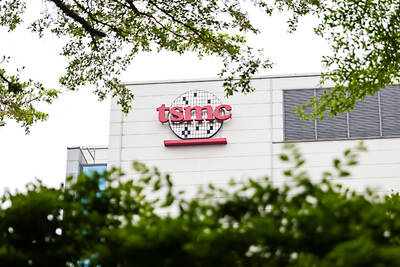
Taiwan Semiconductor Manufacturing Co (TSMC, 台積電), the world’s largest contract chipmaker, said it expects its 2-nanometer (2nm) chip capacity to grow at a compound annual rate of 70 percent from this year to 2028. The projection comes as five fabs begin volume production of 2-nanometer chips this year — two in Hsinchu and three in Kaohsiung — TSMC senior vice president and deputy cochief operating officer Cliff Hou (侯永清) said at the company’s annual technology symposium in Silicon Valley, California, last week. Output in the first year of 2-nanometer production, which began in the fourth quarter of last year, is expected to


 RSS
RSS