


Nearly 250 foreign tourists from six Asian countries are to arrive in Taiwan today after the government from today relaxes COVID-19 border controls, lifting the quarantine mandate, but ordering seven days of self-initiated disease prevention, the Tourism Bureau said yesterday.
Twenty package tour groups organized in Japan, South Korea, Vietnam, Malaysia and Singapore, as well as five from Thailand, are to arrive, with 244 people between them, the bureau said.
The first group is scheduled to arrive at Taiwan Taoyuan International Airport from Thailand at 12:10am, the bureau said, adding that they are on a four-day tour.
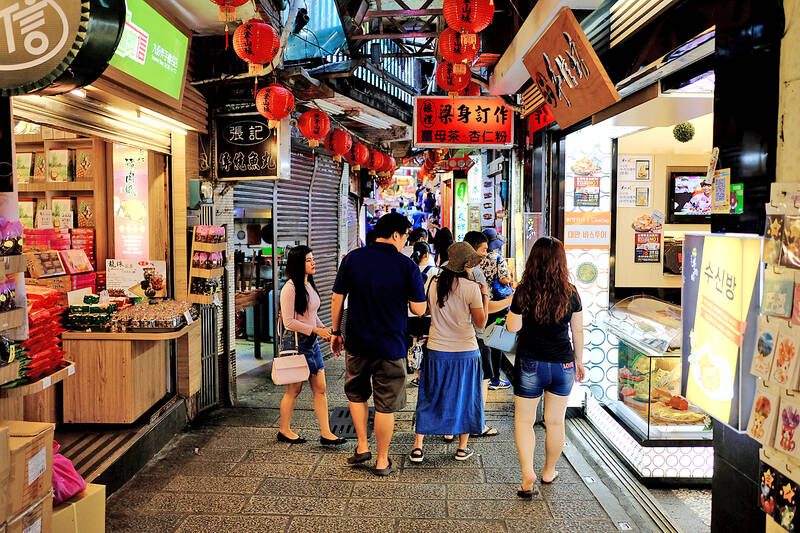
Photo: Lin Hsin-han, Taipei Times
Welcome Holiday (惠康旅行社), the Taiwanese travel agency that arranged the tour for the first group, said all 29 spots available on the tour were sold in three hours.
Meanwhile, the first outbound tour group after the border rules change is to depart for Malaysia at 8:10am for a four-day tour of Penang State, said Lion Travel (雄獅旅行社), the travel agency organizing the tour.
There are 230 more foreign tour groups scheduled to arrive from Friday to the end of this month, which combined would bring 3,630 international tourists, the bureau said.
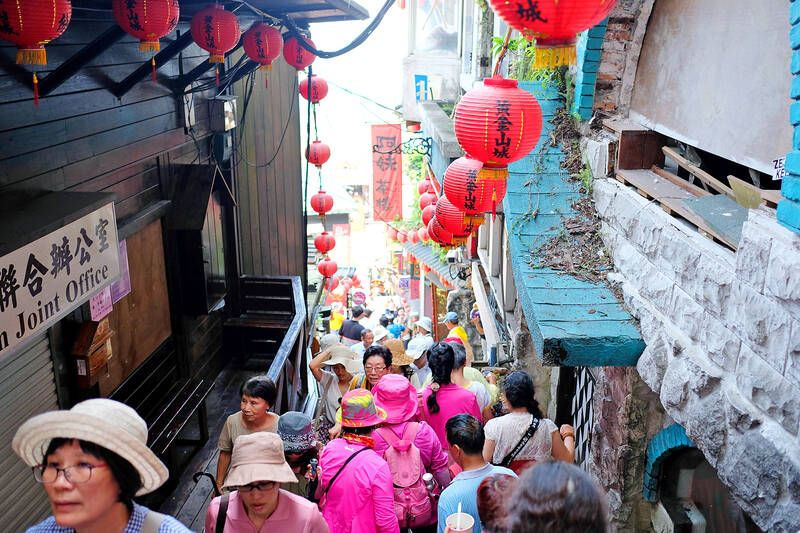
Photo: Lin Hsin-han, Taipei Times
Tourism Bureau Director-General Chang Shi-chung (張錫聰) would welcome the first inbound group at the airport’s Terminal 1, with each member of the group to receive a souvenir, the bureau said.
President Tsai Ing-wen (蔡英文), and Deputy Minister of Health and Welfare Victor Wang (王必勝), who heads the Central Epidemic Command Center (CECC), are to inspect operations at the nation’s largest international airport, it said.
The airport is to be accessed today by 12,322 inbound passengers, 6,238 outbound passengers and 5,586 transit passengers, Taoyuan International Airport Corp said, citing reports from airlines.
From 12am, all restrictions to access the airport’s dining areas, duty-free shops, showering facilities, outdoor smoking areas and observation decks would be lifted, the company said.
Inbound passengers who show no symptoms of COVID-19 can access public transport, the company said, adding that those taking airport taxis would be charged according to the meter.
Civil Aeronautics Administration Director-General Lin Kuo-hsien (林國顯) said that about 10,000 air travelers are to access the international airports in Taipei, Taichung and Kaohsiung, including about 800 people arriving or departing on eight international flights.
From today, domestic air travelers can use lavatories aboard planes, Lin said, adding that observation decks at the airports in Taipei and Kaohsiung would be reopened to the public.
“We want to remind travelers that the COVID-19 pandemic is not completely over,” Lin said. “Passengers still need to wear a mask when they are in airports and should clean their hands with alcohol at entrances.”
“Inbound travelers should pick up four COVID-19 rapid test kits upon arrival and use them while they are in self-initiated disease prevention,” he said.
Minister of Transportation and Communications Wang Kwo-tsai (王國材) said that having so many inbound tourists arriving on the first day of the border reopening is a good start.
Taiwan is welcoming tourists from around the world, he said, adding that hopefully the number of international tourists would quickly return to pre-pandemic levels.
Based on CECC guidelines, arriving travelers would be screened for COVID-19 using rapid test kits on the day they arrive.
The self-initiated prevention period can be conducted in hotels or residences of the passengers themselves, relatives or friends, provided that they meet the criteria of “one person, one room.”
During self-initiated prevention, inbound travelers should avoid contact with people with high risk of severe illness, including people over 65, children under six and immunocompromised people.
They should avoid visiting or taking care of patients in hospitals and long-term care facilities, and are advised to postpone non-urgent medical exams or treatment.
Asymptomatic people must test negative with a rapid test kits within two days before going outside.
They should wear a mask at all times at work and observe social distancing guidelines.
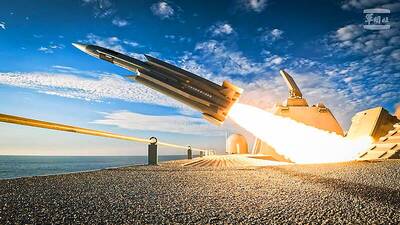
DETERRENCE: With 1,000 indigenous Hsiung Feng II and III missiles and 400 Harpoon missiles, the nation would boast the highest anti-ship missile density in the world With Taiwan wrapping up mass production of Hsiung Feng II and III missiles by December and an influx of Harpoon missiles from the US, Taiwan would have the highest density of anti-ship missiles in the world, a source said yesterday. Taiwan is to wrap up mass production of the indigenous anti-ship missiles by the end of year, as the Chungshan Institute of Science and Technology has been meeting production targets ahead of schedule, a defense official with knowledge of the matter said. Combined with the 400 Harpoon anti-ship missiles Taiwan expects to receive from the US by 2028, the nation would have
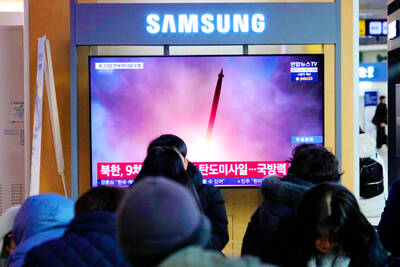
North Korea yesterday fired about 10 ballistic missiles to the sea toward Japan, the South Korean Joint Chiefs of Staff (JCS) said, days after Pyongyang warned of “terrible consequences” over ongoing South Korea-US military drills. Pyongyang recently dashed hopes of a diplomatic thaw with Seoul, Washington’s security ally, describing its latest peace efforts as a “clumsy, deceptive farce.” Seoul’s military detected “around 10 ballistic missiles launched from the Sunan area in North Korea toward the East Sea [Sea of Japan] at around 1:20pm,” JCS said in a statement, referring to South Korea’s name for the body of water. The missiles

‘UNWAVERING FRIENDSHIP’: A representative of a Japanese group that co-organized a memorial, said he hopes Japanese never forget Taiwan’s kindness President William Lai (賴清德) yesterday marked the 15th anniversary of the Tohoku earthquake and tsunami, urging continued cooperation between Taiwan and Japan on disaster prevention and humanitarian assistance. Lai wrote on social media that Taiwan and Japan have always helped each other in the aftermath of major disasters. The magnitude 9 earthquake struck northeastern Japan on March 11, 2011, triggering a massive tsunami that claimed more than 19,000 lives, according to data from Japanese authorities. Following the disaster, Taiwan donated more than US$240 million in aid, making it one of the largest contributors of financial assistance to Japan. In addition to cash donations and
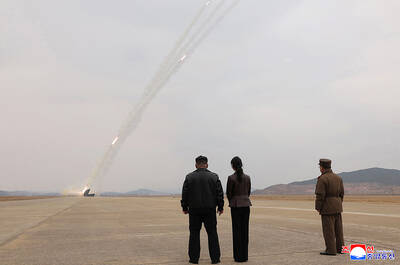
North Korea tested nuclear-capable rocket launchers, state media reported yesterday, a day after Seoul detected the launch of about 10 ballistic missiles. The test comes after South Korean and US forces launched their springtime military drills, due to run until Thursday. North Korean leader Kim Jong-un on Saturday oversaw the testing of the multiple rocket launcher system (MRLS), the Korean Central News Agency (KCNA) said. The test involved 12 600mm-caliber ultra-precision multiple rocket launchers and two artillery companies, it said. Kim said the drill gave Pyongyang’s enemies, within the 420km striking range, a sense of “uneasiness” and “a deep understanding


 RSS
RSS