


Russian President Vladimir Putin has signed laws formally absorbing four Ukrainian regions into Russia, even as its military struggles to control the territory that was illegally annexed.
The documents finalizing the annexation, carried out in defiance of international law, were published on a Russian government Web site yesterday morning.
Earlier this week, both houses of the Russian parliament ratified treaties making the Donetsk, Luhansk, Kherson and Zaporizhzhia regions part of Russia. That followed Kremlin-orchestrated “referendums” in the four regions, which Ukraine and the West have rejected as a sham.

Photo: AFP
The EU has agreed a new round of sanctions against Russia after Moscow’s annexation of the regions, the Czech presidency of the bloc said yesterday.
The latest package — the eighth since Russia’s invasion in February — is going through a final approval procedure which, if no objections emerge, would be published and come into effect today, the Czech EU ambassador said on Twitter.
Ukrainian President Volodymyr Zelenskiy responded to the annexation by announcing a fast-track application to join NATO and formally ruling out talks with Russia.
Zelenskiy’s decree, released on Tuesday, declares that holding negotiations with Putin has become impossible after his decision to take over the four regions of Ukraine.
The head of Zelenskiy’s office, Andriy Yermak, wrote on his Telegram channel shortly after Putin signed the annexation that “the worthless decisions of the terrorist country are not worth the paper they are signed on.”
“A collective insane asylum can continue to live in a fictional world,” he added.
On the ground, Moscow’s war in Ukraine has entered a new, more dangerous phase. Russia faces mounting setbacks, with Ukrainian forces retaking more land in the east and south — the very regions Moscow has pushed to annex.
The borders of the territories Russia is claiming still remain unclear, but the Kremlin has vowed to defend Russia’s territory — as well as the newly absorbed regions — with any means at its disposal, including nuclear weapons.
Russia and Ukraine yesterday gave conflicting assessments of a Ukrainian offensive in the strategic southern Kherson region — one of the four areas that Russia is annexing.
A Russian-installed official in the Kherson region said that Ukrainian advances in the region have been halted.
Kirill Stremousov, in comments to state-run news agency RIA Novosti, said that “as of this morning ... there are no movements” by Kyiv’s forces.
He vowed that “they won’t enter Kherson, it is impossible.”
However, Kyiv’s military said it has recaptured more villages in the Kherson region as a part of its massive counteroffensive effort.
Operational Command South said that the Ukrainian flag has been raised above seven villages previously occupied by the Russians.
On the battlefield yesterday morning, multiple explosions rocked Bila Tserkva, setting off fires at what were described as infrastructure facilities in the city to the south of the capital, Kyiv, regional leader Oleksiy Kuleba said on Telegram.
Early indications are that the city was attacked by so-called kamikaze or suicide drones, he said.
Bila Tserkva is about 80km south of Kyiv.
Additional reporting by AFP

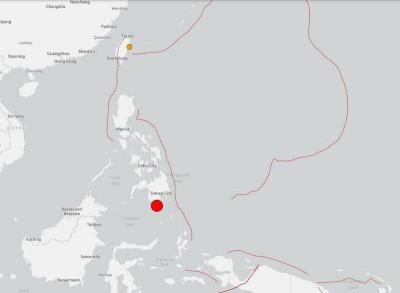
A magnitude 7.8 earthquake struck off the southern coast of Mindanao in the Philippines at 7:38am today, prompting the US Tsunami Warning System to issue an alert for neighboring countries, including Taiwan. The system issued a purple alert indicating a "tsunami threat." The potential threat zone includes Taiwan, the Philippines, Papua New Guinea, Yap and Palau. Philippine authorities were assessing the damage from the quake, with the office of civil defense seeking to verifying initial reports that 15 people had been killed and 129 injured in the region, mostly from falling debris. Arlene Hollero, disaster chief of Maasim town in the Philippines' Sarangani Province,
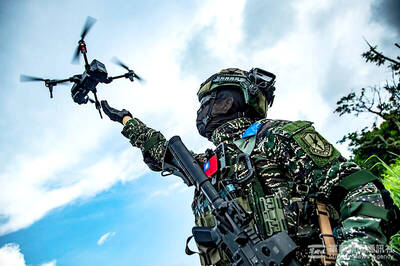
RESILIENCE: Taiwan plays a key role in semiconductors, energy, information infrastructure and advanced manufacturing, AIT Director Raymond Greene said Taiwan’s continued investment in deterrence and resilience remains vital, especially in uncrewed systems and other emerging technologies, American Institute in Taiwan (AIT) Director Raymond Greene said yesterday. Greene made the remarks at the annual National Strategic Summit on Supply Chain Resilience held by the Research Institute for Democracy, Society and Emerging Technology (DSET), a government-backed think tank. As Taiwan last year became the US’ fourth-largest trading partner and supply chain security is becoming more important, cooperation in emerging technologies continues to deepen between the two countries, he said. The US is committed to accelerating innovation, building key infrastructure, strengthening cooperation

‘GRAY ZONE’ PRESSURE: Beijing’s activities are intended to create the deceitful impression that China has jurisdiction over the area around Taiwan, the CGA said Taiwan’s rights over its territorial waters and exclusive economic zone must not be violated by any country, the Mainland Affairs Council said yesterday, adding that it will not accept any unprovoked actions. The council issued the remarks in response to the China Coast Guard conducting maritime enforcement drills near eastern Taiwan and claiming to fully exercise China’s maritime administrative law enforcement authority. The Coast Guard Administration (CGA) has been closely monitoring the situation and is taking concrete steps to defend the nation’s sovereignty and secure its waters, the council said. China has no sovereign rights over the waters off eastern

The National Chungshan Institute of Science and Technology yesterday showcased its locally developed variants of the Vision 60 robotic patrol dog, which it plans to deploy on the nation’s outlying territories in the South China Sea. The variants were produced under the Joint Lab project — created by the institute and domestic companies — and assembled with domestically produced motors, lenses and artificial intelligence (AI) systems alongside licensed tech from the US, Missile and Rocket Systems Research Division deputy director Jen Kuo-kang (任國光) told the media event at a military base in Taipei’s Dazhi (大直) area. Taiwan has built up its strengths


 RSS
RSS