


US Secretary of State Antony Blinken on Friday called for calm over Taiwan when he met his Chinese counterpart, as cross-strait tensions showed signs of easing a notch.
Blinken met for 90 minutes with Chinese Minister of Foreign Affairs Wang Yi (王毅) in New York on the sidelines of the UN General Assembly, in talks a US official described as “extremely candid” and focused largely on Taiwan.
Blinken “stressed that preserving peace and stability across the Taiwan Strait is critical to regional and global security and prosperity,” the US Department of State said in a statement.
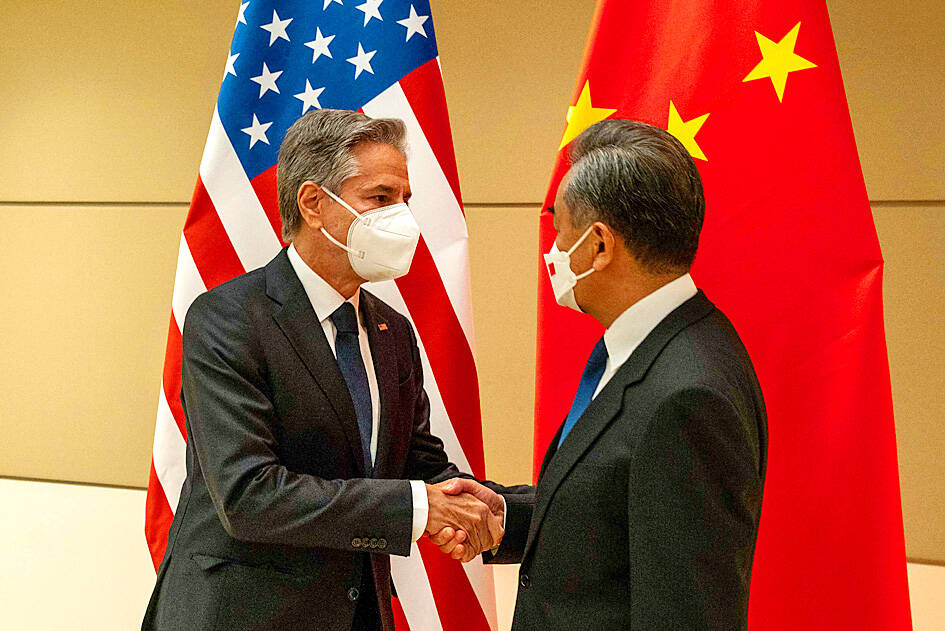
Photo: AFP
He “discussed the need to maintain open lines of communication and responsibly manage the US-PRC relationship, especially during times of tension,” it added, using the acronym for the People’s Republic of China.
A State Department official described the exchange as “direct and honest.”
The official said that Blinken also renewed US warnings not to support Russia’s invasion of Ukraine, amid guarded US hopes that Beijing is keeping a distance from Moscow, nominally its ally.
Blinken met Wang for the first time since a sit-down in July in Bali, Indonesia, where both appeared optimistic regarding stability.
One month later, US House of Representatives Speaker Nancy Pelosi visited Taiwan, infuriating Beijing, which in response staged military exercises seen as a trial run for an invasion.
US President Joe Biden in an interview aired last Sunday said he was ready to intervene militarily if China uses force in Taiwan, once again deviating from decades of US ambiguity.
In the meeting with Blinken, Wang accused the US of “sending very wrong and dangerous signals” that encourage “Taiwan independence,” the Chinese Ministry of Foreign Affairs said in a readout.
Wang told Blinken that China wished for “peaceful reunification” with Taiwan and warned that “the more rampant ‘Taiwan independence’ activities are, the less likely a peaceful solution would be,” it added.
The US official said Blinken insisted to Wang that “there has been no change” to the US policy of only recognizing Beijing and voiced opposition to “unilateral changes to the status quo” by either side.
In a sign that tensions have eased, Wang also met in New York with US Special Presidential Envoy for Climate John Kerry, despite China’s announcement after Pelosi’s visit that it was curbing cooperation with the US on climate issues, a key priority for Biden.
In a speech before his talks with Blinken, Wang called Taiwan “the biggest risk in China-US relations,” and accused the US of stoking “pro-independence forces.”
“Taiwan independence is like a highly disruptive great rhinoceros charging toward us. It must be stopped resolutely,” he said at a meeting of the Asia Society think tank on Thursday.
“Just as the US will not allow Hawaii to be stripped away, China has the right to uphold the unification of the country,” he said.
However, Wang was conciliatory toward Biden. The New York talks are expected to lay the groundwork for a first in-person meeting between Biden and Chinese President Xi Jinping (習近平) since they became their two countries’ leaders, likely in Bali in November on the sidelines of a summit of the G20 economic powers.
Wang said that Biden and Xi seek to “make the China-US relationship work” and to “steer clear of conflict and confrontation.”
In Taipei, the Ministry of Foreign Affairs yesterday expressed “gratitude to the US and other international friends for their support of Taiwan and their concern for peace and stability across the Taiwan Strait.”
The international attention on the Taiwan Strait is crucial to obstructing attempts by China to expand its territory, the ministry said.
China frequently cites visits to Taiwan by international officials, support in the international community for Taiwan’s participation in international organizations, and UN General Assembly Resolution No. 2758 as excuses to engage in acts of aggression toward Taiwan, it said.
Wang’s statement at the Asia Society that the “interference and connivance of the United States” had emboldened “Taiwanese independence forces” was an example of China’s conflation of the issues, the ministry said.
Wang’s justification of aggression toward Taiwan under the pretense of the so-called “one China” principle was “contemptible,” it added.
Additional reporting by Yang Cheng-yu

‘NO SECURITY RISK’: The Railway Bureau reassured the public that the technicians’ activities were limited to technical guidance and did not involve sensitive systems The Railway Bureau yesterday said it had invited eight Chinese technicians to assist with an airport MRT construction project. The bureau issued the confirmation after an Internet user said Chinese nationals had entered the construction zone of Taiwan Taoyuan International Airport’s Terminal 3 project. They asked why “individuals from an enemy state” were allowed access to such a major national infrastructure project, which raised serious concerns over Taiwan’s industrial safety, sensitive systems and information security. The bureau’s Northern Region Engineering Branch Office said subcontractor Taiwan Handle Industrial Co (台灣手把工業) of the Taoyuan airport MRT’s “Contract No. CU05 Project A14 Station Civil, MEP &

The National Chungshan Institute of Science and Technology yesterday showcased its locally developed variants of the Vision 60 robotic patrol dog, which it plans to deploy on the nation’s outlying territories in the South China Sea. The variants were produced under the Joint Lab project — created by the institute and domestic companies — and assembled with domestically produced motors, lenses and artificial intelligence (AI) systems alongside licensed tech from the US, Missile and Rocket Systems Research Division deputy director Jen Kuo-kang (任國光) told the media event at a military base in Taipei’s Dazhi (大直) area. Taiwan has built up its strengths

TIT-FOR-TAT: The US allegedly revoked the visa of a Chinese national working at Xinhua News Agency in the US in response to Beijing’s expulsion of Vivian Wang The Presidential Office yesterday condemned China for expelling a New York Times correspondent from Beijing following the newspaper’s interview with President William Lai (賴清德), saying the move highlighted Beijing’s suppression of press freedom and its threat to international news media. Taiwan has noted a series of recent incidents in which Beijing used similar tactics to “threaten and pressure international media outlets and journalists,” Presidential Office spokeswoman Karen Kuo (郭雅慧) said in a statement. “This concerns not only press freedom and freedom of expression, but also the safety of journalists, and Taiwan and relevant partners are paying close attention to the situation,” she

NOT IMMEDIATE: Taiwan has a chance to appeal the proposed 10 percent tariff before it starts, while other countries face a 12.5 percent tariff from the trade office Taiwan is among 60 economies determined by the US to have failed to impose or enforce a ban on the importation of goods produced with forced labor, according to a notice released on Tuesday by the Office of the US Trade Representative (USTR), which proposed imposing an additional 10 percent or more tariff on them. The USTR in a statement said that following an investigation, it had determined under Section 301 of the Trade Act of 1974 that the failure of the 60 economies to impose and effectively enforce a prohibition on the importation of goods produced with forced labor is


 RSS
RSS