


Singapore has overtaken Hong Kong to become Asia’s top financial center — and the third in the world — according to a new report that puts New York and London in the first and second spots.
Hong Kong slipped to fourth place, battered by strict COVID-19 restrictions and an exodus of talent, while San Francisco moved up two spots to round out the Global Financial Centres Index’s top five.
Hong Kong has struggled to revive its role as a global finance hub as it followed China’s lead in keeping COVID-19 cases to a minimum.
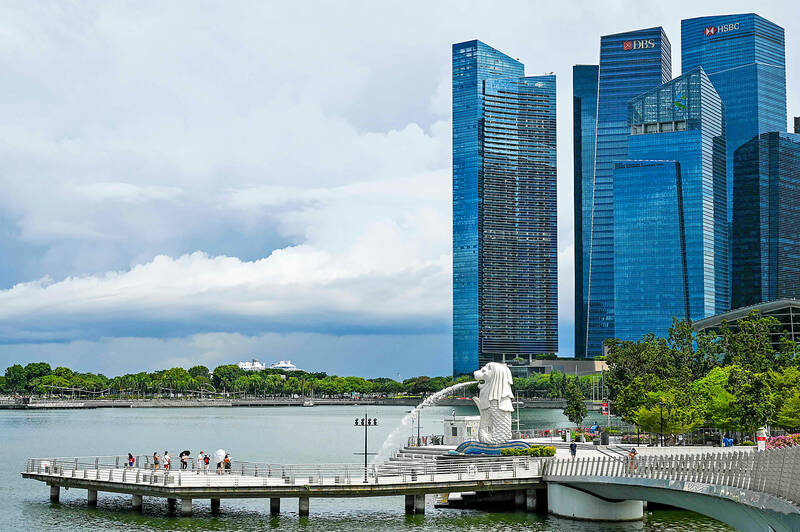
Photo: AFP
However, it announced yesterday that it would end mandatory hotel quarantine for travelers starting on Monday. Visitors must undergo polymerase chain reaction tests on arrival and are to be restricted from visiting restaurants and bars for the first three days of stay.
Tourists who test positive on arrival are to be isolated in hotel rooms or at government camps.
A November summit of global bankers, designed to restore confidence in Hong Kong, has secured pledges from about 20 leading firms to send top executives to an event that should be bolstered by the lifting of quarantine measures.
However, a sudden flurry of mass tourism is unlikely to appear soon. Many global airlines have reduced routes or stopped flying to Hong Kong over the past two years.
Singapore, on the other hand, removed most of its entry requirements in April, and is expecting to record more than 4 million visitors by the end of this year.
A slate of high-profile events including the Milken Institute Asia Summit, the Forbes Global CEO Conference and a Grand Prix are certain to help raise Singapore’s profile as a travel destination.
Shanghai, Beijing and Shenzhen all maintained spots in the index’s top 10, in spite of crippling COVID-19 mitigation measures that have effectively cut off China from the rest of the world.
Paris made a return to the report’s top 10, while Tokyo tumbled to 16th place. Sydney leapt 10 spots up the ranks to No. 13. Dubai and Abu Dhabi reigned supreme in the Middle East, sitting in 17th and 32nd place respectively. Russian financial centers suffered as a result of the war in Ukraine, with Moscow down 22 places to 73, and St Petersburg falling 17 places to 114. Barbados, Xian and Wuhan were the bottom three locations on the list.
The index, compiled by think tanks Z/Yen Partners and the China Development Institute, ranks 119 financial centers and uses data collected from thousands of financial service professionals responding to an online questionnaire.
Additional reporting by AFP

A signaling system malfunction disrupted high-speed rail (HSR) services beginning at 8am today, with trains temporarily reduced to three northbound and three southbound trains per hour as authorities conduct inspections. The malfunction occurred on a section of track in Miaoli County during pre-operation checks early this morning, forcing northbound and southbound trains to use a single track, the HSR operator said. The regular schedule has been replaced with three hourly trains offering only nonreserved seating in each direction, stopping at every station, it said, adding that business class cars would still have reserved seating. Departures from terminal stations are scheduled at the top

DRONE CENTRAL: Taiwan aims to become Asia’s democratic hub for drones, with most exports focused on high-quality military-grade models, an official said Taiwan’s drone industry is expected to expand significantly by 2030, producing 100,000 units per month and exporting half of them, the Ministry of Economic Affairs said yesterday. Current drone production capacity is about 15,000 units per month, but the industry can quickly scale up as demand increases, Industrial Development Administration Director-General Chiou Chyou-huey (邱求慧) told a news conference in Taipei. Taiwan’s drone output grew 2.5-fold last year to NT$12.9 billion (US$408.3 million) under a government program to develop the uncrewed vehicle sector, he said. The Executive Yuan in October last year approved plans to invest NT$44.2 billion into domestic production of uncrewed aerial

VERBOSE VESSELS: A CGA cutter and a China Coast Guard exchanged verbal barbs for more than a day in Taiwanese-controlled waters before the Chinese vessel left The Taiwanese and Chinese coast guards had a standoff near the strategically located Pratas Islands (Dongsha Islands, 東沙群島) in the north of the South China Sea, the Coast Guard Administration (CGA) said yesterday. The two sides engaged in intense radio exchanges over sovereignty claims during the 33-hour standoff. China Coast Guard vessel 3501 eventually left the restricted waters, 26.6 nautical miles (49.2km) west of the Pratas Islands, at 5pm yesterday, the CGA said. Lying approximately between southern Taiwan and Hong Kong, the Taiwan-controlled Pratas are seen by some security experts as vulnerable to Chinese attack due to their distance — more than
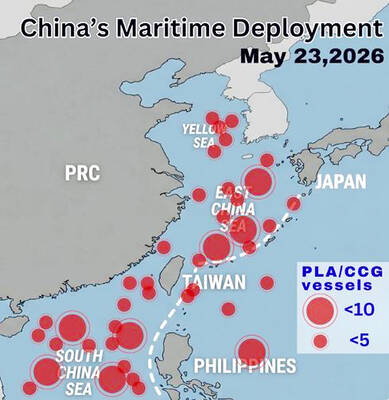
WARNING: China should stop engaging in actions that undermine regional peace and stability, as it would only build resentment among people across the Strait, the CGA said China has deployed more than 100 navy, coast guard and other vessels in waters from the Yellow Sea to the South China Sea and the western Pacific since US President Donald Trump and Chinese President Xi Jinping (習近平) met in Beijing, National Security Council Secretary-General Joseph Wu (吳釗燮) said yesterday. “In this part of the world, #China is the one & only PROBLEM wrecking the #StatusQuo & threatening regional peace & stability,” Wu wrote on X. In a separate post, he said Beijing was coercing Taiwan’s maritime domain, calling it illegal and provocative, after the Coast Guard Administration (CGA) expelled a


 RSS
RSS