


A two-year-old Shanghai-based developer of chip design software was behind an attempt to buy a British firm, a purchase that regulators blocked with little explanation in the latest example of Britain’s increasing hostility toward Chinese investment.
Super Orange HK Holding Ltd (香港超橙控股有限公司) was blocked from buying Bristol-based chip design software provider Pulsic Ltd, British Secretary of State for Business, Energy and Industrial Strategy Kwasi Kwarteng said in a brief statement on Wednesday.
However, Super Orange is controlled by little-known Shanghai UniVista Industrial Software Group (上海合見工業軟件集團), according to Hong Kong public filings and Chinese corporate data.
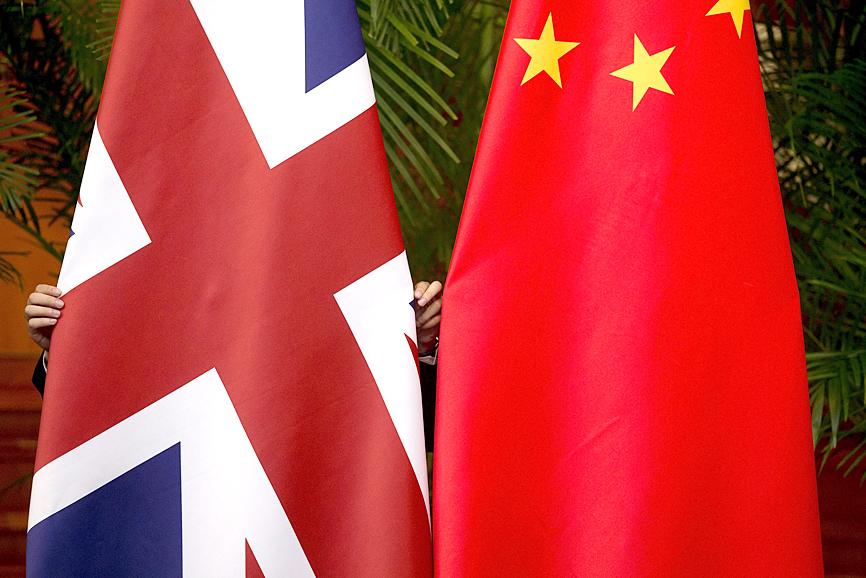
Photo: Reuters
The Shanghai firm is backed by the National Integrated Circuit Industry Investment Fund (國家集成電路產業投資基金) — a powerful US$50 billion state-backed vehicle known within the industry as the “Big Fund” (大基金).
It is unclear what roles Super Orange’s controlling shareholders played in the takeover attempt. Pulsic’s would-be acquirer was founded in Hong Kong in August last year by Nanjing Puxin Software, according to local filings.
That firm is wholly owned by UniVista, according to Chinese corporate database Tianyancha.
UniVista was incorporated only in 2020 and describes itself as a provider of electronic design automation (EDA) tools to the chip industry, or software kits vital to the design of semiconductors. Its No. 2 owner was the Big Fund, which typically bankrolls promising start-ups in their initial stages, according to Tianyancha.
Little is known about Puxin, the UniVista subsidiary that directly controls Super Orange. The office number listed in Puxin’s legal documents did not exist when Bloomberg News visited the Nanjing campus listed on Thursday. Several employees at the business park said the address does not conform with the usual format within the location.
The US has been leaning on allies from the UK to Japan to join in efforts to block China’s chip goals. Pulsic is also a player in EDA tools, employed by leading chipmakers ranging from Taiwan Semiconductor Manufacturing Co (台積電) to Intel Corp.
Beijing considers the sector, dominated by American firms Synopsys Inc and Cadence Design Systems Inc, a key bottleneck in its ambitions to build a world-class semiconductor industry and wean China off US technology.
Pulsic’s would-be acquirer — Super Orange HK Holding — had a sole and founding director identified as Zhou Nuo. He ceded his post in December to Xu Yun (徐昀), Hong Kong filings showed. Xu, the former head of Cadence’s Chinese business, is now a co-CEO at UniVista.
Xu, once named one of China’s most influential female chip executives, was also a director of the similarly named Super Orange HK Ltd, a separate entity founded in March that is wholly owned by Shanghai UniVista Technology. Her co-CEO is Pan Jianyue (潘建岳), who headed Synopsys Inc’s China and Asia-Pacific business before the pair founded the other UniVista Industrial last year.
Xu and Pan said in an interview in November last year that they harbor ambitions to not just replace US technology, but build a globe-spanning operation that can go toe-to-toe with the industry’s leaders.

South Korea has adjusted its electronic arrival card system to no longer list Taiwan as a part of China, a move that the Ministry of Foreign Affairs said would help facilitate exchanges between the two sides. South Korea previously listed “Taiwan” as “Taiwan (China)” in the drop-down menus of its online arrival card system, where people had to fill out where they came from and their next destination. The ministry had requested South Korea make a revision and said it would change South Korea’s name on Taiwan’s online immigration system from “Republic of Korea” to “Korea (South),” should the issue not be

The Legislative Yuan’s Finance Committee yesterday approved proposed amendments to the Amusement Tax Act (娛樂稅法) that would abolish taxes on films, cultural activities and competitive sporting events, retaining the fee only for dance halls and golf courses. The proposed changes would set the maximum tax rate for dance halls and golf courses at 50 and 20 percent respectively, with local governments authorized to suspend the levies. Article 2 of the act says that “amusement tax shall be levied on tickets sold or fees charged by amusement places, facilities or activities” in six categories: “Cinema; professional singing, story-telling, dancing, circus, magic show, acrobatics

Tainan, Taipei and New Taipei City recorded the highest fines nationwide for illegal accommodations in the first quarter of this year, with fines issued in the three cities each exceeding NT$7 million (US$220,639), Tourism Administration data showed. Among them, Taipei had the highest number of illegal short-term rental units, with 410. There were 3,280 legally registered hotels nationwide in the first quarter, down by 14 properties, or 0.43 percent, from a year earlier, likely indicating operators exiting the market, the agency said. However, the number of unregistered properties rose to 1,174, including 314 illegal hotels and 860 illegal short-term rental

INFLATION UP? The IMF said CPI would increase to 1.5 percent this year, while the DGBAS projected it would rise to 1.68 percent, with GDP per capita of US$44,181 The IMF projected Taiwan’s real GDP would grow 5.2 percent this year, up from its 2.1 percent outlook in January, despite fears of global economic disruptions sparked by the US-Iran conflict. Taiwan’s consumer price index (CPI) is projected to increase to 1.5 percent, while unemployment would be 3.4 percent, roughly in line with estimates for Asia as a whole, the international body wrote in its Global Economic Outlook Report published in the US on Monday. The figures are comparatively better than the IMF outlook for the rest of the world, which pegged real GDP growth at 3.1 percent, down from 3.3 percent


 RSS
RSS