


Taiwan yesterday reiterated that it would not succumb to pressure from Beijing after China carried out its most provocative military drills in decades in retaliation for US House of Representatives Speaker Nancy Pelosi’s trip to Taiwan last week.
“We will never bow to pressure. We uphold freedom and democracy, and believe Taiwanese disapprove [of] China’s bullying actions with force and saber rattling at our door,” Premier Su Tseng-chang (蘇貞昌) said yesterday.
China had “arrogantly” disrupted regional peace and stability, he said, calling on Beijing to not flex its military muscles.
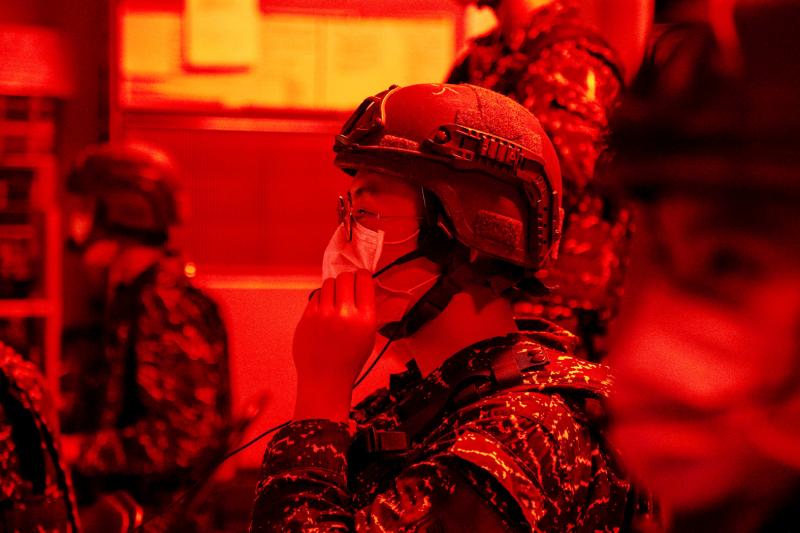
Photo: Military News Agency
President Tsai Ing-wen (蔡英文) has also called on the international community to “support democratic Taiwan” and “halt any escalation of the regional security situation.”
The Chinese People’s Liberation Army (PLA) military exercises started on Thurdsay. They included missile strikes on targets in the seas around Taiwan proper and aircraft crossing the median line of the Taiwan Strait.
The exercises were set to end yesterday, although Beijing has announced fresh drills in the Yellow Sea between China and the Korean Peninsula, which are to run until Monday next week.
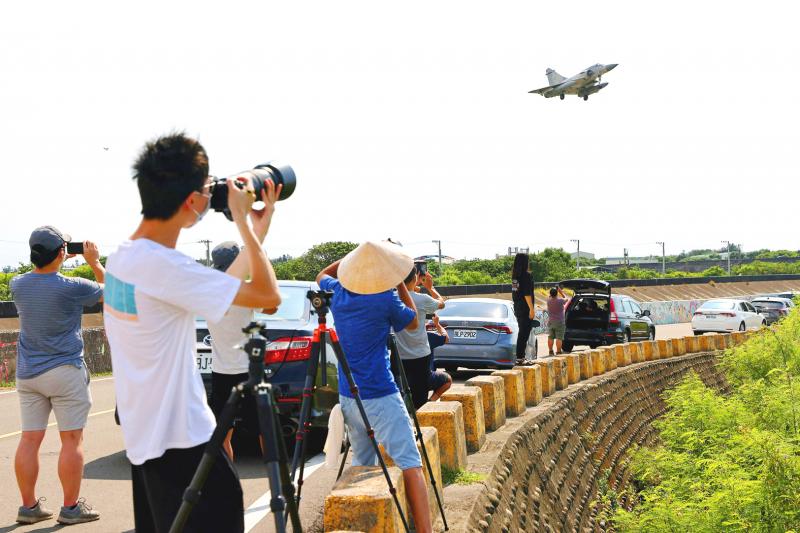
Photo: Ann Wang, Reuters
A Chinese state television report yesterday said that the PLA would from now on conduct “regular” drills on the eastern side of the median line of the Taiwan Strait, prompting condemnation from the Ministry of Foreign Affairs.
The ministry urged China to stop its “unreasonable behavior,” which it said endangers the region, and even common global well-being.
Yesterday, Beijing conducted “practical joint exercises in the sea and airspace surrounding Taiwan Island as planned,” the Chinese Eastern Theater Command said.
The drills were focused “on testing the joint firepower on the ground and long-range air strike capabilities,” it said.
The Ministry of National Defense confirmed that China had dispatched “planes, vessels and drones” around the Taiwan Strait, “simulating attacks on Taiwan’s main island and on ships in our waters.”
Beijing also sent drones over Taiwan’s outlying islands, it added.
However, the ministry disputed Chinese state media reports saying that the PLA’s Nanjing Type 052D destroyer had sailed into Taiwan’s territorial waters near Ho-Ping Power Plant in Hualien County, and urged Taiwanese not to be taken in by Beijing’s disinformation campaigns.
About 10 warships each from China and Taiwan sailed at close quarters in the Taiwan Strait, with some Chinese vessels crossing the median line, an unofficial buffer separating the two nations, a person with knowledge of the matter said.
As Chinese forces “pressed” the line, as they did on Saturday, Taiwan remained close to monitor and, where possible, prevent the Chinese from crossing it, the person said.
“The two sides are showing restraint,” the person said, describing the high-seas maneuvers as a game of “cat and mouse.”
“One side tries to cross, and the other stands in the way and forces them to a more disadvantageous position, and they eventually return to the other side,” the person said.
Taiwan said it mobilized a “joint intelligence surveillance and reconnaissance system to closely monitor the enemy situation,” and dispatched planes and vessels.
Meanwhile, the Ministry of Transportation and Communications said that flights through Taiwan’s airspace had gradually resumed yesterday at about noon, as most notifications for Chinese military drills near the nation were “no longer in effect.”
However, Taiwan would continue to direct flights and ships away from a Chinese military drill off its east coast until 10am this morning, it said in a statement.
China has so far also cut off defense and climate talks with the US, and imposed sanctions on Pelosi and her family in retaliation for her visit.
While the administration of US President Joe Biden and Pelosi say Washington remains committed to the US’ “one China” policy, the US has criticized Beijing’s actions in the Taiwan Strait, with White House press secretary Karine Jean-Pierre calling them “fundamentally irresponsible.”
“There’s no need and no reason for this escalation,” Jean-Pierre said.
Singaporean Coordinating Minister for National Security Teo Chee Hean (張志賢) said on Facebook on Saturday that the US-China tensions over Taiwan are “an issue that can lead to conflict and war to the detriment of all parties involved, especially the people in Taiwan.”
The tensions would have a negative impact on Southeast Asia, Teo said, adding: “We hope that wisdom will prevail.”
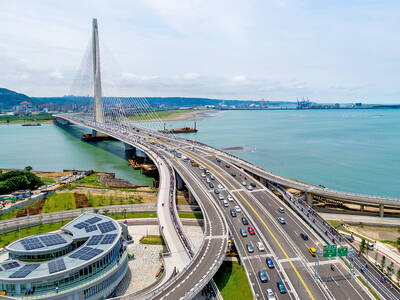
The Ministry of Transportation and Communications yesterday inaugurated the Danjiang Bridge across the Tamsui River in New Taipei City, saying that the structure would be an architectural icon and traffic artery for Taiwan. Feted as a major engineering achievement, the Danjiang Bridge is 920m long, 211m tall at the top of its pylon, and is the longest single-pylon asymmetric cable-stayed bridge in the world, the government’s Web site for the structure said. It was designed by late Iraqi-British architect Zaha Hadid. The structure, with a maximum deck of 70m, accommodates road and light rail traffic, and affords a 200m navigation channel for boats,
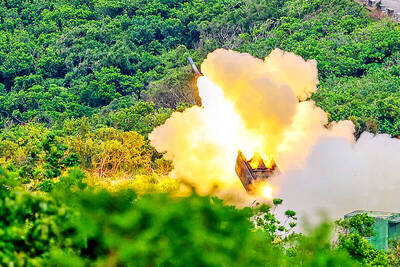
PRECISION STRIKES: The most significant reason to deploy HIMARS to outlying islands is to establish a ‘dead zone’ that the PLA would not dare enter, a source said A High Mobility Artillery Rocket System (HIMARS) would be deployed to Penghu County and Dongyin Island (東引) in Lienchiang County (Matsu) to force the Chinese military to retreat at least 100km from the coastline, a military source said yesterday. Taiwan has been procuring HIMARS and Army Tactical Missile Systems (ATACMS) from the US in batches. Once all batches have been delivered, Taiwan would possess 111 HIMARS units and 504 ATACMS, which have a range of 300km. Considering that “offense is the best defense,” the military plans to forward-deploy the systems to outlying islands such as Penghu and Dongyin so that

WHAT WAS ALL THAT FOR? Jaw Shaw-kong said that Cheng Li-wen had pushed for more drastic cuts and attacked him, just for the outcome to be nearly identical to his bill The legislature yesterday passed a supplementary budget bill to fund the purchase of separate packages of US military equipment, with the combined amount of spending capped at NT$780 billion (US$24.8 billion). The Chinese Nationalist Party (KMT) and Taiwan People’s Party (TPP) used their legislative majority to pass the bill, which runs until 2033 and has two main funding provisions. One was for NT$300 billion of arms sales already approved by the US for Taiwan on Dec. 17 last year, the other was for NT$480 billion for another arms package expected to be announced by Washington. The bill, which fell short of the NT$1.25

‘CLEAR MESSAGE’: The bill would set up an interagency ‘tiger team’ to review sanctions tools and other economic options to help deter any Chinese aggression toward Taiwan US Representative Young Kim has introduced a bill to deter Chinese aggression against Taiwan, calling for an interagency “tiger team” to preplan coordinated sanctions and economic measures in response to possible Chinese military or political action against Taiwan. “[Chinese President] Xi Jinping [習近平] has directed the People’s Liberation Army to be ready to invade Taiwan by 2027. China has a plan. America should have one too,” Kim said in a news release on Thursday last week. She introduced the “Deter PRC [People’s Republic of China] aggression against Taiwan act” to “ensure the US has a coordinated sanctions strategy ready should


 RSS
RSS