


Indian and Chinese foreign ministers were to attend a regional conference in Uzbekistan yesterday, a day after New Delhi expressed concern over a Chinese military ship’s planned visit to a strategic port in India’s southern neighbor Sri Lanka.
New Delhi worries that the Chinese-built and leased Hambantota port will be used by China as a military base in India’s backyard. The US$1.5 billion port is near the main shipping route from Asia to Europe.
Relations between India and China have been strained since armed clashes on their border two years ago killed at least 20 Indian and four Chinese soldiers.
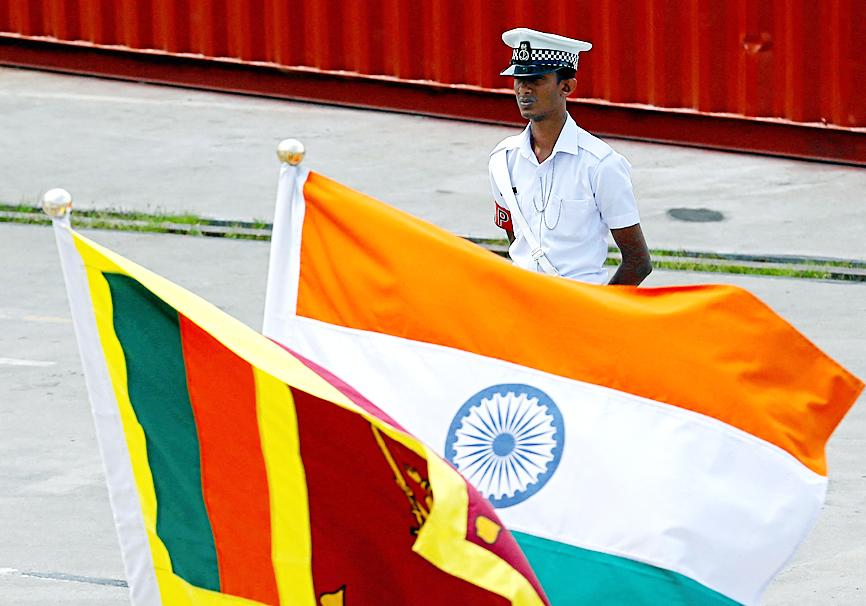
Photo: Reuters
Shipping data from Refinitiv Eikon showed the research and survey vessel Yuan Wang 5 was en route to Hambantota, Sri Lanka, and was expected to arrive on Aug. 11, as the country is facing its worst economic crisis in seven decades. India has provided its neighbor with nearly US$4 billion in support this year alone.
Foreign security analysts describe the Yuan Wang 5 as one of China’s latest generation of space-tracking ships, which monitors satellite, rocket and intercontinental ballistic missile launches.
The Pentagon’s annual report on China’s military modernization says the Yuan Wang ships are operated by the Strategic Support Force of the Chinese People’s Liberation Army.
The Indian government is monitoring the planned visit of the Chinese ship, Indian Ministry of Foreign Affairs spokesman Arindam Bagchi said on Thursday, adding that New Delhi would protect its security and economic interests.
Bagchi declined to say if Indian Minister of External Affairs Subrahmanyam Jaishankar would meet his Chinese counterpart Wang Yi (王毅) at the Shanghai Cooperation Organisation (SCO) meeting in the Uzbek capital, Tashkent. SCO members include China, India, Russia, Pakistan and central Asian nations.
Sri Lanka is a “dialogue partner” in the group, but it was not immediately clear if it was attending.
India has lodged a verbal protest with the Sri Lankan government against the ship’s visit.
A Sri Lankan consulting firm, Belt & Road Initiative Sri Lanka, said on its Web site that the Yuan Wang 5 would be in Hambantota for one week to “conduct space tracking, satellite control and research tracking in the northwestern part of the Indian Ocean region through August and September.”
Sri Lanka formally handed over commercial activities at its main southern port to a Chinese company in 2017 on a 99-year lease after struggling to repay its debt.
China is one of Sri Lanka’s biggest lenders and has also funded airports, roads and railways, unnerving India.
Sri Lanka angered India in 2014 when it allowed a Chinese submarine and a warship to dock in Colombo.

‘UNFRIENDLY’: Changing the nationality listing of Taiwanese residents to ‘China’ goes against EU foreign policy as well as democratic and human rights principles, MOFA said Taiwan yesterday called on Denmark to correct its designation of the nationality of Taiwanese residents as “China” or face retaliatory measures. The Danish government in 2024 changed the nationality of Taiwanese citizens on their residence permits from “Taiwan” to “China.” The decision goes against EU foreign policy and contravenes democratic and human rights principles, Ministry of Foreign Affairs (MOFA) spokesman Hsiao Kuang-wei (蕭光偉) said. Denmark should present a solution acceptable to Taiwan as soon as possible and correct the erroneous designation to preserve the longstanding friendship between the two nations, Hsiao said. The issue could damage Denmark’s image and business reputation in Taiwan,

KEY INDUSTRY: The vice premier discussed a plan to create a non-red drone supply chain by next year, which has been allocated a budget of more than NT$7.2 billion The government has budgeted NT$44.2 billion (US$1.38 billion) to cultivate Taiwan’s uncrewed aerial vehicle (UAV) industry over the next five years, which would make the nation a major player in the industry’s democratic supply chain in the Asia-Pacific region, Premier Cho Jung-tai (卓榮泰) said yesterday. Cho made the remarks during a visit to the facilities of Cub Elecparts Inc (為升電裝). Democratic Progressive Party (DPP) Legislator Chen Su-yueh (陳素月) and Chinese Nationalist Party (KMT) Legislator Hsieh Yi-fong (謝依鳳) also participated in the trip. Cub Elecparts has transitioned from the automotive industry to the defense industry, which is the top priority among the nation’s
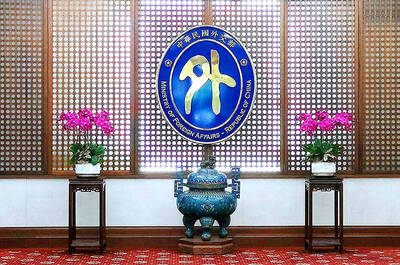
SOUTH KOREA DISPUTE: If Seoul continues to ignore its request, Taiwan would change South Korea’s designation on its arrival cards, the foreign ministry said If South Korea does not reply appropriately to a request to correct Taiwan’s name on its e-Arrival card system before March 31, the government would take corresponding measures to change how South Korea is labeled on the online Taiwan Arrival Card system, the Ministry of Foreign Affairs said yesterday. South Korea’s e-Arrival card system lists Taiwan as “China (Taiwan)” in the “point of departure” and “next destination” fields. Taipei has asked Seoul to change the wording. Since March 1, South Koreans who hold government-issued Alien Resident Certificates (ARC) have been identified as from “South Korea” rather than the “Republic of Korea,” the
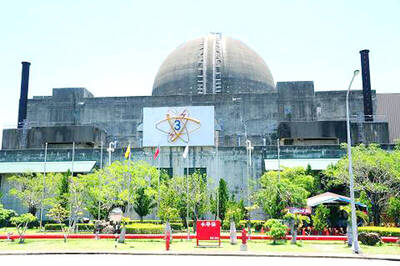
SUFFICIENT: The president said Taiwan has enough oil for next month, with reserves covering more than 100 days and natural gas enough for 12 to 14 days A restart plan for the Guosheng Nuclear Power Plant in New Taipei City’s Wanli District (萬里) and the Ma-anshan Nuclear Power Plant in Pingtung County’s Hengchun Township (恆春) would be submitted to the Nuclear Safety Commission by the end of the month, President William Lai (賴清德) said yesterday, reversing the government’s policy to abolish nuclear energy. On May 17 last year, Taiwan shut down its last nuclear reactor and became the first non-nuclear nation in East Asia, fulfilling the Democratic Progressive Party (DPP) government’s pledge of a “nuclear-free homeland.” Even without nuclear power, Taiwan can maintain a stable electricity supply until 2032,


 RSS
RSS