


Ferdinand Marcos Jr, the namesake son of an ousted dictator, was yesterday sworn in as Philippine president in one of the greatest political comebacks in recent history that opponents say was pulled off by whitewashing his family’s image.
His rise to power, 36 years after an army-backed “People Power” revolt booted his father from office, upends politics in the Asian democracy, where a public holiday, monuments and the Philippine constitution stand as reminders of the end of his father’s tyrannical rule.
However, in his inaugural speech, Marcos Jr defended the legacy of his late father, who he said accomplished many things that were not done since the nation’s independence, adding that he would emulate him.
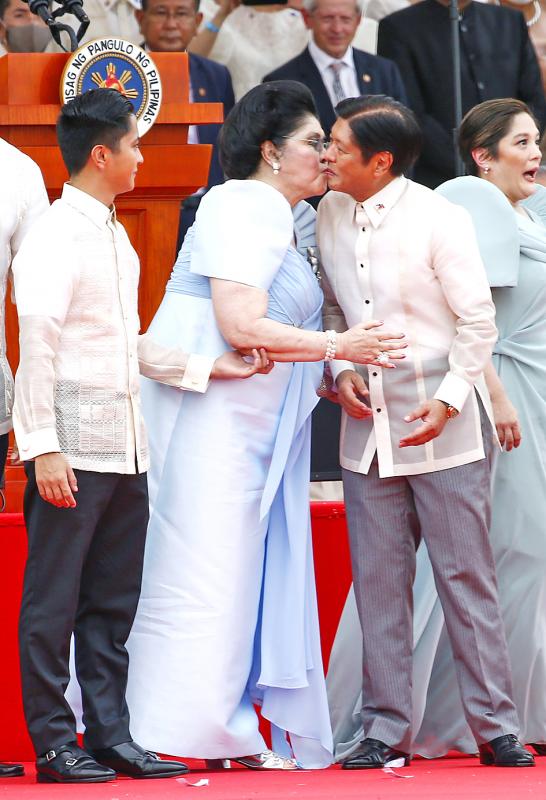
Photo: EPA-EFE
“He got it done, sometimes with the needed support, sometimes without. So will it be with his son,” he said to applause from his supporters in the crowd. “You will get no excuses from me.”
“My father built more and better roads, produced more rice than all administrations before his,” Marcos Jr said, while also praising the infrastructure projects by his equally controversial predecessor, Rodrigo Duterte.
Calling for unity, he said: “We will go further together than against each other, pushing forward not pulling each other.”
He did not touch on the human rights atrocities and plunder his father was accused of, saying he would not talk about the past, but the future.
Rights advocates and survivors of the martial law era under his father protested Marcos Jr’s inauguration, which took place at a noontime ceremony at the steps of the National Museum in Manila. Thousands of police officers, including anti-riot contingents, SWAT commandos and snipers, were deployed in the bayside tourist district for security.
Chinese Vice President Wang Qishan (王岐山) and US Vice President Kamala Harris’ husband, Doug Emhoff, were among foreign dignitaries attending.
In Taipei, the Ministry of Foreign Affairs (MOFA) expressed regret that Taiwan was not invited to the inauguration ceremony.
Despite the lack of an invite, ministry deputy spokesperson Tsuei Ching-lin (崔靜麟) said that Taiwan’s representative office in Manila had passed on President Tsai Ing-wen’s (蔡英文) congratulations to Marcos Jr.
The representative office has learned through various channels from Manila — which does not formally recognize Taipei and instead maintains diplomatic relations with Beijing — that it decided not to invite Taiwanese government representatives to the ceremony “after taking consideration of all factors involved.”
Democratic Progressive Party (DPP) lawmakers criticized the ministry over the affair.
DPP Legislator Chao Tien-lin (趙天麟) said it was the second time in recent months that Taiwan was locked out by a neighboring country, referring to Taiwan not being invited to the inauguration of South Korean President Yoon Suk-yeol in May.
“We ask MOFA to assess what happened,” he said.
During the 2010 inauguration of then-Philippine president Benigno Aquino III, then-minister of health Yeh Ching-chuan (葉金川) attended the ceremony in a personal capacity and passed on a congratulatory message from then-president Ma Ying-jeou (馬英九).
It was the last time that a former or serving Taiwanese government official had attended the inauguration of a Philippine president.
Additional reporting by Jason Pan and CNA
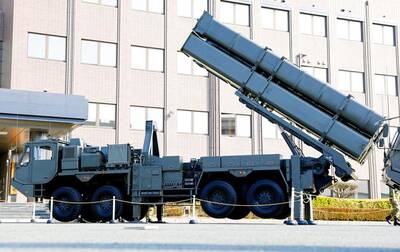
Japan has deployed long-range missiles in a southwestern region near China, the Japanese defense minister said yesterday, at a time when ties with Beijing are at their lowest in recent years. The missiles were installed in Kumamoto in the southern region of Kyushu, as Japan is attempting to shore up its military capacity as China steps up naval activity in the East China Sea. “Standoff defense capabilities enable us to counter the threat of enemy forces attempting to invade our country ... while ensuring the safety of our personnel,” Japanese Minister of Defense Shinjiro Koizumi said. “This is an extremely important initiative for

The nation’s fastest supercomputer, Nano 4 (晶創26), is scheduled to be launched in the third quarter, and would be used to train large language models in finance and national defense sectors, the National Center for High-Performance Computing (NCHC) said. The supercomputer, which would operate at about 86.05 petaflops, is being tested at a new cloud computing center in the Southern Taiwan Science Park in Tainan. The exterior of the server cabinet features chip circuitry patterns overlaid with a map of Taiwan, highlighting the nation’s central position in the semiconductor industry. The center also houses Taiwania 2, Taiwania 3, Forerunner 1 and

MORE POPULAR: Taiwan Pass sales increased by 59 percent during the first quarter compared with the same period last year, the Tourism Administration said The Tourism Administration yesterday said that it has streamlined the Taiwan Pass, with two versions available for purchase beginning today. The tourism agency has made the pass available to international tourists since 2024, allowing them to access the high-speed rail, Taiwan Railway Corp services, four MRT systems and four Taiwan Tourist Shuttles. Previously, five types of Taiwan Pass were available, but some tourists have said that the offerings were too complicated. The agency said only two types of Taiwan Pass would be available, starting from a three-day pass with the high-speed rail and a three-day pass with Taiwan Railway Corp. The former costs NT$2,800
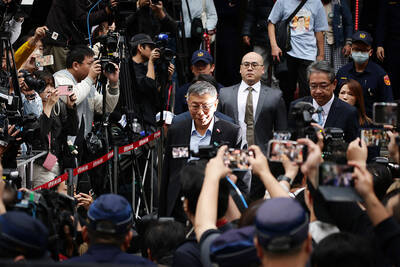
FIRST TRIAL: Ko’s lawyers sought reduced bail and other concessions, as did other defendants, but the bail judge denied their requests, citing the severity of the sentences Former Taipei mayor Ko Wen-je (柯文哲) was yesterday sentenced to 17 years in prison and had his civil rights suspended for six years over corruption, embezzlement and other charges. Taipei prosecutors in December last year asked the Taipei District Court for a combined 28-year, six-month sentence for the four cases against Ko, who founded the Taiwan People’s Party (TPP). The cases were linked to the Core Pacific City (京華城購物中心) redevelopment project and the mismanagement of political donations. Other defendants convicted on separate charges included Chinese Nationalist Party (KMT) Taipei City Councilor Angela Ying (應曉薇), who was handed a 15-year, six-month sentence; Core Pacific


 RSS
RSS