


Russian forces have stepped up their shelling in Ukraine’s Kharkiv and Donetsk regions, Kyiv said yesterday, after Ukrainian President Volodymyr Zelenskiy said to expect greater hostilities ahead of a historic EU decision on Ukraine’s bid for candidate status.
Nearly four months after Russia launched a bloody invasion of his nation, Zelenskiy said in his evening address on Sunday that there had been “few such fateful decisions for Ukraine” as the one it expects from the EU this week.
“Obviously, we expect Russia to intensify hostile activity this week... We are preparing. We are ready,” he said.
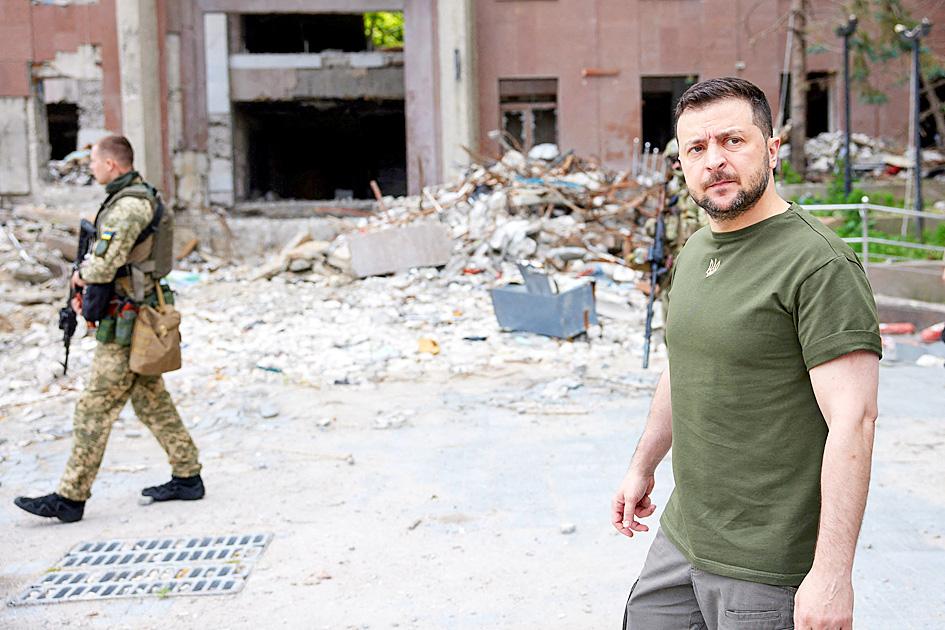
Photo: Reuters / Ukrainian Presidential Press Service
Leaders of the EU’s 27 member states are to discuss at a summit on Thursday and Friday whether to add Ukraine to the list of nations vying for membership.
EU foreign ministers gathering in Luxembourg began the week urging Moscow to stop blocking the export of vitally needed grain from Ukraine, a top global supplier.
“One cannot imagine that millions of tonnes of wheat remain blocked in Ukraine, while in the rest of the world people are suffering hunger. This is a real war crime,” EU High Representative for Foreign Affairs and Security Policy Josep Borrell said.
Moscow has denied responsibility for the food crisis, and blames Western sanctions for the disrupted deliveries that have pushed up cereal prices and fanned fears of famines in vulnerable regions.
On the ground, Russia appeared to be making some battlefield advances in the east.
In its daily update yesterday, Ukraine’s presidency reported heavier Russian shelling in the Kharkiv region in the northeast.
In the Donetsk region, the intensity of the attacks “is growing along the entire front line” it said, leaving at least one person dead and injuring seven people, including a child.
Fighting also continued in the key industrial city of Severodonetsk in the east, with Ukraine saying that it had lost control of the adjacent village of Metyolkine.
“Unfortunately, we do not control Metyolkine anymore and the enemy continues to build up its reserves,” Lugansk Governor Sergiy Gaiday wrote on social media.
Moscow’s forces have for weeks been battling to seize the eastern Donbas region, after being repelled from other parts of the nation following the Feb. 24 invasion.
A chemical plant in Severodonetsk, where hundreds of civilians are said to be sheltering, was being shelled “constantly,” Gaiday said.
On Sunday, NATO Secretary-General Jens Stoltenberg said that the war could grind on “for years,” and urged Western nations to be ready to offer long-term military, political and economic aid.
Ukraine has repeatedly urged Western nations to step up their deliveries of arms, despite warnings from nuclear-armed Russia that it could trigger wider conflict.
The Russian Ministry of Defense on Sunday said that it had launched missile strikes during the previous 24 hours, with one attack on a top-level Ukrainian military meeting near the city of Dnipro killing “more than 50 generals and officers.”
It said that it also targeted a building housing weapons in Mykolaiv, destroying Ukrainian artillery and armored vehicles.
There was no independent verification of the claims.

The National Chungshan Institute of Science and Technology yesterday showcased its locally developed variants of the Vision 60 robotic patrol dog, which it plans to deploy on the nation’s outlying territories in the South China Sea. The variants were produced under the Joint Lab project — created by the institute and domestic companies — and assembled with domestically produced motors, lenses and artificial intelligence (AI) systems alongside licensed tech from the US, Missile and Rocket Systems Research Division deputy director Jen Kuo-kang (任國光) told the media event at a military base in Taipei’s Dazhi (大直) area. Taiwan has built up its strengths

RIGHT DIRECTION: Taiwan’s efforts to prevent forced labor include a proposal to ‘fully prohibit’ employers from withholding workers’ documents, an official said Taiwan is to establish a mechanism to restrict imports of goods linked to forced labor, the Executive Yuan said yesterday, after the US proposed imposing additional tariffs on Taiwanese goods over labor concerns. “The Ministry of Labor and the Ministry of Economic Affairs are to establish an interministerial review procedure,” Executive Yuan spokesperson Michelle Lee (李慧芝) said at a news briefing in Taipei. “The government is to use the Foreign Trade Act [貿易法] as the legal basis to restrict imports of goods produced with forced labor” and bring its supply chain governance more in line with international standards on human rights, resilience

NOT IMMEDIATE: Taiwan has a chance to appeal the proposed 10 percent tariff before it starts, while other countries face a 12.5 percent tariff from the trade office Taiwan is among 60 economies determined by the US to have failed to impose or enforce a ban on the importation of goods produced with forced labor, according to a notice released on Tuesday by the Office of the US Trade Representative (USTR), which proposed imposing an additional 10 percent or more tariff on them. The USTR in a statement said that following an investigation, it had determined under Section 301 of the Trade Act of 1974 that the failure of the 60 economies to impose and effectively enforce a prohibition on the importation of goods produced with forced labor is

TIT-FOR-TAT: The US allegedly revoked the visa of a Chinese national working at Xinhua News Agency in the US in response to Beijing’s expulsion of Vivian Wang The Presidential Office yesterday condemned China for expelling a New York Times correspondent from Beijing following the newspaper’s interview with President William Lai (賴清德), saying the move highlighted Beijing’s suppression of press freedom and its threat to international news media. Taiwan has noted a series of recent incidents in which Beijing used similar tactics to “threaten and pressure international media outlets and journalists,” Presidential Office spokeswoman Karen Kuo (郭雅慧) said in a statement. “This concerns not only press freedom and freedom of expression, but also the safety of journalists, and Taiwan and relevant partners are paying close attention to the situation,” she


 RSS
RSS