


Taiwan might file a complaint with the WTO against a Chinese ban on grouper imports, the Council of Agriculture (COA) said yesterday, after China claimed that it had detected the banned chemicals malachite green and crystal violet in fish imported from Taiwan.
The ban, announced on Friday and starts tomorrow, is the latest in a series of restrictions China imposed on Taiwanese farm products, including pineapples, custard apples and java apples.
Taiwan had called the bans unfair and politically motivated.
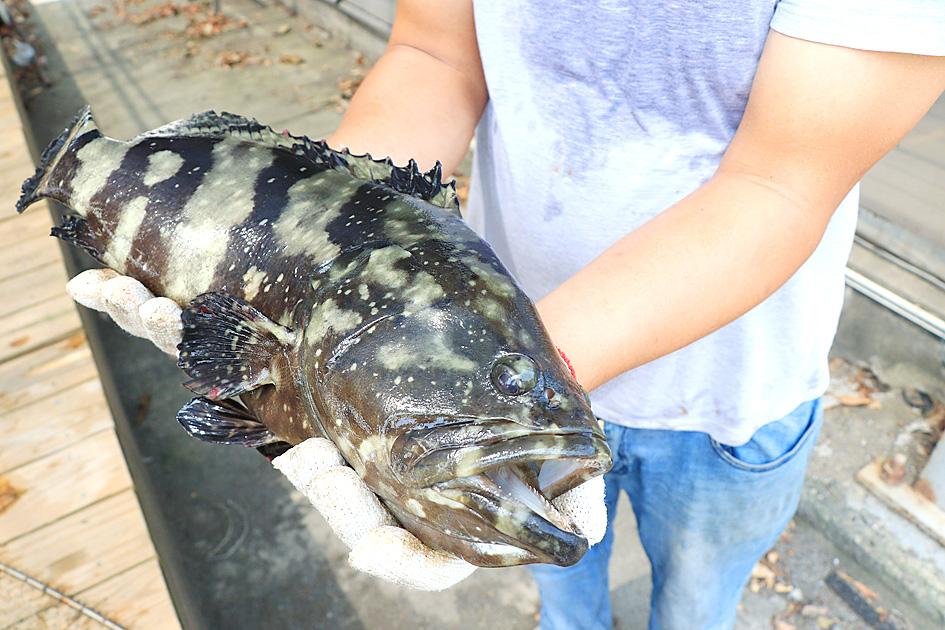
Photo courtesy of the Tainan City Government via CNA
Malachite green and crystal violet are organic dyes used to exterminate parasites and treat viral infections on fish farms. Taiwan has banned their use in the fishing industry.
COA Minister Chen Chi-chung (陳吉仲) told a news conference that the substances China claims to have found have not been detected for five years in Taiwan.
The new ban followed China’s unfounded allegations of impurities in fish imports from two aquafarms in Pingtung County late last year, said Chen, who was speaking via teleconference, as he was isolating after testing positive for COVID-19.
However, none of the claimed impurities were found at the aquafarms, he added.
Should China continue to ignore scientific evidence gathered by Taiwan, the COA might challenge Beijing at the WTO’s Sanitary and Phytosanitary Measures Committee, he said.
Grouper exports have declined during the COVID-19 pandemic, and the COA has been seeking to increase the share of domestically farmed groupers on the Taiwanese market from 30 percent to 60 percent, he said.
Beijing’s ban is at odds with the internationally accepted practice to return or destroy tainted agricultural products in such situations, Bureau of Animal and Plant Health Inspection and Quarantine Director-General Tu Wen-jane (杜文珍) said.
When Taiwanese authorities found sharpbelly originating in China to contain malachite green, no import ban was implemented, COA officials said.
The COA would first appeal the grouper ban directly, even though China has not responded to scientific data Taiwan gathered in response to last year’s bans, they said.
The Mainland Affairs Council expressed regret and dissatisfaction at the grouper ban, calling it harmful to the legitimate interests of Taiwanese aquafarmers.
“We call on China to rescind this ban to facilitate the resumption of normal dialogue and trade across the Taiwan Strait,” it said. “Allowing a technicality to affect cross-strait ties serves only to inflame Taiwanese anger at Beijing’s bullying.”
Commenting on condition of anonymity, a fish farm operator said that the import ban, although unwelcome, did not come as a surprise.
After last year’s fruit bans, “grouper farmers have expected that sooner or later, China would pull something like this... We will deal with it head-on,” they said.
Additional reporting by Chung Li-hua

‘NO SECURITY RISK’: The Railway Bureau reassured the public that the technicians’ activities were limited to technical guidance and did not involve sensitive systems The Railway Bureau yesterday said it had invited eight Chinese technicians to assist with an airport MRT construction project. The bureau issued the confirmation after an Internet user said Chinese nationals had entered the construction zone of Taiwan Taoyuan International Airport’s Terminal 3 project. They asked why “individuals from an enemy state” were allowed access to such a major national infrastructure project, which raised serious concerns over Taiwan’s industrial safety, sensitive systems and information security. The bureau’s Northern Region Engineering Branch Office said subcontractor Taiwan Handle Industrial Co (台灣手把工業) of the Taoyuan airport MRT’s “Contract No. CU05 Project A14 Station Civil, MEP &

The National Chungshan Institute of Science and Technology yesterday showcased its locally developed variants of the Vision 60 robotic patrol dog, which it plans to deploy on the nation’s outlying territories in the South China Sea. The variants were produced under the Joint Lab project — created by the institute and domestic companies — and assembled with domestically produced motors, lenses and artificial intelligence (AI) systems alongside licensed tech from the US, Missile and Rocket Systems Research Division deputy director Jen Kuo-kang (任國光) told the media event at a military base in Taipei’s Dazhi (大直) area. Taiwan has built up its strengths
TIT-FOR-TAT: The US allegedly revoked the visa of a Chinese national working at Xinhua News Agency in the US in response to Beijing’s expulsion of Vivian Wang The Presidential Office yesterday condemned China for expelling a New York Times correspondent from Beijing following the newspaper’s interview with President William Lai (賴清德), saying the move highlighted Beijing’s suppression of press freedom and its threat to international news media. Taiwan has noted a series of recent incidents in which Beijing used similar tactics to “threaten and pressure international media outlets and journalists,” Presidential Office spokeswoman Karen Kuo (郭雅慧) said in a statement. “This concerns not only press freedom and freedom of expression, but also the safety of journalists, and Taiwan and relevant partners are paying close attention to the situation,” she

NOT IMMEDIATE: Taiwan has a chance to appeal the proposed 10 percent tariff before it starts, while other countries face a 12.5 percent tariff from the trade office Taiwan is among 60 economies determined by the US to have failed to impose or enforce a ban on the importation of goods produced with forced labor, according to a notice released on Tuesday by the Office of the US Trade Representative (USTR), which proposed imposing an additional 10 percent or more tariff on them. The USTR in a statement said that following an investigation, it had determined under Section 301 of the Trade Act of 1974 that the failure of the 60 economies to impose and effectively enforce a prohibition on the importation of goods produced with forced labor is


 RSS
RSS