


In the most significant effort yet to punish Russia for its war in Ukraine, the EU agreed to ban the overwhelming majority of Russian oil imports after tense negotiations that exposed the cracks in the bloc’s unity.
From the moment that Russia invaded on Feb. 24, the West has sought to hit Moscow’s lucrative energy sector to cut off funding for its war.
However, any such move is a double-edged sword, especially in Europe, which relies on the country for 25 percent of its oil and 40 percent of its natural gas. European countries that are even more heavily dependent on Russia have been especially reluctant to act.
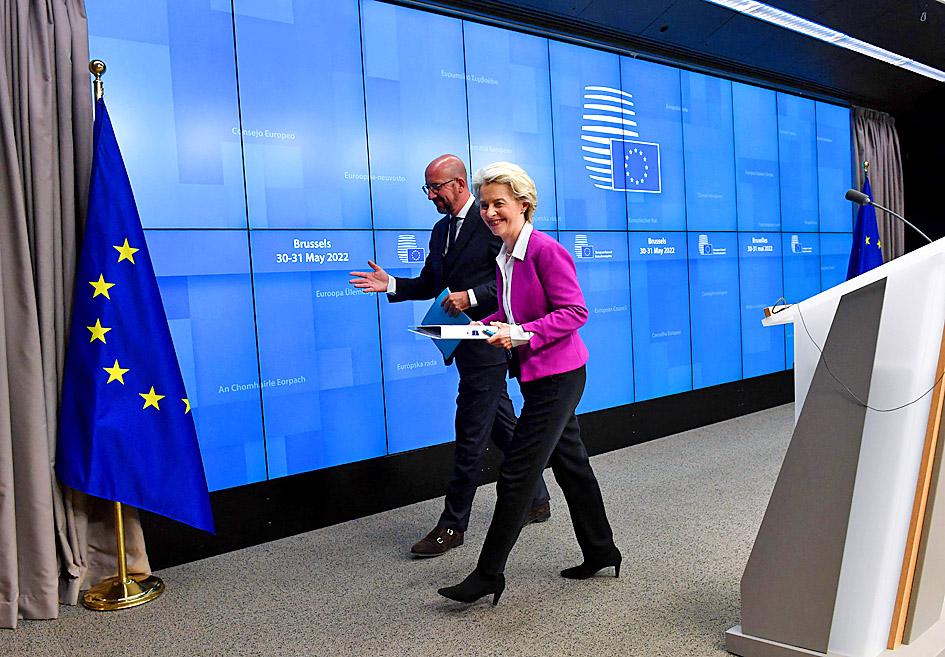
Photo: AFP
In a move unthinkable just months ago, EU leaders late on Monday agreed to cut about 90 percent of all Russian oil imports over the next six months.
Belgian Prime Minister Alexander de Croo called the embargo a “big step forward,” while Irish Prime Minister Micheal Martin hailed it as “a watershed moment.”
However, the two leaders cautioned that Europe would need time to adjust to the impact — and any further bans on Russian energy would come slowly.
In response to the EU’s decision, Mikhail Ulyanov, Russia’s permanent representative to international organizations in Vienna, wrote on Twitter: “Russia will find other importers.”
Russia has also not shied away from withholding its energy supplies, despite the economic damage it could suffer as a result.
Yesterday, Russian energy giant Gazprom said it would cut natural gas supplies to Dutch trader GasTerra.
It is considering cutting off Denmark, while it has shut off supplies to Bulgaria, Poland and Finland.
GasTerra said the move was announced after it refused Gazprom’s “one-sided payment requirements.”
That is a reference to Russian President Vladimir Putin’s demand that European nations pay for gas in rubles — an arrangement many have refused.
Talks at the EU’s headquarters in Brussels yesterday were to focus on ways to end the trading bloc’s dependence on Russian energy, by diversifying supplies and speeding up the transition to renewable sources.
Leaders were also expected to discuss how to help Ukraine export millions of tonnes of grain trapped inside the country as a global food crisis grows.
EU leaders plan to call on Russia to halt its attacks on transport infrastructure in Ukraine and lift its blockade of Black Sea ports so that food can be shipped.
The EU oil embargo was tied up in a new package of sanctions that would also target Russia’s biggest bank and state media outlets accused of spreading propaganda.
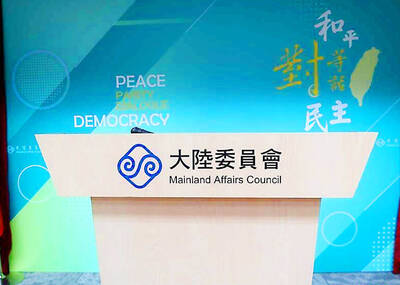
NO RECIPROCITY: Taipei has called for cross-strait group travel to resume fully, but Beijing is only allowing people from its Fujian Province to travel to Matsu, the MAC said The Mainland Affairs Council (MAC) yesterday criticized an announcement by the Chinese Ministry of Culture and Tourism that it would lift a travel ban to Taiwan only for residents of China’s Fujian Province, saying that the policy does not meet the principles of reciprocity and openness. Chinese Deputy Minister of Culture and Tourism Rao Quan (饒權) yesterday morning told a delegation of Chinese Nationalist Party (KMT) lawmakers in a meeting in Beijing that the ministry would first allow Fujian residents to visit Lienchiang County (Matsu), adding that they would be able to travel to Taiwan proper directly once express ferry

FAST RELEASE: The council lauded the developer for completing model testing in only four days and releasing a commercial version for use by academia and industry The National Science and Technology Council (NSTC) yesterday released the latest artificial intelligence (AI) language model in traditional Chinese embedded with Taiwanese cultural values. The council launched the Trustworthy AI Dialogue Engine (TAIDE) program in April last year to develop and train traditional Chinese-language models based on LLaMA, the open-source AI language model released by Meta. The program aims to tackle the information bias that is often present in international large-scale language models and take Taiwanese culture and values into consideration, it said. Llama 3-TAIDE-LX-8B-Chat-Alpha1, released yesterday, is the latest large language model in traditional Chinese. It was trained based on Meta’s Llama-3-8B

STUMPED: KMT and TPP lawmakers approved a resolution to suspend the rate hike, which the government said was unavoidable in view of rising global energy costs The Ministry of Economic Affairs yesterday said it has a mandate to raise electricity prices as planned after the legislature passed a non-binding resolution along partisan lines to freeze rates. Chinese Nationalist Party (KMT) lawmakers proposed the resolution to suspend the price hike, which passed by a 59-50 vote. The Taiwan People’s Party (TPP) voted with the KMT. Legislative Speaker Han Kuo-yu (韓國瑜) of the KMT said the resolution is a mandate for the “immediate suspension of electricity price hikes” and for the Executive Yuan to review its energy policy and propose supplementary measures. A government-organized electricity price evaluation board in March

NOVEL METHODS: The PLA has adopted new approaches and recently conducted three combat readiness drills at night which included aircraft and ships, an official said Taiwan is monitoring China’s People’s Liberation Army (PLA) exercises for changes in their size or pattern as the nation prepares for president-elect William Lai’s (賴清德) inauguration on May 20, National Security Bureau (NSB) Director-General Tsai Ming-yen (蔡明彥) said yesterday. Tsai made the comment at a meeting of the Legislative Yuan’s Foreign Affairs and National Defense Committee, in response to Democratic Progressive Party (DPP) Legislator Wang Ting-yu’s (王定宇) questions. China continues to employ a carrot-and-stick approach, in which it applies pressure with “gray zone” tactics, while attempting to entice Taiwanese with perks, Tsai said. These actions aim to help Beijing look like it has


 RSS
RSS