


Shanghai residents yesterday fought with police over plans to open quarantine facilities near their homes, underscoring burgeoning anger over the Chinese government’s handling of its worst COVID-19 outbreak since the disease’s initial outbreak in Wuhan.
People living at the Nashi community in Shanghai’s east tried to stop workers in hazmat suits from erecting fencing around several buildings that have units similar to serviced apartments, several people with knowledge of the matter said on condition of anonymity.
Now-censored clips showed scores of police dragging away protesters worried that they could catch the virus from people who moved into the buildings.
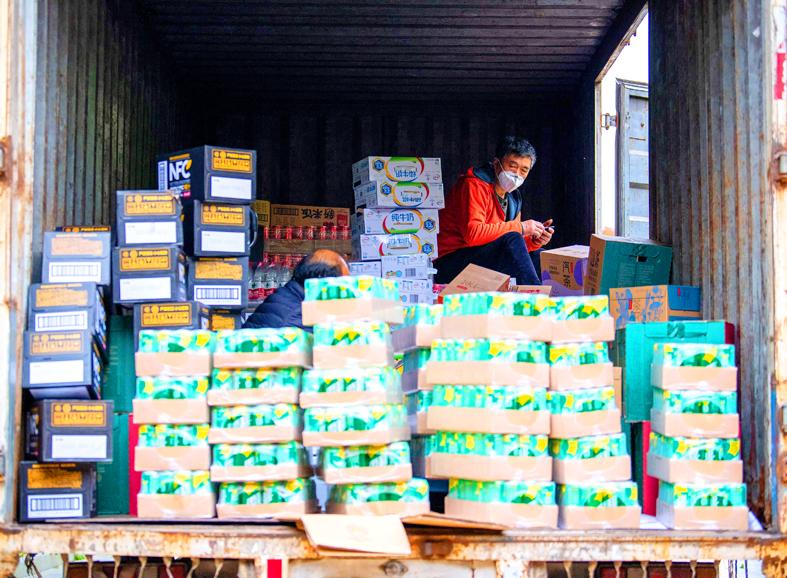
Photo: AFP
Officers can be seen trying to push angry people back, some of whom are screaming and shouting: “Police are beating us.”
The company that manages the community said that “relevant departments” handled the matter, an apparent reference to police.
The firm added that it was acting on government orders to carry out COVID-19 control work and that residents were compensated for moving.
Anger has mounted over a lack of food, medical supplies, information on when their ordeal would end and freedom to step outside. Some families have been awoken late at night by health workers in hazmat suits, shouting over loudspeakers that they must assemble outside for COVID-19 testing.
Several instances of public indignation have appeared on Chinese social media, only to be blocked by authorities worried that unrest could spread.
Videos of the fighting at the Nashi community have disappeared from Sina Weibo, and a search using the hashtag of the neighborhood’s name yields no results.
The Shanghai outbreak, involving the Omicron variant of SARS-CoV-2, is straining the government’s ability to enforce Chinese President Xi Jinping’s (習近平) demand that cities be totally free of the virus.
Shanghai posted a record of more than 27,700 new cases on Wednesday, although the figure dipped to about 23,000 on Thursday.
The vast majority of the cases were mild or asymptomatic.
Shanghai has been scrambling to build isolation facilities. It has converted many of its exhibition halls, indoor stadiums and schools into quarantine centers. Upscale hotels have been told to hand over rooms.
Officials took over five buildings in the Nashi neighborhood last month, although residents said there was little complaint because the towers were out of the way.
Officials went back on Tuesday, telling residents that they would take over nine more buildings, and tenants had to be out that day.

A Chinese aircraft carrier group entered Japan’s economic waters over the weekend, before exiting to conduct drills involving fighter jets, the Japanese Ministry of Defense said yesterday. The Liaoning aircraft carrier, two missile destroyers and one fast combat supply ship sailed about 300km southwest of Japan’s easternmost island of Minamitori on Saturday, a ministry statement said. It was the first time a Chinese aircraft carrier had entered that part of Japan’s exclusive economic zone (EEZ), a ministry spokesman said. “We think the Chinese military is trying to improve its operational capability and ability to conduct operations in distant areas,” the spokesman said. China’s growing
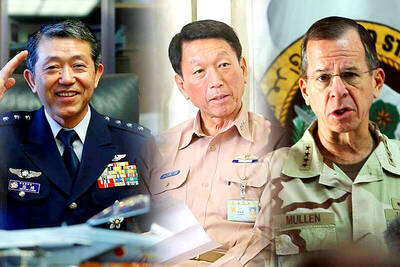
Nine retired generals from Taiwan, Japan and the US have been invited to participate in a tabletop exercise hosted by the Taipei School of Economics and Political Science Foundation tomorrow and Wednesday that simulates a potential Chinese invasion of Taiwan in 2030, the foundation said yesterday. The five retired Taiwanese generals would include retired admiral Lee Hsi-min (李喜明), joined by retired US Navy admiral Michael Mullen and former chief of staff of the Japan Self-Defense Forces general Shigeru Iwasaki, it said. The simulation aims to offer strategic insights into regional security and peace in the Taiwan Strait, it added. Foundation chair Huang Huang-hsiung
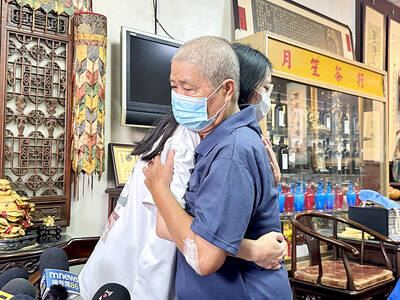
PUBLIC WARNING: The two students had been tricked into going to Hong Kong for a ‘high-paying’ job, which sent them to a scam center in Cambodia Police warned the public not to trust job advertisements touting high pay abroad following the return of two college students over the weekend who had been trafficked and forced to work at a cyberscam center in Cambodia. The two victims, surnamed Lee (李), 18, and Lin (林), 19, were interviewed by police after landing in Taiwan on Saturday. Taichung’s Chingshui Police Precinct said in a statement yesterday that the two students are good friends, and Lin had suspended her studies after seeing the ad promising good pay to work in Hong Kong. Lee’s grandfather on Thursday reported to police that Lee had sent

BUILDUP: US General Dan Caine said Chinese military maneuvers are not routine exercises, but instead are ‘rehearsals for a forced unification’ with Taiwan China poses an increasingly aggressive threat to the US and deterring Beijing is the Pentagon’s top regional priority amid its rapid military buildup and invasion drills near Taiwan, US Secretary of Defense Pete Hegseth said on Tuesday. “Our pacing threat is communist China,” Hegseth told the US House of Representatives Appropriations Subcommittee on Defense during an oversight hearing with US General Dan Caine, chairman of the Joint Chiefs of Staff. “Beijing is preparing for war in the Indo-Pacific as part of its broader strategy to dominate that region and then the world,” Hegseth said, adding that if it succeeds, it could derail


 RSS
RSS