


Taiwan’s democracy is an example for the “1 billion people on the other side of the Strait,” and it is important for democracies worldwide to unite and help Taiwan defend its values, the head of a visiting Swedish parliamentary delegation said yesterday.
In an online meeting with President Tsai Ing-wen (蔡英文), who is undergoing home isolation, Boriana Aberg, chairperson of the Swedish-Taiwanese Parliamentarian Association, said she was proud to see Taiwan ranked No. 8 on a global democracy list earlier this year.
She was referring to the 2021 Democracy Index rankings released by the Economist Intelligence Unit in February, which listed Taiwan as the No. 1 “full democracy” in Asia, and the eighth worldwide.
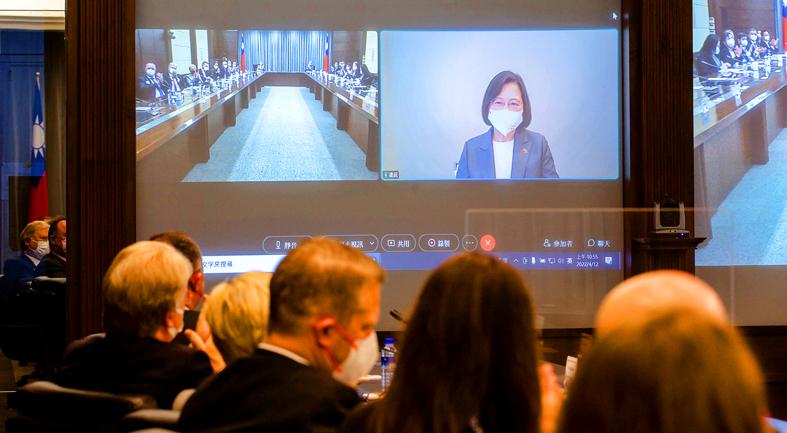
Photo courtesy of the Presidential Office via CNA
While Taiwan’s democracy serves as “an example for the 1 billion people on the other side of the Strait,” it is also a major threat to the communist regime in China, which forbids its people from enjoying any form of freedom, Aberg said.
That is why Beijing has over the years been threatening Taipei with unification, by force if necessary, she said, adding that the world is currently witnessing the consequences of “a dictator’s ambition for unification” in the war in Ukraine.
In light of the atrocities committed by Russia in its invasion of Ukraine, it is the duty of the world’s democracies to “stand with Taiwan, and defend its freedom and its democratic values by any means,” Aberg said.
In the international arena, her delegation supports Taiwan’s inclusion in the WHO, but it is “a shame” that Taiwan has been barred from attending the annual World Health Assembly for years, she said.
“We are prepared to do everything in our power to defend the existence and sovereignty of Taiwan,” said Aberg, who arrived in Taipei on Sunday with a delegation for a five-day visit.
Charlie Weimers, coleader of the delegation, said that the EU and Taiwan share democratic values and threats of an authoritarian takeover.
“We have shared interests to protect the rule-based world order, in order for small democracies like Sweden and Taiwan to continue to live and thrive,” said Weimers, who is a member of the European Parliament.
He said that during a meeting on Monday with Minister Without Portfolio Audrey Tang (唐鳳), the Swedish delegation learned more about Taiwan’s experience and expertise in combating Chinese disinformation.
The delegation also met with Swedish business representatives in Taipei on Monday, Weimers said, adding that he has always been supportive of a EU-Taiwan trade agreement.
“I will continue to advocate my own personal conviction, which is that the EU-Taiwan friendship should have no end limit, no forbidden areas and no upper bounds,” he said.
Tsai thanked the delegation for their long-awaited visit to Taiwan, which she said had been postponed due to the COVID-19 pandemic.
Taiwan and Sweden are like-minded partners that share universal values of freedom and democracy, the president said.
In the face of the expansion of authoritarianism, democratic partners around the world must unite to defend their way of life and to build a resilient democratic alliance, she said.
Tsai also urged the creation of a Taiwan-Sweden air services agreement that would allow direct flights between the two nations, and closer private-sector cooperation and trade exchanges.
Tsai’s meeting with the delegation was scheduled to be held at the Presidential Office, but it was changed to an online discussion after she came into contact with someone who later tested positive for COVID-19, and she subsequently went into home isolation, her spokesperson said.
Vice President William Lai (賴清德) later received the Swedish visitors at the Presidential Office.

‘NO SECURITY RISK’: The Railway Bureau reassured the public that the technicians’ activities were limited to technical guidance and did not involve sensitive systems The Railway Bureau yesterday said it had invited eight Chinese technicians to assist with an airport MRT construction project. The bureau issued the confirmation after an Internet user said Chinese nationals had entered the construction zone of Taiwan Taoyuan International Airport’s Terminal 3 project. They asked why “individuals from an enemy state” were allowed access to such a major national infrastructure project, which raised serious concerns over Taiwan’s industrial safety, sensitive systems and information security. The bureau’s Northern Region Engineering Branch Office said subcontractor Taiwan Handle Industrial Co (台灣手把工業) of the Taoyuan airport MRT’s “Contract No. CU05 Project A14 Station Civil, MEP &

A signaling system malfunction disrupted high-speed rail (HSR) services beginning at 8am today, with trains temporarily reduced to three northbound and three southbound trains per hour as authorities conduct inspections. The malfunction occurred on a section of track in Miaoli County during pre-operation checks early this morning, forcing northbound and southbound trains to use a single track, the HSR operator said. The regular schedule has been replaced with three hourly trains offering only nonreserved seating in each direction, stopping at every station, it said, adding that business class cars would still have reserved seating. Departures from terminal stations are scheduled at the top

Taiwan is still in the process of assessing the possibility of recruiting workers from Eswatini, the Ministry of Foreign Affairs said yesterday, adding that its goal is to help Eswatini upgrade its vocational training centers. If there are plans to recruit workers from Eswatini, safeguarding national security, protecting public health and ensuring the employment rights of Taiwanese would be prerequisites, Department of West Asian and African Affairs Director-General Yen Chia-liang (顏嘉良) told a news conference. Key considerations would also include filling labor shortages in specific industries, and fostering bilateral professional and technical exchanges, he said. Yen was asked about the progress of labor

A US uncrewed surface vessel (USV) encountered multiple Chinese warships during an autonomous transit of the Taiwan Strait, US defense company Seasats said in a statement on Wednesday. Seasats announced that a Lightfish USV had completed the first autonomous transit of the Taiwan Strait. Over five days, the USV traversed the entire length of the Strait while constantly monitoring surface vessel traffic, the company said. The Lightfish encountered multiple Chinese warships, one of which was a Chinese People’s Liberation Army Navy (PLAN) Type 056 corvette, it said. The Chinese vessels were operating “well within Taiwan’s exclusive economic zone without transmitting their identity via the


 RSS
RSS