


The US on Tuesday announced a ban on imports of Russian oil, firing one of its biggest economic weapons against Moscow, which yesterday accused Washington of declaring an economic war on Russia that was sowing mayhem in the energy markets.
US President Joe Biden said the US oil embargo on Russia would cut “the main artery” of Moscow’s economy, and vowed that Russia’s invasion of Ukraine would “never be a victory” for Russian President Vladimir Putin.
Britain said it would join the US in phasing out Russian oil by the end of the year, while oil giants BP and Shell announced an immediate halt to Russian oil and gas purchases.
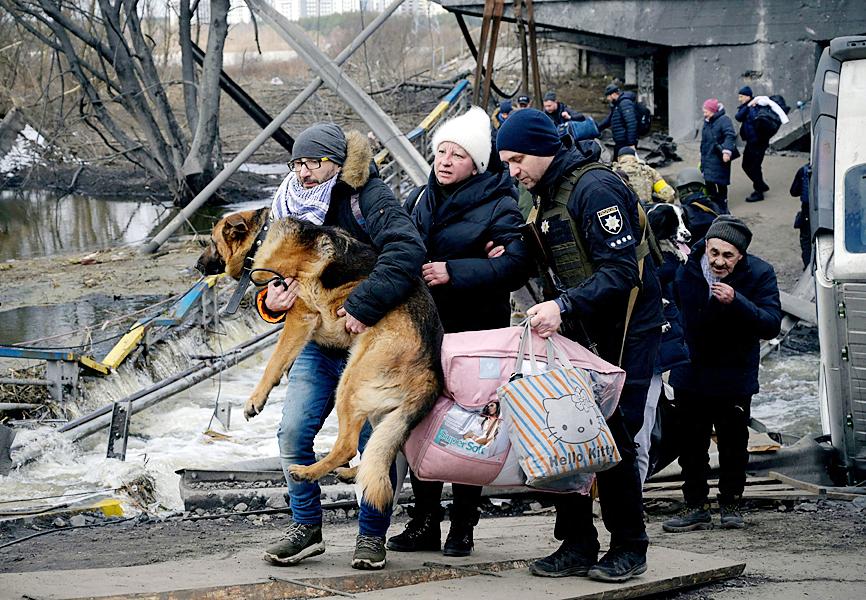
Photo: Reuters
The EU also said it would slash gas imports by two-third.
Kremlin spokesman Dmitry Peskov cast the West’s sanctions as “hostile bacchanalia” that had roiled global markets and warned that it was unclear how far turbulence on global energy markets would go.
Russia might rethink its energy-supply commitments in light of the sanctions, he told reporters.

Photo: EPA-EFE
“European leaders unanimously recognize that Russia is fulfilling all its contractual obligations without interruption and in full,” Peskov said. “But you see the hostile bacchanalia that the countries of the ‘collective West’ have caused of course makes the situation very difficult and forces us to seriously think about this.”
Meanwhile, renewed efforts to evacuate civilians from besieged and bombarded Ukrainian cities were under way yesterday, as authorities seek to rescue people from increasingly dire conditions. Days of shelling have largely cut residents of the southern city of Mariupol off from the outside world, and forced them to scavenge for food and water.
Authorities announced another ceasefire to allow civilians to escape from Mariupol, Sumy in the northeast, Enerhodar in the south, Volnovakha in the southeast, Izyum in the east and several towns in the region around the capital, Kyiv.
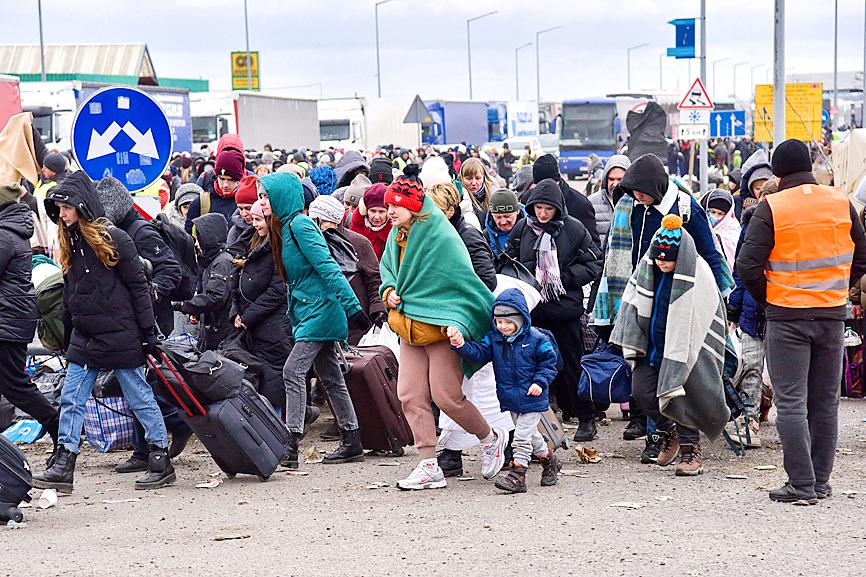
Photo: EPA-EFE
Previous attempts to establish safe evacuation corridors have largely failed due to attacks by Russian forces, and there were few details on yesterday’s new effort.
However, air raid sirens repeatedly went off in the capital and explosions could be heard there, raising tensions in the rattled city.
Mariupol, where nearly half of the population of 430,000 is hoping to flee, has been surrounded by Russian forces for days. Corpses lie in the streets, and people break into stores in search of food and melt snow for water. Thousands huddle in basements, sheltering from the Russian shells pounding the strategic port on the Azov Sea.
Thousands of people are thought to have been killed, both civilians and soldiers, in two weeks of fighting since Putin’s forces invaded.
The UN estimates that more than 2 million people have fled the country, the biggest exodus of refugees in Europe since the end of World War II.
The crisis is likely to get worse as Russian forces step up their bombardment of cities throughout the country in response to stronger-than-expected resistance from Ukrainian forces.
Russian losses have been “far in excess” of what Putin and his generals expected, CIA Director William Burns told a US congressional meeting on Tuesday.
An intensified push by Russian forces could mean “an ugly next few weeks,” he said, adding that Putin was likely to “grind down the Ukrainian military with no regard for civilian casualties.”
The British Ministry of Defence yesterday said that fighting continued northwest of Kyiv. The cities of Kharkiv, Chernihiv, Sumy and Mariupol were being heavily shelled and remained encircled by Russian forces.
Russian forces were placing military equipment on farms and amid residential buildings in the northern city of Chernihiv, Ukraine’s general staff said.
In the south, Russians dressed in civilian clothes were advancing on the city of Mykolaiv, a Black Sea shipbuilding center of half a million people, it said.
Meanwhile, the Ukrainian military was building up defenses in cities in the north, south and east, and forces around Kyiv are “holding the line” against the Russian offensive.
Ukraine’s state-run nuclear company Energoatom yesterday said that radioactive substances could be released from the Chernobyl nuclear power plant because it cannot cool spent nuclear fuel after its power connection was severed.
It said that fighting made it impossible to immediately repair the high-voltage power line to the plant, which was captured by Russian forces.
Energoatom said there were about 20,000 spent fuel assemblies at Chernobyl that could not be kept cool amid a power outage.
Their warming could lead to “the release of radioactive substances into the environment. The radioactive cloud could be carried by wind to other regions of Ukraine, Belarus, Russia, and Europe,” it said in a statement.

A signaling system malfunction disrupted high-speed rail (HSR) services beginning at 8am today, with trains temporarily reduced to three northbound and three southbound trains per hour as authorities conduct inspections. The malfunction occurred on a section of track in Miaoli County during pre-operation checks early this morning, forcing northbound and southbound trains to use a single track, the HSR operator said. The regular schedule has been replaced with three hourly trains offering only nonreserved seating in each direction, stopping at every station, it said, adding that business class cars would still have reserved seating. Departures from terminal stations are scheduled at the top

Taiwan is still in the process of assessing the possibility of recruiting workers from Eswatini, the Ministry of Foreign Affairs said yesterday, adding that its goal is to help Eswatini upgrade its vocational training centers. If there are plans to recruit workers from Eswatini, safeguarding national security, protecting public health and ensuring the employment rights of Taiwanese would be prerequisites, Department of West Asian and African Affairs Director-General Yen Chia-liang (顏嘉良) told a news conference. Key considerations would also include filling labor shortages in specific industries, and fostering bilateral professional and technical exchanges, he said. Yen was asked about the progress of labor

A US uncrewed surface vessel (USV) encountered multiple Chinese warships during an autonomous transit of the Taiwan Strait, US defense company Seasats said in a statement on Wednesday. Seasats announced that a Lightfish USV had completed the first autonomous transit of the Taiwan Strait. Over five days, the USV traversed the entire length of the Strait while constantly monitoring surface vessel traffic, the company said. The Lightfish encountered multiple Chinese warships, one of which was a Chinese People’s Liberation Army Navy (PLAN) Type 056 corvette, it said. The Chinese vessels were operating “well within Taiwan’s exclusive economic zone without transmitting their identity via the

VERBOSE VESSELS: A CGA cutter and a China Coast Guard exchanged verbal barbs for more than a day in Taiwanese-controlled waters before the Chinese vessel left The Taiwanese and Chinese coast guards had a standoff near the strategically located Pratas Islands (Dongsha Islands, 東沙群島) in the north of the South China Sea, the Coast Guard Administration (CGA) said yesterday. The two sides engaged in intense radio exchanges over sovereignty claims during the 33-hour standoff. China Coast Guard vessel 3501 eventually left the restricted waters, 26.6 nautical miles (49.2km) west of the Pratas Islands, at 5pm yesterday, the CGA said. Lying approximately between southern Taiwan and Hong Kong, the Taiwan-controlled Pratas are seen by some security experts as vulnerable to Chinese attack due to their distance — more than


 RSS
RSS