


British Prime Minister Boris Johnson on Saturday said that if Western nations failed to fulfill their promises to support Ukraine’s independence, it would have damaging consequences worldwide, including for Taiwan.
Russian troops are massed near Ukraine’s borders, and Russian President Vladimir Putin has overseen military exercises by strategic nuclear missile forces, but Russia rejects Western concerns that it is poised to invade.
“We do not fully know what President Putin intends, but the omens are grim,” Johnson told a security conference in Munich, Germany.
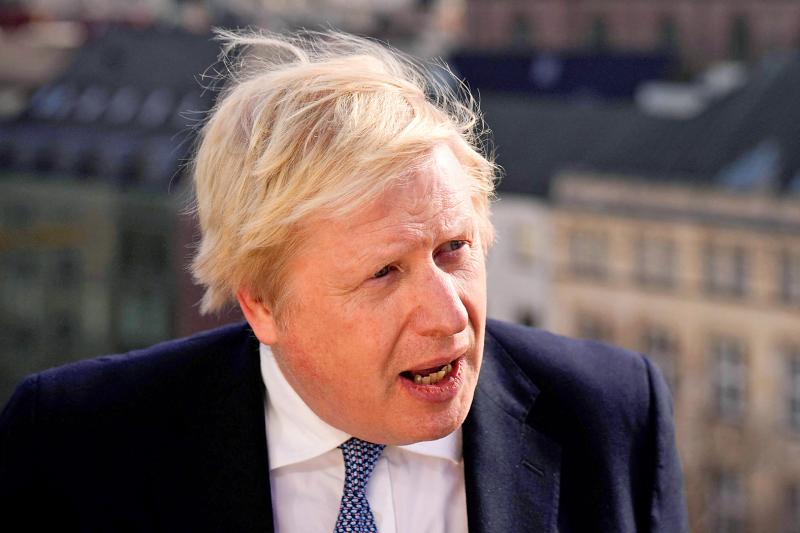
Photo: AFP
“If Ukraine is endangered, the shock will echo around the world, and those echoes will be heard in East Asia, will be heard in Taiwan,” he said. “People would draw the conclusion that aggression pays and that might is right.”
China has threatened the use of force to gain control of Taiwan.
Johnson said that Western nations have repeatedly told Ukraine that they would support its independence.
“How hollow, how meaningless, how insulting those words would seem, if at the very moment when their sovereignty and independence is imperiled, we simply look away,” he said.
On Tuesday, the UK said it could block Russian companies from raising capital in London, and passed legislation to widen sanctions on Russian businesses and individuals if the country invades Ukraine.
“We will sanction Russian individuals and companies of strategic importance to the Russian state, and we will make it impossible for them to raise finance on the London capital markets,” Johnson said.
Europe must also wean itself off Russian oil and gas supplies to stop being at risk of being blackmailed, he added.

The Tourism Administration yesterday announced that it would reward repeat international visitors with incentives of up to NT$8,000 to boost inbound tourism. The incentives are available to all international tourists, it said, adding that repeat visitors would be rewarded with NT$5,000 and would receive an additional NT$3,000 if they bring travel companions. The nation received 2,990,657 inbound visitors during the first quarter, marking a 3.8 percent increase from the same period last year, agency data showed. Japanese nationals are among groups visiting Taiwan the most. About 1.48 million Japanese tourists arrived last year, a year-on-year increase of more than 12
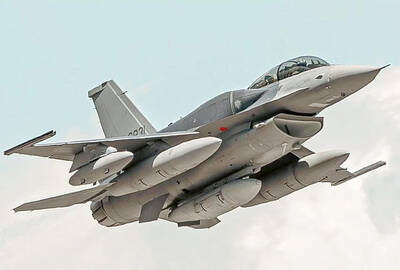
66 FIGHTER JETS: The aircraft is likely undergoing preparations for its transfer to Taiwan — a significant step forward in the nation’s modernization program, a lawmaker said The first of Taiwan’s order of F-16V Block 70 aircraft has been sighted in Texas ahead of delivery, Democratic Progressive Party (DPP) Legislator Wang Ting-yu (王定宇) said. Taiwan’s first F-16V Block 70 two-seat aircraft, tail number 6831, was seen flying from Lockheed Martin’s production facility in Greenville, South Carolina, to Naval Air Station Joint Reserve Base Fort Worth in Texas, Wang wrote on Facebook yesterday. The plane is likely undergoing preparations for its transfer to Taiwan, marking a significant step forward in the Republic of China Air Force’s modernization program, Wang said, citing military analysts. The F-16V Block 70 is a new-build version
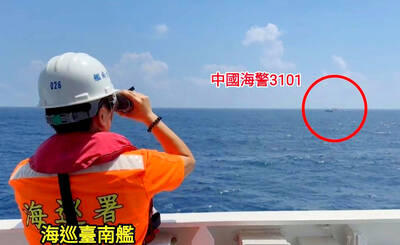
‘BRAZEN’: The holiday did not stop China from activities that infringe on Taiwan’s maritime jurisdiction, but the CGA is ready to defend the nation, Kuan Bi-ling said Beijing is intensifying maritime pressure on Taiwan, but the nation will never yield, Ocean Affairs Council Deputy Minister Sung Chen-en (宋承恩) said. The Coast Guard Administration (CGA) has adopted a “shadowing and monitoring” approach to avoid falling into a Chinese trap to escalate tensions and deepen the conflict, Sung said in an interview published yesterday in the Chinese-language Liberty Times (the Taipei Times’ sister newspaper). China Coast Guard formations patrolling waters east of Taiwan, as well as official Chinese vessels entering areas around Itu Aba Island (Taiping Island, 太平島) and Pratas Islands (Dongsha Islands, 東沙群島) show Beijing’s attempts to significantly step up
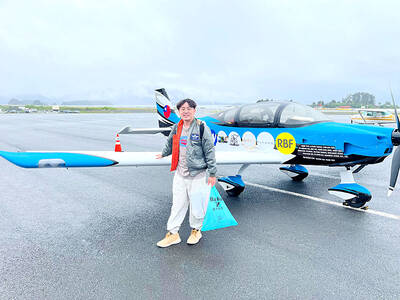
Taiwanese aviator Roger Lin (林睿哲) returned to Taiwan on Saturday after completing a nine-day round-the-world journey in a single-engine aircraft, becoming the first Taiwanese pilot to achieve the feat. Lin departed on June 5 from Los Angeles, California, and continued through Alaska, Japan, Taiwan, the Philippines, Indonesia, Malaysia, Thailand, Nepal, Jordan, Norway, Iceland and Canada before landing at the Taipei International Airport (Songshan) via Los Angeles and Japan. Lin shared numerous photos and videos of his journey on a Facebook page titled “Pilot Roger’s Around the World Flight,” including a video showing his aircraft flying over the Danjiang Bridge and


 RSS
RSS