


Australian political leaders apologized to staffers who have endured decades of bullying, harassment and sexual assault at Parliament House and other government offices.
The presiding officers of the Australian House of Representatives and Senate yesterday delivered the apology on behalf of a cross-section of parties as part of a statement acknowledging a toxic workplace culture.
That culture was exposed by Australian Sex Discrimination Commissioner Kate Jenkins’ investigation.

Photo: EPA-EFE
The investigation was triggered by former government staffer Brittany Higgins, who went public a year ago with her allegation that she had been raped by a more senior colleague in a minister’s Parliament House office weeks before the 2019 election.
Higgins said she felt that she had to make a choice between reporting her allegations to police and continuing her career.
She quit her government job in January last year and reported her allegation to police.
Higgins was one of seven women who were given exemptions from a disease prevention ban on viewers sitting in the public gallery of the House.
Australian Prime Minister Scott Morrison thanked Higgins for the courage she had shown in making her allegations.
“I am sorry. We are sorry. I’m sorry to Ms Higgins for the terrible things that took place here,” Morrison told parliament.
“The place that should have been a place of safety and contribution turned out to be a nightmare. But I’m sorry for far more than that. For all of those who came before Ms Higgins and endured the same, but she had the courage to speak, and so here we are,” Morrison added.
More than 1,700 people made contributions to Jenkins’ report.
Her report found that 37 percent of people currently in parliamentary workplaces had experienced bullying and 33 percent had experienced sexual harassment.
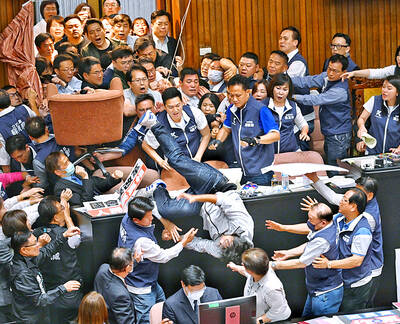
MUSICAL INTERLUDE: During the altercations, KMT Legislator Hsu Chiao-hsin at one point pulled out a flute and started to play the national anthem A massive brawl erupted between governing and opposition lawmakers in the main chamber of the legislature in Taipei yesterday over legislative reforms. President-elect William Lai (賴清德) is to be inaugurated on Monday, but his Democratic Progressive Party (DPP) lost its majority in the legislature and the Chinese Nationalist Party (KMT) has been working with the Taiwan People’s Party (TPP) to promote their mutual ideas. The opposition parties said the legislative reforms would enable better oversight of the Executive Yuan, including a proposal to criminalize officials who are deemed to make false statements in the legislature. “The DPP does not want this to be
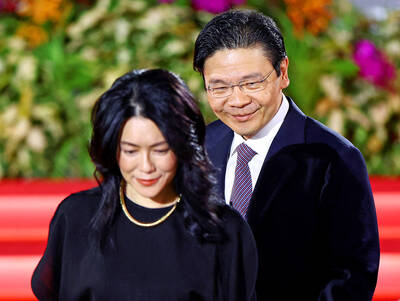
Singapore yesterday swore in Lawrence Wong (黃循財) as the city-state’s new prime minister in a ceremony broadcast live on television after Lee Hsien Loong (李顯龍) stepped down following two decades in office. Wong, formerly deputy prime minister, was inaugurated at the Istana government office shortly after 8pm to become the second person outside the Lee family to lead the nation. “I ... do solemnly swear that I will at all times faithfully discharge my duties as prime minister according to law, and to the best of my knowledge and ability, without fear or favor, affection or ill-will. So help me God,” the
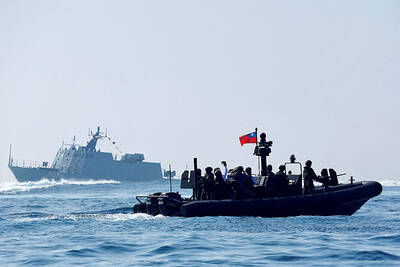
BASIC OPERATIONS: About half a dozen navy ships from both countries took part in the days-long exercise based on the Code for Unplanned Encounters at Sea An unpublicized joint military exercise between Taiwan and the US in the Pacific Ocean last month was carried out in accordance with an international code, the Ministry of National Defense (MND) said yesterday. According to a Reuters report citing four unnamed sources, the two nations’ navies last month conducted joint drills in the Western Pacific. The drills were not made public at the time, but “about half-a-dozen navy ships from both sides, including frigates and supply and support vessels, participated in the days-long exercises,” Reuters reported, citing the sources. The drills were designed to practice “basic” operations such as communications, refueling and resupplies,

‘TOO LATE’: Yu Pei-chen, a Taoyuan councilor and ex-army general, said the Chinese officials were 41 years late in imposing sanctions on him, as he enlisted in 1983 China’s Taiwan Affairs Office (TAO) yesterday announced sanctions against five Taiwanese politicians, pundits and public figures critical of Beijing, accusing them of spreading disinformation about China. The five are: Liu Bao-jie (劉寶傑), Lee Zheng-hao (李正皓), Wang Yi-chuan (王義川), Yu Pei-chen (于北辰), Huang Shih-tsung (黃世聰), TAO spokesman Chen Binhua (陳斌華) told a routine news briefing, adding that the sanctions included their families. They were responsible for making up and spreading false information about China that “deceived some Taiwanese, sowed division ... and harmed brotherly goodwill across the Strait,” Chen said. Speech is not free from the regulations of Chinese law, which punishes manufacturing incorrect


 RSS
RSS