


The Central Epidemic Command Center (CECC) yesterday said it expects imported cases of COVID-19 to further increase today and tomorrow — the peak period for international arrivals before the Lunar New Year holiday.
The nation has seen more imported cases of COVID-19 since it implemented a new policy on Tuesday requiring travelers on long-haul flights to undergo a polymerase chain reaction (PCR) test upon arrival.
Those who test positive are taken directly to hospitals from airports.
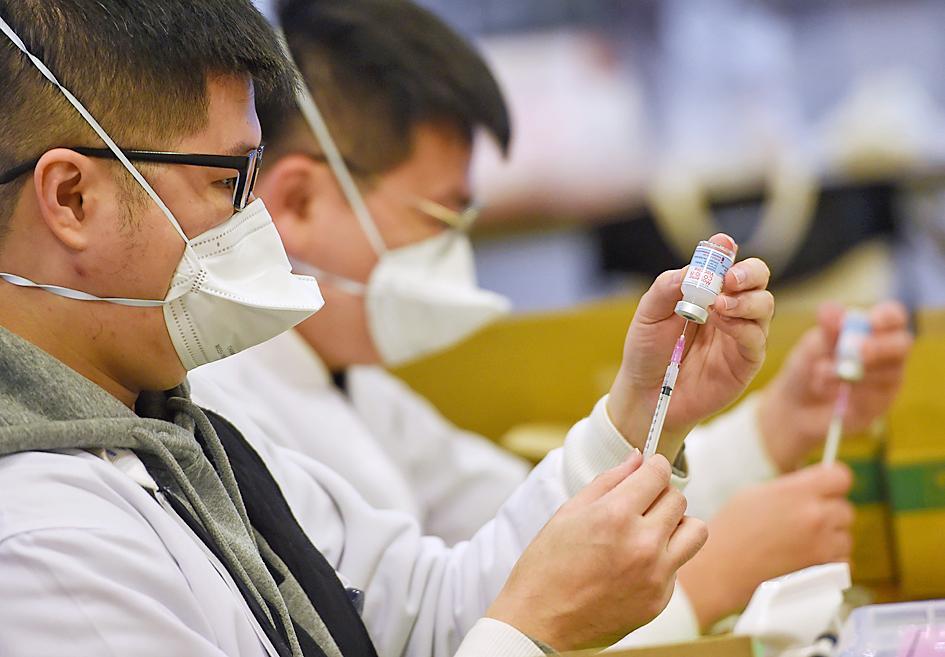
Photo: Liu Hsin-de, Taipei Times
Most of the recent confirmed cases of COVID-19 were travelers arriving from the US, CECC data showed.
On Tuesday, 58 of the 625 travelers arriving at Taiwan Taoyuan International Airport tested positive for COVID-19, a positivity rate of 9.28 percent, with 30 of the 58 confirmed cases coming from the US, the data showed.
On Wednesday, 24 of the 430 travelers arriving at Taoyuan airport tested positive, a positivity rate of 5.58 percent. Of the 24 confirmed cases, 19 came from the US, the center said.
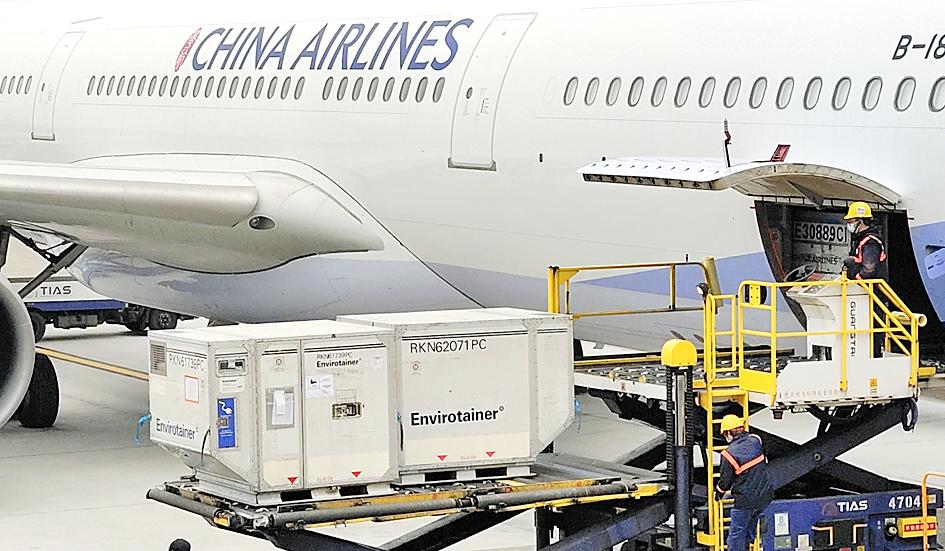
Photo: Tony Yao, Taipei Times
Yesterday morning, 14 of the 180 arriving travelers tested positive, with 13 of the confirmed cases coming from the US, it said.
Victor Wang (王必勝), the center’s on-site commander at Taoyuan airport, said more international travelers are expected to arrive today and tomorrow, when most people are returning for the Lunar New Year holiday, which begins on Jan. 31.
Visitors from overseas are required to undergo a 14-day quarantine.
“We expect the positivity rate to remain high among travelers” arriving today and tomorrow, he said.
About 4,200 people are expected to arrive today and 3,900 tomorrow, said Centers for Disease Control Director-General Chou Jih-haw (周志浩), who also heads the CECC’s disease surveillance division.
To ease the burden on hospitals, Wang said that travelers on the same flight, or of the same gender or family can now stay in the same ward.
Asked if some inbound travelers might have “bought” negative PCR test reports before departure to be allowed to travel — which might explain the relatively high positivity rate among international arrivals — Wang said it is possible that the travelers took the test when the disease was still in the incubation phase.
“It would be difficult to verify the authenticity of the report, and therefore it is necessary to administer PCR tests upon their arrival,” he said.
Unlike Tuesday, when some of the passengers waited up to four hours for PCR test results, CECC personnel at Taoyuan airport are now able to complete the test in about one hour after implementing changes to facilitate testing, he added.
The CECC yesterday reported 14 new domestic cases of COVID-19, all but one of which were linked to a wider outbreak of the disease originating at Taoyuan airport.
The first case related to the airport, involving a janitor, was reported on Monday last week.
Several other airport personnel and their family members and friends have since tested positive for COVID-19, and the disease has spread among the contacts of those cases.
Among the 14 domestic cases reported yesterday, 13 can be traced back to the airport. Two are family members of previously confirmed cases, 10 are employees at the Union Bank of Taiwan’s Taoyuan branch and one is a family member of a bank employee.
The source of the cluster at the bank is the relative of an airport employee who earlier tested positive for the disease.
The woman visited the branch on Jiansing Road in Jhongli District (中壢) on Dec. 30 and Tuesday last week, said Minister of Health and Welfare Chen Shih-chung (陳時中), who heads the center.
Surveillance footage shows that during her visit on Tuesday last week, which lasted an hour, she took off her mask while talking on her cellphone, Chen told a news briefing in Taipei yesterday.
As three bank employees tested positive for COVID-19 on Wednesday, the bank cluster has 14 cases.
The infected employees work on different floors at the branch, and it is possible that they caught the disease at work or during a year-end dinner on Friday, Chen said.
The other 17 bank employees tested negative, Chen said.
The other new domestic case is a nurse who treats COVID-19 patients at Taipei City Hospital’s Renai branch.
The woman began showing symptoms on Tuesday and she tested positive the next day, CECC specialist advisory panel convener Chang Shan-chwen (張上淳) said.
Eleven of the new domestic cases have been classified as breakthrough cases of COVID-19, while a woman in her 20s and a boy younger than 10 had not been vaccinated, he said, adding that the vaccination status of one case was still being determined.
The center also reported one death, a Taiwanese man in his 50s.
The man began experiencing COVID-19 symptoms early last month when he was in Vietnam and he returned to Taiwan on a medical charter flight on Dec. 17.
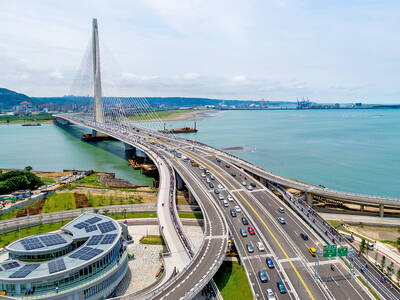
The Ministry of Transportation and Communications yesterday inaugurated the Danjiang Bridge across the Tamsui River in New Taipei City, saying that the structure would be an architectural icon and traffic artery for Taiwan. Feted as a major engineering achievement, the Danjiang Bridge is 920m long, 211m tall at the top of its pylon, and is the longest single-pylon asymmetric cable-stayed bridge in the world, the government’s Web site for the structure said. It was designed by late Iraqi-British architect Zaha Hadid. The structure, with a maximum deck of 70m, accommodates road and light rail traffic, and affords a 200m navigation channel for boats,
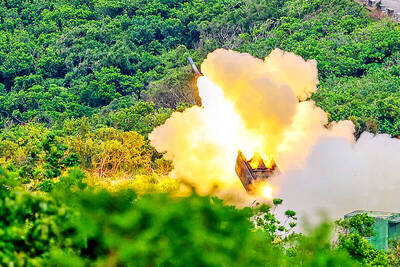
PRECISION STRIKES: The most significant reason to deploy HIMARS to outlying islands is to establish a ‘dead zone’ that the PLA would not dare enter, a source said A High Mobility Artillery Rocket System (HIMARS) would be deployed to Penghu County and Dongyin Island (東引) in Lienchiang County (Matsu) to force the Chinese military to retreat at least 100km from the coastline, a military source said yesterday. Taiwan has been procuring HIMARS and Army Tactical Missile Systems (ATACMS) from the US in batches. Once all batches have been delivered, Taiwan would possess 111 HIMARS units and 504 ATACMS, which have a range of 300km. Considering that “offense is the best defense,” the military plans to forward-deploy the systems to outlying islands such as Penghu and Dongyin so that
Taiwan Semiconductor Manufacturing Co (TSMC, 台積電), the world’s largest foundry service provider, yesterday said that global semiconductor revenue is projected to hit US$1.5 trillion in 2030, after the figure exceeds US$1 trillion this year, as artificial intelligence (AI) demand boosts consumption of token and compute power. “We are still at the beginning of the AI revolution, but we already see a significant impact across the whole semiconductor ecosystem,” TSMC deputy cochief operating officer Kevin Zhang (張曉強) said at the company’s annual technology symposium in Hsinchu City. “It is fair to say that in the past decade, smartphones and other mobile devices were
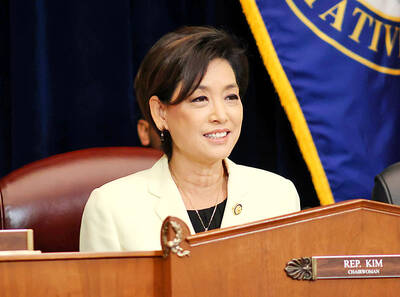
‘CLEAR MESSAGE’: The bill would set up an interagency ‘tiger team’ to review sanctions tools and other economic options to help deter any Chinese aggression toward Taiwan US Representative Young Kim has introduced a bill to deter Chinese aggression against Taiwan, calling for an interagency “tiger team” to preplan coordinated sanctions and economic measures in response to possible Chinese military or political action against Taiwan. “[Chinese President] Xi Jinping [習近平] has directed the People’s Liberation Army to be ready to invade Taiwan by 2027. China has a plan. America should have one too,” Kim said in a news release on Thursday last week. She introduced the “Deter PRC [People’s Republic of China] aggression against Taiwan act” to “ensure the US has a coordinated sanctions strategy ready should


 RSS
RSS