


A monument at a Hong Kong university that commemorates the 1989 Tiananmen Square Massacre was removed by workers yesterday over the objections of its Danish creator.
The 8m Pillar of Shame, which depicts 50 torn and twisted bodies piled on top of each other, was created by sculptor Jens Galschiot to symbolize the lives lost during the bloody military crackdown on protesters in Beijing’s Tiananmen Square on June 4, 1989.
Workers barricaded the monument at the University of Hong Kong on Wednesday night.
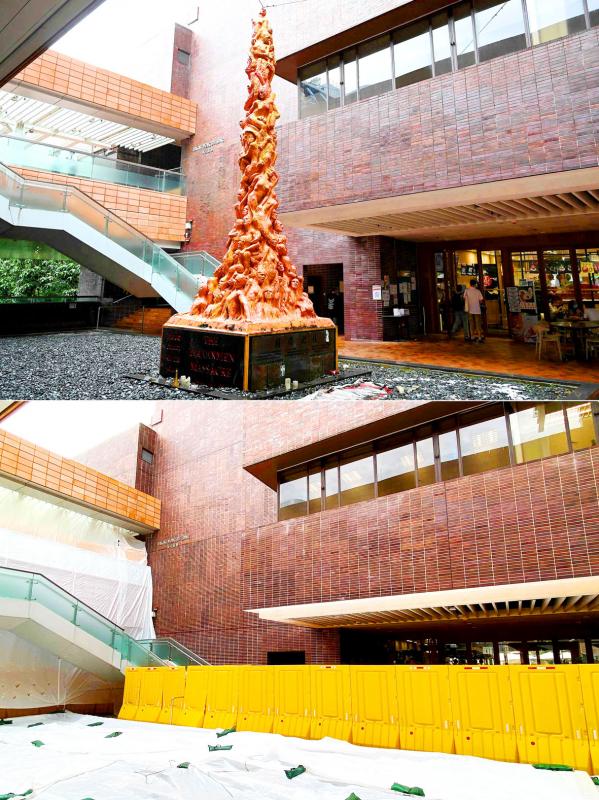
Photo: AFP
Drilling sounds and loud clanging could be heard coming from the boarded-up site, which was patrolled by guards.
The removal happened in the same week that Hong Kong Chief Executive Carrie Lam (林鄭月娥) traveled to Beijing to report on developments in the territory, where authorities have silenced dissent following the implementation of a sweeping National Security Law that appeared to target democracy advocates following mass protests in 2019.
The Pillar of Shame became an issue in October, with the university demanding that it be removed, even as rights advocates protested.
Galschiot offered to take it back to Denmark, provided he was given legal immunity that he would not be prosecuted under the security law, but has not succeeded so far.
“No party has ever obtained any approval from the university to display the statue on campus, and the university has the right to take appropriate actions to handle it at any time,” the university said in a statement yesterday.
“Latest legal advice given to the university cautioned that the continued display of the statue would pose legal risks to the university based on the Crimes Ordinance enacted under the Hong Kong colonial government,” it said.
Galschiot said he was only aware of what was happening to the sculpture on Wednesday from social media and other reports.
“We don’t know exactly what happened, but I fear they destroy it,” he said. “This is my sculpture and it is my property.”
Galschiot said that he would sue the university if necessary to protect the sculpture.

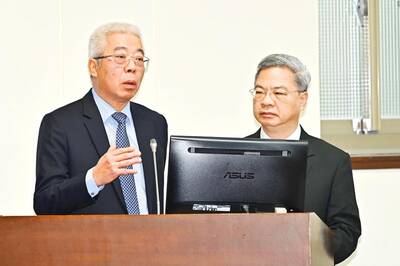
Taiwan has arranged for about 8 million barrels of crude oil, or about one-third of its monthly needs, to be shipped from the Red Sea this month to bypass the Strait of Hormuz and ease domestic supply pressures, CPC Corp, Taiwan (CPC, 台灣中油) said yesterday. The state-run oil company has worked with Middle Eastern suppliers to secure routes other than the Strait of Hormuz, through which about 20 percent of the world’s oil and liquefied natural gas typically passes, CPC chairman Fang Jeng-zen (方振仁) said at a meeting of the legislature’s Economics Committee in Taipei. Suppliers in Saudi Arabia have indicated they
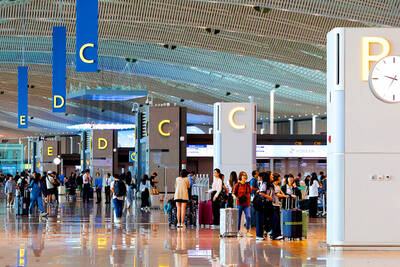
South Korea has adjusted its electronic arrival card system to no longer list Taiwan as a part of China, a move that the Ministry of Foreign Affairs said would help facilitate exchanges between the two sides. South Korea previously listed “Taiwan” as “Taiwan (China)” in the drop-down menus of its online arrival card system, where people had to fill out where they came from and their next destination. The ministry had requested South Korea make a revision and said it would change South Korea’s name on Taiwan’s online immigration system from “Republic of Korea” to “Korea (South),” should the issue not be

Tainan, Taipei and New Taipei City recorded the highest fines nationwide for illegal accommodations in the first quarter of this year, with fines issued in the three cities each exceeding NT$7 million (US$220,639), Tourism Administration data showed. Among them, Taipei had the highest number of illegal short-term rental units, with 410. There were 3,280 legally registered hotels nationwide in the first quarter, down by 14 properties, or 0.43 percent, from a year earlier, likely indicating operators exiting the market, the agency said. However, the number of unregistered properties rose to 1,174, including 314 illegal hotels and 860 illegal short-term rental
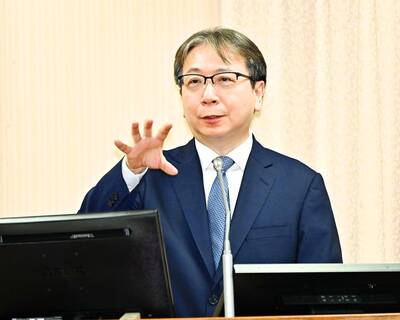
AIR ALERT: China’s reservation of airspace over the Yellow Sea and East China Sea could be an attempt to test the US’ response ahead of a Trump-Xi meeting, the NSB head said China’s attempts to infiltrate Taiwan are systematic, planned and targeted, with activity shifting from recruiting mid-level military officers to rank-and-file enlisted personnel, National Security Bureau (NSB) Director-General Tsai Ming-yen (蔡明彥) said yesterday. The Chinese Communist Party’s (CCP) integrates national security, intelligence operations and “united front” efforts into a dense network to conduct intelligence gathering and espionage in Taiwan, Tsai said at a meeting of the legislature’s Foreign Affairs and National Defense Committee. It uses specific networks to screen targets through exchange activities and recruiting local collaborators to establish intelligence-gathering organizations, he said. China is also shifting who it targets to lower-ranking military personnel,


 RSS
RSS