


Existing COVID-19 vaccines will struggle against the fast-spreading Omicron variant of SARS-CoV-2, the head of vaccine manufacturer Moderna said yesterday.
First reported to the WHO in southern Africa less than a week ago, the new strain has rapidly spread from Africa to the Pacific, and from Europe to North America as dozens of countries have announced travel restrictions.
While no deaths have yet been reported from Omicron, and it could take weeks to know how infectious and how resistant the strain might prove to vaccines, its emergence underscores how besieged the world remains by COVID-19, nearly two years after the first cases were recorded.
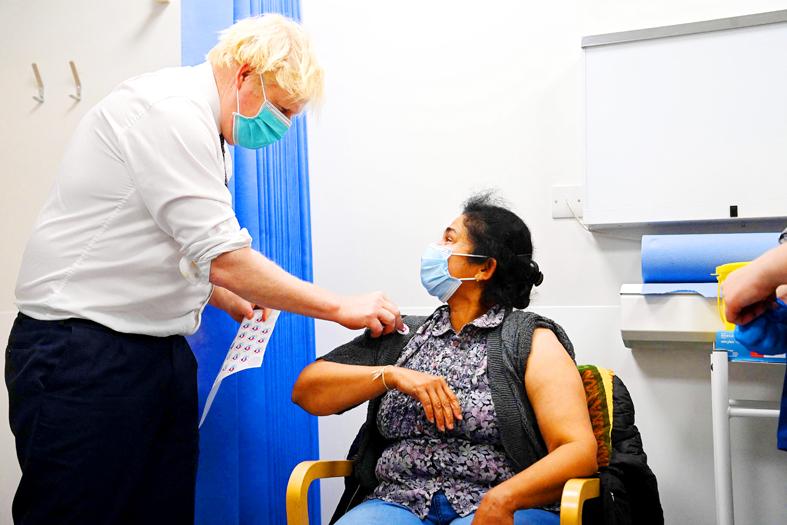
Photo: AFP
Moderna CEO Stephane Bancel told the Financial Times in an interview published yesterday that data would be available on the effectiveness of vaccines in two weeks’ time, but that scientists were pessimistic.
“All the scientists I’ve talked to ... are like: ‘This is not going to be good,’” Bancel said, warning against a “material drop” in the effectiveness of current jabs against Omicron.
Pfizer, another US drug maker, on Monday said that it began on Friday testing its current COVID-19 vaccine against the Omicron variant.
“I don’t think the result will be the vaccines don’t protect,” Pfizer CEO Albert Bourla said.
However, the testing could show that existing shots “protect less,” which would mean “that we need to create a new vaccine,” he said.
“Friday we made our first DNA template, which is the first possible inflection of the development process of a new vaccine,” he said.
Johnson & Johnson (J&J) also said on Monday that it is “pursuing an Omicron-specific variant vaccine and will progress it as needed.”
China warned that the fast-spreading Omicron variant would cause challenges in hosting February’s Winter Olympics in Beijing, with thousands of athletes, media and participants arriving from overseas required to enter a strict “closed-loop” bubble.
“But China has a lot of experience in responding to COVID-19,” Chinese Ministry of Foreign Affairs spokesman Zhao Lijian (趙立堅) said. “I firmly believe the Winter Olympics will be conducted smoothly.”
On Monday, US President Joe Biden said the strain was “a cause for concern, not a cause for panic,” adding that he does not foresee new lockdowns or extending travel restrictions for now.
Meanwhile, the US Centers for Disease Control and Prevention on Monday broadened its recommendation for COVID-19 booster shots for all adults as the new Omicron variant is identified in more countries.
The agency had previously approved boosters for all adults, but only recommended them for those 50 years and older or if they live in a long-term care setting.
“Everyone ages 18 and older should get a booster shot either when they are 6 months after their initial Pfizer or Moderna series or 2 months after their initial J&J vaccine,” CDC Director Rochelle Walensky said in a statement.

Japan has deployed long-range missiles in a southwestern region near China, the Japanese defense minister said yesterday, at a time when ties with Beijing are at their lowest in recent years. The missiles were installed in Kumamoto in the southern region of Kyushu, as Japan is attempting to shore up its military capacity as China steps up naval activity in the East China Sea. “Standoff defense capabilities enable us to counter the threat of enemy forces attempting to invade our country ... while ensuring the safety of our personnel,” Japanese Minister of Defense Shinjiro Koizumi said. “This is an extremely important initiative for

MORE POPULAR: Taiwan Pass sales increased by 59 percent during the first quarter compared with the same period last year, the Tourism Administration said The Tourism Administration yesterday said that it has streamlined the Taiwan Pass, with two versions available for purchase beginning today. The tourism agency has made the pass available to international tourists since 2024, allowing them to access the high-speed rail, Taiwan Railway Corp services, four MRT systems and four Taiwan Tourist Shuttles. Previously, five types of Taiwan Pass were available, but some tourists have said that the offerings were too complicated. The agency said only two types of Taiwan Pass would be available, starting from a three-day pass with the high-speed rail and a three-day pass with Taiwan Railway Corp. The former costs NT$2,800

POLLS CONCERNS: There are concerns within the KMT that a Cheng Li-wun-Xi Jinping meeting could trigger a voter backlash in elections in November Chinese Nationalist Party (KMT) Chairwoman Cheng Li-wun (鄭麗文) accepted an invitation from Chinese President Xi Jinping (習近平) to visit next month, her party and Chinese state media reported yesterday. Cheng, who took up her role in November last year, “gladly accepted” the invitation to lead a delegation to China, the KMT said in a statement, confirming a Xinhua news agency report. Cheng “looks forward to joint efforts by both parties to advance the peaceful development of cross-strait relations, promote cross-strait exchanges and cooperation, and work for peace in the Taiwan Strait and greater well-being for people on both sides,” the statement said. Chinese

SIGNIFICANT TO THE WORLD: The delegation’s visit aims to send a clear message that bipartisan support for Taiwan is consistent, US Senator Jeanne Shaheen said The US Senate’s bipartisan support for Taiwan remains strong and Taiwan-US ties would continue for decades to come, a US Senate delegation said in Taipei yesterday, while calling on the legislature to swiftly pass a special defense budget bill. A US delegation led by Democratic US Senator Jeanne Shaheen and Republican US Senator John Curtis — both members of the US Senate Committee on Foreign Relations — arrived in Taiwan yesterday for a two-day visit. The other senators of the delegation included Senate Taiwan Caucus cochair Thom Tillis and Senate Committee on Armed Services senior member Jacky Rosen. Shaheen told a news


 RSS
RSS