

China’s punitive campaign against Lithuania is “unjustified” and “disproportionate,” and Vilnius allowing Taiwan to set up a representative office in the country does not breach the EU’s “one China” policy, senior leaders of the bloc wrote in an open letter on Thursday.
EU Commission President Ursula von der Leyen and European Council President Charles Michel vowed to “push back” against “threats, political pressure and coercive measures” aimed at any of the bloc’s member states.
Beijing had objected to Lithuania allowing the office to use the name “Taiwanese Representative Office,” rather than a name using “Taipei,” as is common for Taiwan’s representative offices abroad.
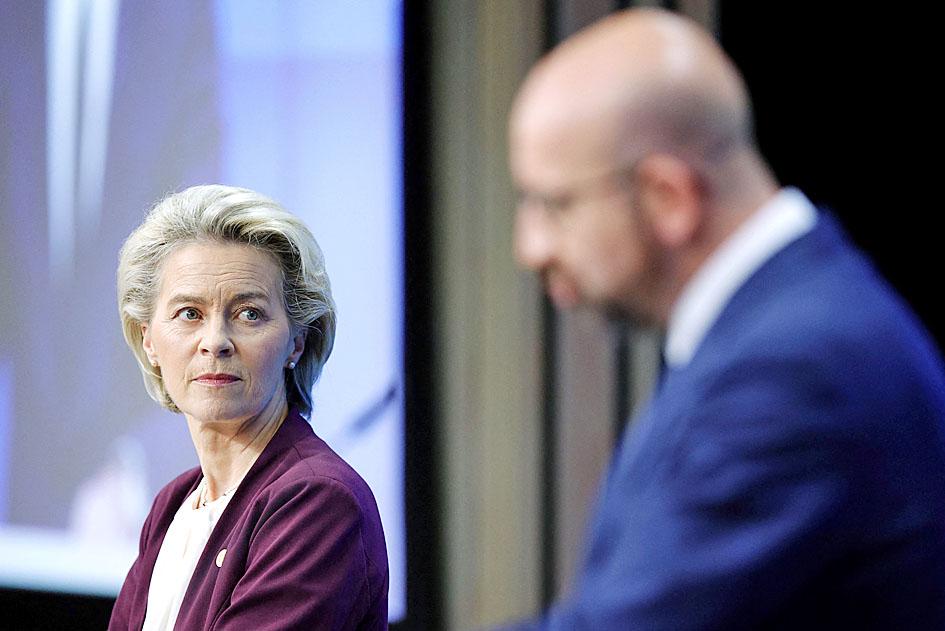
Photo: AFP
Beijing said that the name implied that Taiwan is a sovereign nation.
After Vilnius declined to request a name change, the Chinese Ministry of Foreign Affairs in August requested that Lithuania withdraw its ambassador from Beijing and recalled its own envoy from Vilnius.
Von der Leyen and Michel said that the naming of the representative office does not constitute a breach of the EU’s “one China” policy, and that the EU and its members have the right to deepen their ties and cooperation with Taiwan.
The two EU leaders added that they were in contact with Chinese officials to de-escalate tensions over the issue.
Von der Leyen and Michel’s letter came in response to a letter from the Formosa Club, a group of cross-party EU and Canadian legislators seeking to promote closer ties with Taiwan.
The group’s letter, sent two months ago, called for “a far stronger response” from the EU to the Lithuania-China rift.
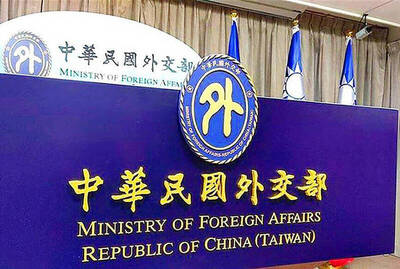
In Taipei, the Ministry of Foreign Affairs yesterday thanked the EU leaders in a statement, saying that the EU and the Formosa Club supporting the development of ties between Taiwan and Lithuania would also contribute to deeper partnerships with other EU nations.

Taiwan, which accounts for more than half of the global outsourced semiconductor assembly and testing market, is well-positioned to develop copackaged optics (CPO) and manufacture precision silicon photonics chips, the Ministry of Economic Affairs said yesterday. Silicon photonics are emerging as a mainstream optical communications technology and is seen as key to overcoming bottlenecks in AI computing power. The technology is a key project under the government’s New 10 Major AI Infrastructure Projects, with industry, government, academia and research institutions working to overcome critical technological hurdles and build a self-reliant silicon photonics supply chain, the ministry said. Nvidia Corp in March invested US$4
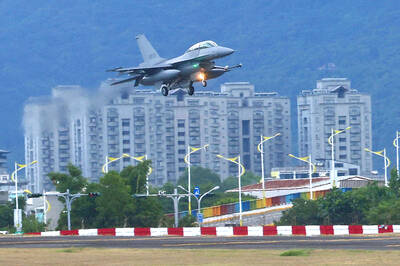
The air force plans to build 26 more hardened aircraft shelters as the number of F-16Vs stationed along Taiwan’s east coast is expected to reach 120 when the final shipment of 66 jets procured from the US arrives. The incoming jets would be stationed at Chihhang Air Base in Taitung County, augmenting the F-16V Block 20s operated by the 5th Tactical Fighter Wing in Hualien County, officials said yesterday. The air force plans to allocate more than NT$6.88 billion (US$218.1 million) from next year to 2031 to build the shelters in Hualien and Taitung as part of the implementation of a “one
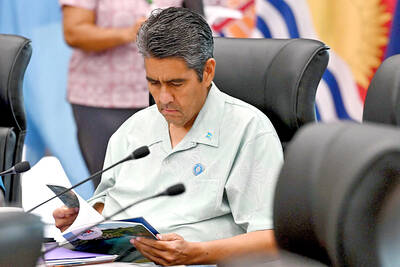
Palau’s president yesterday called for a “unified” Pacific response to a missile test by China in July, while Taiwan and its Pacific allies a day earlier at the Pacific Islands Forum (PIF) reaffirmed their commitment to peace, stability and prosperity. China gave only a handful of nations short notice before test-firing an intercontinental ballistic missile in July, sparking condemnation from several Pacific leaders. The 18-member PIF being held in Palau was expected to release a communique after press time last night, with a formal response to the test possibly included. Palau, which invited Taiwan to attend sideline events as an aid partner, urged
China’s continued efforts to inject geopolitical rivalry into the region and disrupt Pacific nations’ discussions of regional issues warrant greater international attention, a foreign affairs official said yesterday. Minister of Foreign Affairs Lin Chia-lung (林佳龍) last week led a delegation to diplomatic ally Palau to attend events related to the 55th Pacific Islands Forum (PIF) summit. However, the absence of some member-state leaders has been interpreted by some people as a sign of fracturing in Pacific unity. Thirteen PIF members were represented by their heads of state or government, while Fiji, New Caledonia, Vanuatu and Samoa sent ministerial-level representatives, a diplomatic official


 RSS
RSS