


The Central Epidemic Command Center (CECC) yesterday introduced five enhanced COVID-19 monitoring measures to prevent the Delta variant of SARS-CoV-2 from entering local communities.
It also reported four local and two imported COVID-19 cases, and no deaths.
Minister of Health and Welfare Chen Shih-chung (陳時中), who heads the center, said the four cases — two men and two women — were reported in New Taipei City.
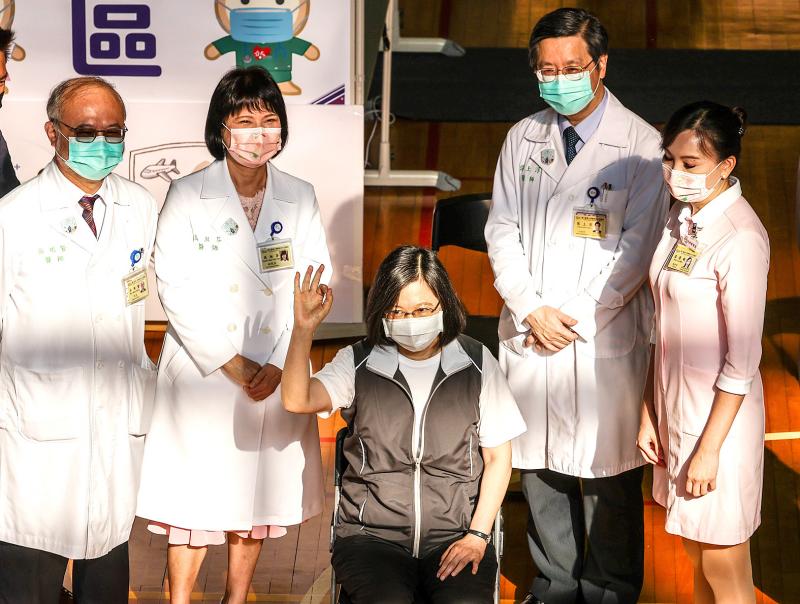
Photo: CNA
Two tested positive during isolation, and the infection sources of the other two remain unclear and are being investigated, he said.
The risk level for Taipei and New Taipei City has been lowered from “high-medium” risk to “medium” risk, but the center is still debating whether visitors should be allowed at long-term care centers in the two municipalities, Chen said, adding that a decision would be made at a meeting tomorrow.
The two imported cases were a student from Russia and a man from Lithuania, CECC data showed.
They both presented negative test results from within three days of boarding a plane to Taiwan and tested negative upon arrival at the airport, but experienced symptoms during quarantine, the data showed.
While the local COVID-19 situation is under control, the center would implement enhanced measures to monitor for virus transmission in local communities, Chen said.
The measures include distributing government-funded COVID-19 home test kits to contracted healthcare facilities from Monday next week, so that physicians can give the kits to high-risk patients, he said.
High-risk workers at the nation’s four international airports would be given a government-funded rapid test every seven days, starting from Monday next week.
Wastewater surveillance would be expanded from 11 areas to 22 to detect early signs of viral transmission within communities, Chen said, adding that another measure would be the continued testing for COVID-19 contamination on imported food packaging, although there have been no positive tests so far.
An antibody test would be conducted to determine the prevalence of COVID-19, its geographical distribution and infection trend in Taiwan, he said, adding that 5,000 random blood samples taken from local blood donation centers between April and last month would be used for the test.
Centers for Disease Control Deputy Director-General Chuang Jen-hsiang (莊人祥), who is the CECC’s spokesman, said that the center has submitted its plan for the antibody test to the institutional review board, and personal identifiers would be removed from the data.
As the Delta variant spreads in many countries, enhanced border control measures and local community COVID-19 monitoring and disease prevention measures must be implemented to prevent it from entering local communities, the CECC said.
Separately, inoculations with the COVID-19 vaccine developed by domestic firm Medigen Vaccine Biologics Corp (高端疫苗) began yesterday.
President Tsai Ing-wen (蔡英文) received her first dose of the vaccine at the gymnasium of National Taiwan University’s College of Medicine at about 7:30am.
The process of Tsai checking in with her National Health Insurance card, speaking with a physician and receiving the shot was broadcast live on the her Facebook page.
Asked if anybody had an adverse reaction after being vaccinated, Chen said that, as of noon, three people fainted or felt faint immediately after they were vaccinated, and they all had low blood pressure and a rapid heartbeat.
One case returned home after being assessed and was found to have no other issues, while the other two were taken to hospital for further examination, but had no other obvious problems, so they left the hospital by noon, he said.
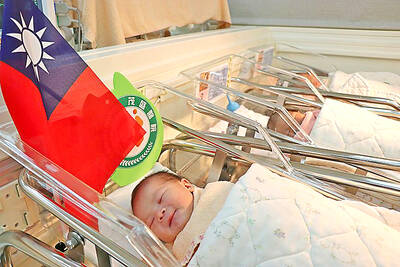
AGING: As of last month, people aged 65 or older accounted for 20.06 percent of the total population and the number of couples who got married fell by 18,685 from 2024 Taiwan has surpassed South Korea as the country least willing to have children, with an annual crude birthrate of 4.62 per 1,000 people, Ministry of the Interior data showed yesterday. The nation was previously ranked the second-lowest country in terms of total fertility rate, or the average number of children a woman has in her lifetime. However, South Korea’s fertility rate began to recover from 2023, with total fertility rate rising from 0.72 and estimated to reach 0.82 to 0.85 by last year, and the crude birthrate projected at 6.7 per 1,000 people. Japan’s crude birthrate was projected to fall below six,
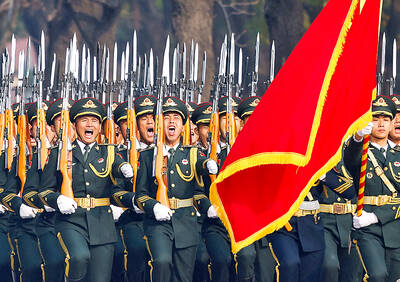
Conflict with Taiwan could leave China with “massive economic disruption, catastrophic military losses, significant social unrest, and devastating sanctions,” a US think tank said in a report released on Monday. The German Marshall Fund released a report titled If China Attacks Taiwan: The Consequences for China of “Minor Conflict” and “Major War” Scenarios. The report details the “massive” economic, military, social and international costs to China in the event of a minor conflict or major war with Taiwan, estimating that the Chinese People’s Liberation Army (PLA) could sustain losses of more than half of its active-duty ground forces, including 100,000 troops. Understanding Chinese
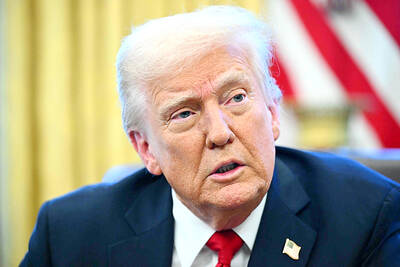
US President Donald Trump in an interview with the New York Times published on Thursday said that “it’s up to” Chinese President Xi Jinping (習近平) what China does on Taiwan, but that he would be “very unhappy” with a change in the “status quo.” “He [Xi] considers it to be a part of China, and that’s up to him what he’s going to be doing, but I’ve expressed to him that I would be very unhappy if he did that, and I don’t think he’ll do that. I hope he doesn’t do that,” Trump said. Trump made the comments in the context
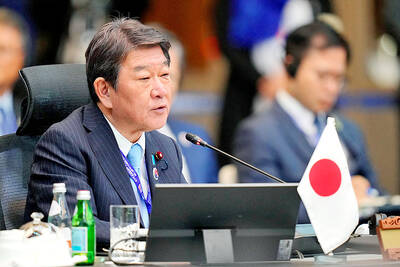
SELF-DEFENSE: Tokyo has accelerated its spending goal and its defense minister said the nation needs to discuss whether it should develop nuclear-powered submarines China is ramping up objections to what it sees as Japan’s desire to acquire nuclear weapons, despite Tokyo’s longstanding renunciation of such arms, deepening another fissure in the two neighbors’ increasingly tense ties. In what appears to be a concerted effort, China’s foreign and defense ministries issued statements on Thursday condemning alleged remilitarism efforts by Tokyo. The remarks came as two of the country’s top think tanks jointly issued a 29-page report framing actions by “right-wing forces” in Japan as posing a “serious threat” to world peace. While that report did not define “right-wing forces,” the Chinese Ministry of Foreign Affairs was


 RSS
RSS