

US President Joe Biden, Russian President Vladimir Putin and Chinese President Xi Jinping (習近平) were yesterday among the world leaders who met virtually for an APEC summit in Wellington, seeking collective actions to navigate the COVID-19 pandemic and its economic fallout.
New Zealand, the revolving APEC host, said this week that it would chair the extraordinary meeting ahead of a formal gathering in November, the first time such an additional meeting has been held.
The meeting was to highlight growing concerns over COVID-19 outbreaks in the Indo-Pacific region, including in Australia, Indonesia and Thailand.

Photo AFP
New Zealand Prime Minister Jacinda Ardern stressed the importance of the 21-member group working together to navigate a way out of the pandemic in a call with Biden ahead of the meeting.
However, tensions among APEC members — mostly notably between the West and China over the origins of COVID-19, trade, Xinjiang and the South China Sea — could yet upend the agenda. A senior Biden administration official said that the US president would use the forum to demonstrate his commitment to a free and open Indo-Pacific region.
“As one of the first opportunities he has to engage with many of these leaders, he will make clear that the US has an enduring commitment to the region. He will put forward a vision for the region that is based on our values,” the official said.
Biden would also discuss how the region can work together to fuel the global economic recovery.
The meeting was to include an “interactive” question-and-answer session where leaders can ask questions or make comments, a format that is unusual for APEC summits, where events are usually scripted.
“We expect a dynamic and interactive discussion among leaders. That is the intention of such a meeting,” a regional diplomat said. “We hope through this leaders’ meeting there will be a more concrete program for mitigating the pandemic.”
APEC includes the world’s three largest economies and impoverished nations such as Papua New Guinea, as well as members at vastly different points in the COVID-19 cycle, providing further challenges for building consensus.
APEC’s consensus model has been tested in the past few years, with the group unable to agree on a communique at a 2018 meeting in Papua New Guinea, driven by differences between the US and China.
The 2019 APEC meeting in Chile was cancelled due to protests, while the one in Malaysia last year saw officials hastily organizing a virtual meeting as the pandemic locked down the world.
Last month, APEC trade ministers agreed to review trade barriers, and expedite the cross-border transit of COVID-19 vaccines, but stopped short of a broad commitment to remove tariffs, which New Zealand was pushing for.
APEC members have recorded more than 50 million virus cases and more than 1 million deaths.
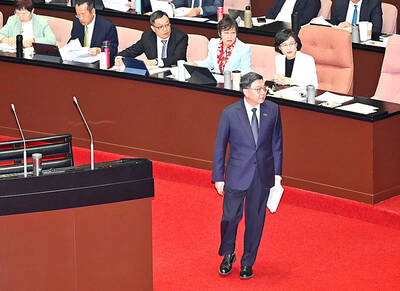
The government is monitoring online rumors that a pneumonic plague outbreak has spread from Russia into China, and it might enhance quarantine measures, Premier Cho Jung-tai (卓榮泰) said yesterday. During a legislative meeting, Democratic Progressive Party Legislator Wang Ting-yu (王定宇) said that rumors had circulated that the disease had spread across several Chinese provinces. He asked Cho whether the government was prepared to prevent the disease spreading to Taiwan, given the volume of traffic between the two sides, and how concerned the government was about the alleged outbreak. The Ministry of Health and Welfare had implemented border quarantine measures after briefing the Executive
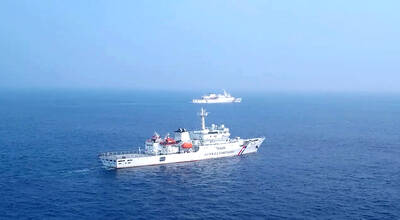
PATROL PARTNERS: The ‘Chiayi’ and the ‘Penghu’ departed for a two-day joint patrol of Palau’s exclusive economic zone, the CGA’s second diplomatic visit to the country The Coast Guard Administration (CGA) set a record for its southernmost deployment of a coast guard vessel as the vessels Chiayi and the Penghu reached Palau’s Pulo Anna Island on Saturday in a cooperative exercise between the two countries. The island, about 217 nautical miles (401km) southwest of Koror in the Palauan state of Sonsorol and 1,220 nautical miles from Taiwan’s southernmost point, Oluanpi (鵝鑾鼻), is the furthest south a CGA vessel has sailed. The two vessels are in Palau for the coast guard’s second diplomatic visit to the country. They docked at Malakal Harbor on Tuesday last week. The coast guard
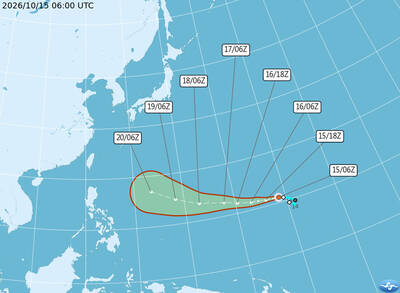
EAST OF GUAM: Tropical Storm Champi is forecast to strengthen into a typhoon, but its effect on Taiwan is uncertain due to the presence of a high-pressure system Tropical Storm Champi formed yesterday and has the potential to increase in strength, the Central Weather Administration (CWA) said yesterday. Forecasters are closely monitoring a Pacific high-pressure system that would dictate whether the storm turns north or moves toward Taiwan next week, the CWA said. The most likely scenario is that it turns northward after passing the Ryukyu Islands, CWA forecaster Cheng Chieh-jen (鄭傑仁) said. As of 8pm yesterday, Champi was east of Guam moving west-northwest at 20kph, CWA data showed. It had maximum sustained winds near the center of 72kph and gusts of up to 101kph, the data showed. If the Pacific high-pressure system
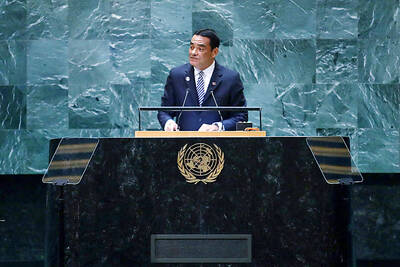
RIGHT TO DIPLOMACY: Under the UN Charter, every state has the right to conduct foreign policy free from external pressure, Belize said in a statement Belize and Paraguay on Monday condemned Beijing sanctions over their countries’ ties with Taiwan, saying China’s actions create unnecessary tensions. Earlier on Monday, Beijing announced sanctions against Paraguayan Minister of Information and Communication Technologies Gustavo Villate and Belizean Minister of Foreign Affairs Francis Fonseca. The Paraguayan Ministry of Foreign Affairs said it rejected the sanctions, writing on X that they created unnecessary friction. It added that it reaffirmed its support for Taiwan and its commitment to democratic values and principles. Villate told the Spanish-language Paraguayan daily ABC Color the sanctions were “predictable” and linked them to several cooperation projects between Taiwan and Paraguay. The projects


 RSS
RSS