


The Central Epidemic Command Center (CECC) yesterday reported 88 locally transmitted COVID-19 infections and nine deaths, and confirmed that two more cases from a cluster in Pingtung County had the Delta variant.
Among the 88 local cases, 48 are males and 40 are females, aged from under five to over 90, said Minister of Health and Welfare Chen Shih-chung (陳時中), who heads the center.
Twenty-seven of them tested positive while under isolation or upon ending isolation, he added.
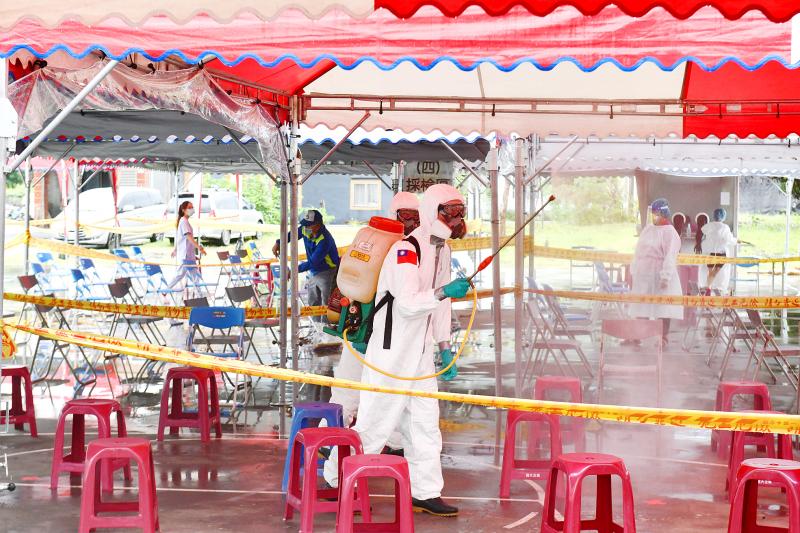
Photo: Tsai Tsung-hsien, Taipei Times
New Taipei City reported the most cases at 41, followed by Taipei with 33; Tainan with eight; Taoyuan with three; and Hsinchu City and Nantou and Pingtung counties with one each, he said.
The infection sources of 60 cases have been identified, 26 cases are being investigated and two have unclear infection sources, CECC data showed.
The nine deaths reported are three men and six women, aged in their 40s to 90s, all of whom had underlying health conditions.
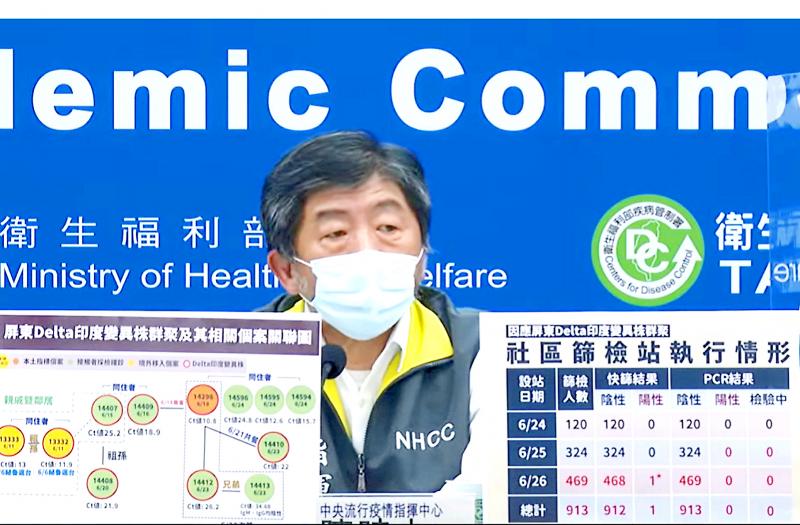
Photo copied by Tsai Tsung-hsien, Taipei Times
Of the total 632 COVID-19 deaths reported since last year, 624 were locally transmitted cases and eight were imported.
Chen said two more people involved in a cluster of 12 cases in Pingtung County have been confirmed to have the Delta variant.
Centers for Disease Control (CDC) Deputy Director-General Philip Lo (羅一鈞), deputy head of the CECC’s medical response division, said that there are now eight people — six locally transmitted cases and two imported cases — in the cluster infected with the variant.
As the remaining four cases in the cluster are family members of two people infected with the Delta variant, they have likely been infected with the same virus strain, he said, adding that the CECC would also conduct genome sequencing on a few suspected cases with unknown infection sources in other areas.
Meanwhile, the CPBL has submitted a proposal to resume its pro baseball games under strict COVID-19 preventive measures, but nonetheless decided to maintain the suspension to ensure fans’ safety.
Chen said that the disease prevention plan submitted by the league was feasible.
However, as several cluster infections have recently been reported and the situations need to be clarified, it is not appropriate to resume games at this time, he said.
There have been concerns about whether more people under the age of 18 might become infected, as they are not eligible for COVID-19 vaccinations.
Of the more than 13,300 confirmed cases reported after May 11, only 921 cases — about 6.9 percent — are under the age of 20, Lo said.
Of the 921 cases, only four people had severe COVID-19 symptoms, accounting for about 0.2 percent of all severe cases, he said.
While young people can be infected, people who are 65 or older have been prioritized to receive vaccines as they are more at risk of having severe symptoms, Lo said.
In other news, self-paid polymerase chain reaction tests for COVID-19 are now available at hospitals operated by the Ministry of Health and Welfare at a lower cost, the CECC said.
The price of standard tests, which are processed within 48 hours, has been reduced from NT$5,000 to NT$3,500, while the price of expedited tests, which are typically ready on the same day, has been cut from NT$7,000 to NT$4,500, it said.
Additional reporting by CNA

Taiwan has arranged for about 8 million barrels of crude oil, or about one-third of its monthly needs, to be shipped from the Red Sea this month to bypass the Strait of Hormuz and ease domestic supply pressures, CPC Corp, Taiwan (CPC, 台灣中油) said yesterday. The state-run oil company has worked with Middle Eastern suppliers to secure routes other than the Strait of Hormuz, through which about 20 percent of the world’s oil and liquefied natural gas typically passes, CPC chairman Fang Jeng-zen (方振仁) said at a meeting of the legislature’s Economics Committee in Taipei. Suppliers in Saudi Arabia have indicated they
South Korea has adjusted its electronic arrival card system to no longer list Taiwan as a part of China, a move that the Ministry of Foreign Affairs said would help facilitate exchanges between the two sides. South Korea previously listed “Taiwan” as “Taiwan (China)” in the drop-down menus of its online arrival card system, where people had to fill out where they came from and their next destination. The ministry had requested South Korea make a revision and said it would change South Korea’s name on Taiwan’s online immigration system from “Republic of Korea” to “Korea (South),” should the issue not be

Tainan, Taipei and New Taipei City recorded the highest fines nationwide for illegal accommodations in the first quarter of this year, with fines issued in the three cities each exceeding NT$7 million (US$220,639), Tourism Administration data showed. Among them, Taipei had the highest number of illegal short-term rental units, with 410. There were 3,280 legally registered hotels nationwide in the first quarter, down by 14 properties, or 0.43 percent, from a year earlier, likely indicating operators exiting the market, the agency said. However, the number of unregistered properties rose to 1,174, including 314 illegal hotels and 860 illegal short-term rental

AIR ALERT: China’s reservation of airspace over the Yellow Sea and East China Sea could be an attempt to test the US’ response ahead of a Trump-Xi meeting, the NSB head said China’s attempts to infiltrate Taiwan are systematic, planned and targeted, with activity shifting from recruiting mid-level military officers to rank-and-file enlisted personnel, National Security Bureau (NSB) Director-General Tsai Ming-yen (蔡明彥) said yesterday. The Chinese Communist Party’s (CCP) integrates national security, intelligence operations and “united front” efforts into a dense network to conduct intelligence gathering and espionage in Taiwan, Tsai said at a meeting of the legislature’s Foreign Affairs and National Defense Committee. It uses specific networks to screen targets through exchange activities and recruiting local collaborators to establish intelligence-gathering organizations, he said. China is also shifting who it targets to lower-ranking military personnel,


 RSS
RSS