


The Central Epidemic Command Center (CECC) yesterday reported 476 locally transmitted COVID-19 cases, 35 backlogged cases and 37 deaths.
Minister of Health and Welfare Chen Shih-chung (陳時中), who heads the center, said that most of the total of 511 cases live in New Taipei City, with 229 cases, followed by Taipei with 144, Miaoli County with 66, Taoyuan with 16, Keelung with 13 and Changhua County with 11.
Taichung reported nine new cases; Hsinchu County seven; Pingtung County four; Kaohsiung as well as Nantou and Chiayi counties reported three each; and Hsinchu City, Yunlin County and Tainan reported one new case each.
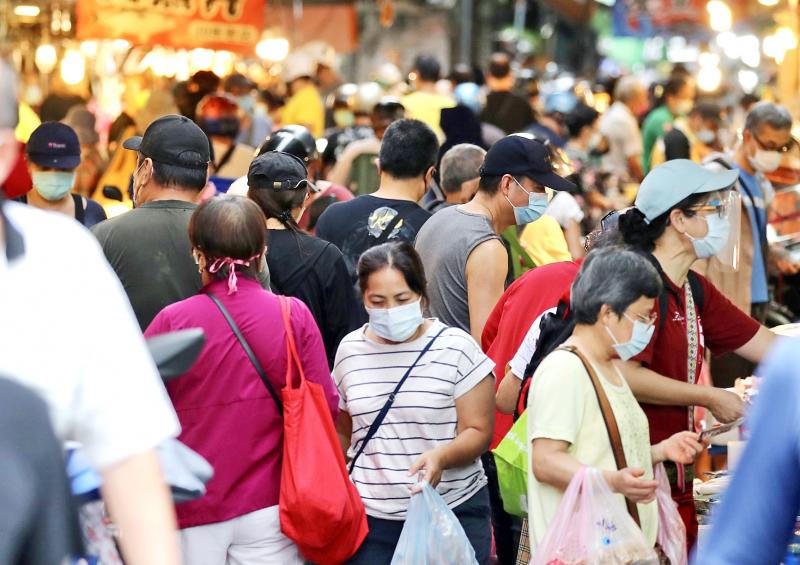
Photo: CNA
The 37 dead are 25 men and 12 women, who were aged from their 30s to their 90s, Chen said.
It was the highest daily COVID-19 death toll in Taiwan, where 224 people have died of the disease since the pandemic began.
Centers for Disease Control (CDC) Director-General Chou Jih-haw (周志浩), head of the CECC’s disease surveillance division, said one of the deceased was a man in his 30s who lived in a high-infection risk area in Taipei. The man had been hospitalized since the middle of last month and died on Tuesday.
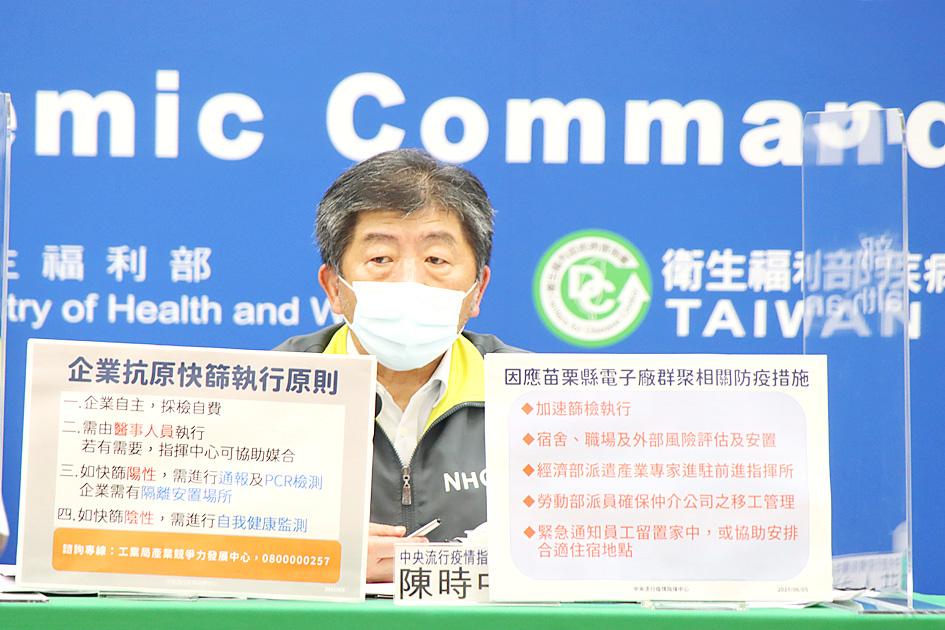
Photo: CNA
He did not mention underlying health conditions, Chou said.
CDC Deputy Director-General Philip Lo (羅一鈞), deputy chief of the center’s medical response division, said an analysis on all the COVID-19 fatalities as of Friday showed that 89.1 percent were aged 60 or above, with an average age of 72.
Among the dead, 81.7 percent had underlying health conditions, and the average time between the onset of symptoms and death was 8.3 days, he said.
The increase in deaths in the past few days reflects the peak in case counts in the middle of last month, when elderly people accounted for the largest proportion of confirmed cases, some of whom later developed severe symptoms and died, he said.
Among the 9,368 cases confirmed since April 20, 1,659 people, or 17.7 percent, developed severe pneumonia or acute respiratory distress syndrome, he said.
Among the 3,471 confirmed cases aged 60 or above, the figure is higher at 1,155 people, or 33.3 percent, he added.
Chen said that the center yesterday morning held an online session to improve the quality of care for severe COVID-19 patients, including a talk on the clinical treatment of severe cases by National Taiwan University Hospital (NTUH) Hsinchu Branch superintendent Yu Chung-jen (余忠仁), and a talk on care practices in COVID-19 intensive care units (ICU) by NTUH isolation ICU division director Ruan Sheng-yuan (阮聖元).
The session was attended by about 3,900 healthcare professionals, he said.
Lo said that if a person with severe COVID-19 develops a critical and irreversible condition, their physician may discuss the option of a do-not-resuscitate order with the patient’s family, but it is not the general guideline.
There are five main guidelines for treating people with severe COVID-19: non-invasive respiratory support through high-flow nasal cannula therapy or mask; endotracheal intubation; the use of antiviral medication remdesivir; the use of monoclonal antibodies and steroids; and the use of anticoagulants in patients with high risk of blood clotting.
The participants in the online session raised concerns about silent hypoxia in people with mild symptoms, as they do not experience any breathing difficulty, but might experience a sudden and rapid drop in blood oxygen level, leading to a high risk of death, Lo said.
The CECC and local governments have tried to move all of the people hospitalized with COVID-19 to quarantine facilities where healthcare professionals can monitor their conditions, he said.
Chen said the mortality rate of COVID-19 in Taiwan has increased from more than 1 percent to about 2 percent yesterday.
Asked if the center would raise the COVID-19 alert to level 4, meaning a nationwide lockdown, to prevent the virus from spreading further, Chen said the outbreak situation needs to be further observed, adding that the CECC specialist advisory panel has not recommended such a step.
Separately, sources said the CECC has reported to the Executive Yuan that it is considering extending the level 3 alert for two more weeks, until June 28.
The Cabinet has asked the Ministry of Education to make preparations for extending the suspension of classes in case the level 3 measures are extended, as parents would need to be informed in advance, sources added.
Additional reporting by Lee Hsin-fang
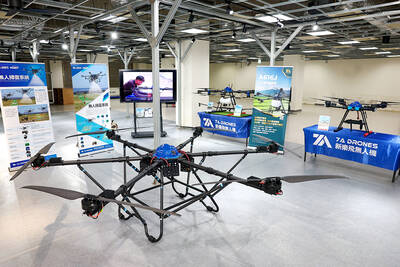
DRONE CENTRAL: Taiwan aims to become Asia’s democratic hub for drones, with most exports focused on high-quality military-grade models, an official said Taiwan’s drone industry is expected to expand significantly by 2030, producing 100,000 units per month and exporting half of them, the Ministry of Economic Affairs said yesterday. Current drone production capacity is about 15,000 units per month, but the industry can quickly scale up as demand increases, Industrial Development Administration Director-General Chiou Chyou-huey (邱求慧) told a news conference in Taipei. Taiwan’s drone output grew 2.5-fold last year to NT$12.9 billion (US$408.3 million) under a government program to develop the uncrewed vehicle sector, he said. The Executive Yuan in October last year approved plans to invest NT$44.2 billion into domestic production of uncrewed aerial
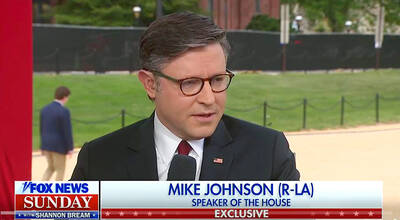
RESOLUTE BACKING: Two Republican senators are planning to introduce legislation that would impose immediate sanctions on China if it attempts to invade Taiwan US House of Representatives Speaker Mike Johnson on Sunday reaffirmed US congressional support for Taiwan, saying the US and “all freedom-loving people” have a stake in preventing China from seizing Taiwan by force. Johnson made the remarks in an interview with Fox News Sunday on US President Donald Trump’s summit with Chinese President Xi Jinping (習近平) last week. In an interview that aired on Friday on Fox News, just as Trump wrapped up a high-stakes visit to China, he said he has yet to green-light a new US$14 billion arms package to Taiwan and that it “depends on China.” “It’s a very good
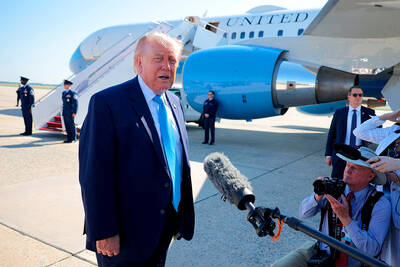
US President Donald Trump yesterday said he would speak to President William Lai (賴清德) as his administration considers whether to move ahead with a US$14 billion weapons sale to Taiwan — a potential arms deal that has drawn criticism from China. “Well, I’ll speak to him. I speak to everybody,” Trump told reporters yesterday when asked if he had any plans to call his counterpart, although he did not offer a time frame for when such a conversation could take place. Trump previously said he would speak to the person “that’s running Taiwan,” without specifying who he meant. “We have that situation very
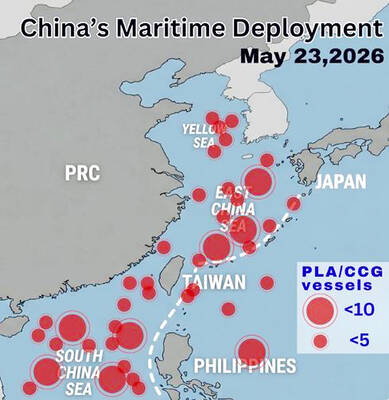
WARNING: China should stop engaging in actions that undermine regional peace and stability, as it would only build resentment among people across the Strait, the CGA said China has deployed more than 100 navy, coast guard and other vessels in waters from the Yellow Sea to the South China Sea and the western Pacific since US President Donald Trump and Chinese President Xi Jinping (習近平) met in Beijing, National Security Council Secretary-General Joseph Wu (吳釗燮) said yesterday. “In this part of the world, #China is the one & only PROBLEM wrecking the #StatusQuo & threatening regional peace & stability,” Wu wrote on X. In a separate post, he said Beijing was coercing Taiwan’s maritime domain, calling it illegal and provocative, after the Coast Guard Administration (CGA) expelled a


 RSS
RSS