


The nationwide level 3 COVID-19 alert is to be extended until June 14, the Central Epidemic Command Center (CECC) announced yesterday, as it reported 281 locally transmitted cases, 261 backlogged cases and six deaths.
Minister of Health and Welfare Chen Shih-chung (陳時中), who heads the center, said the extension means that classes at all school levels would also be suspended until June 14, and everyone should continue to practice disease prevention measures.
The COVID-19 alert was raised to level 3 for the whole nation on Wednesday last week, four days after it was issued in Taipei and New Taipei City, where the vast majority of confirmed cases were reported.

Photo: Ann Wang, Reuters
“We strongly urge everyone to keep being responsible — wear a mask, keep a proper social distance, avoid unnecessary gatherings and keep to the rule on gatherings of no more than five people indoors or 10 people outdoors,” Chen said.
“Although the [level 3 warning] period has been extended, everyone should endure it for the sake of disease prevention,” he said. “If we do not endure it, COVID-19 might continue to spread, causing even more stress in our lives.”
Businesses should continue to follow the CECC’s business continuity guidelines, such as remote working, Chen said, adding that the Executive Yuan would announce a COVID-19 relief program in response to the extended level 3 alert.

Photo: Liao Chen-huei, Taipei Times
Among the 281 new locally transmitted cases reported, 154 were in New Taipei City; 49 in Taipei; 16 in Taoyuan; 10 each in Tainan, Keelung and Changhua County; nine in Taichung; four each in Pingtung County and Hsinchu City; and one to three cases each in eight other cities or counties.
Of the 261 backlogged cases, 155 live in Taipei, 89 in New Taipei City, five each in Yilan County and Taoyuan, three each in Keelung and Changhua County, and one in Taichung.
The backlogged cases have been added to the daily case counts for May 16 to Monday, bringing the total number of confirmed cases to 510 people on Monday last week — the peak — followed by 468 cases on Wednesday last week and 435 cases on Thursday last week, CECC data showed.

Of the 542 cases reported yesterday, 186 had recently visited Taipei’s Wanhua District (萬華), 28 were linked to a cluster infection at Wanhua teahouses, 131 were associated with previous clusters or cases, 111 had an unclear connection to previous cases and 86 were still being investigated, Chen said.
The six deaths were five men and one woman, who ranged in age from 60 to 90, showed symptoms of COVID-19 between May 8 and Saturday last week, tested positive between May 15 and Monday, and died between Thursday last week and Monday, the CECC said.
Aside from a man in his 60s, who did not have a chronic disease, but had visited Wanhua recently, the other five had underlying medical conditions. The five men died in hospital, while the woman, who was in her 60s, died in a quarantine hotel on Monday, two days after testing positive.
Chen said that judging from the daily number of confirmed cases since the recent outbreak of local infections, the peak period was between May 15 and May 17, and as the COVID-19 situation has not dramatically deteriorated over the past few days, there was no need to raise the nationwide COVID-19 alert to level 4.
However, the testing positivity rates remain high at many stations, and the center is still concerned that the screening speed is not fast enough, he said.
The period between when a person experiences an onset of symptoms to when the person gets tested and when the test result comes back is still too long, he said.
“We are concerned that there are still hidden infected cases that have not been detected, and they pose a high risk of infecting family members, as well as local communities,” he said.
The more stringent disease prevention and control measures since the level 3 alert was issued have proved to be effective so far, but if the warning was removed on Friday, as originally planned, these hidden infection cases could continue to spread the virus and cause the outbreak to worsen, so the CECC specialist advisory panel recommended that the control measures not be loosened, Chen said.
A visibly emotional Chen talked about cases of police officers testing positive, saying that officers have been exposed to infection risks from searching for people who contravene quarantine rules or those who have gone missing after testing positive, as well as cracking down on recreational venues that should have suspended business according to regulations, or people who refuse to wear a mask, which should be every individual’s responsibility.
“These behaviors have caused police officers to be exposed to high infection risks, as well as having added an extra burden to the society,” he said, choking back tears.
“Now that several police officers have been infected, I hope those people who are not fulfilling their disease prevention duties will be able to self-reflect,” he said.
Chen also announced that a batch of 2 million vaccine doses would arrive in Taiwan by the end of next month, and a total of 10 million doses of vaccines, including domestically produced ones, would be available by the end of August.
Given the current COVID-19 situation, people who are exposed to confirmed cases at work would have first priority to get vaccinated, he said, adding that the brand names of the vaccines would not be publicized at this time to prevent external interference from disrupting the schedule.
The CECC also released a “community rapid testing station process flow chart” to help boost efficiency at testing stations, and eased the rules to allow hospitals in Taipei and New Taipei City to admit more than one patient in each designated COVID-19 hospital room, if admission capacity is strained.
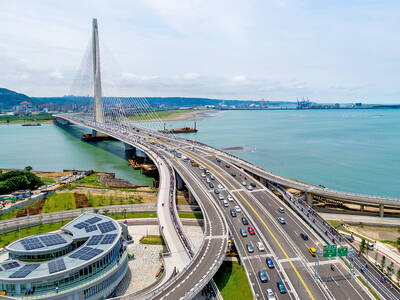
The Ministry of Transportation and Communications yesterday inaugurated the Danjiang Bridge across the Tamsui River in New Taipei City, saying that the structure would be an architectural icon and traffic artery for Taiwan. Feted as a major engineering achievement, the Danjiang Bridge is 920m long, 211m tall at the top of its pylon, and is the longest single-pylon asymmetric cable-stayed bridge in the world, the government’s Web site for the structure said. It was designed by late Iraqi-British architect Zaha Hadid. The structure, with a maximum deck of 70m, accommodates road and light rail traffic, and affords a 200m navigation channel for boats,
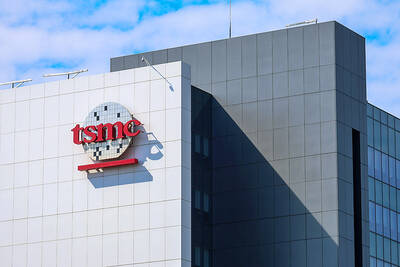
Taiwan Semiconductor Manufacturing Co (TSMC, 台積電), the world’s largest foundry service provider, yesterday said that global semiconductor revenue is projected to hit US$1.5 trillion in 2030, after the figure exceeds US$1 trillion this year, as artificial intelligence (AI) demand boosts consumption of token and compute power. “We are still at the beginning of the AI revolution, but we already see a significant impact across the whole semiconductor ecosystem,” TSMC deputy cochief operating officer Kevin Zhang (張曉強) said at the company’s annual technology symposium in Hsinchu City. “It is fair to say that in the past decade, smartphones and other mobile devices were
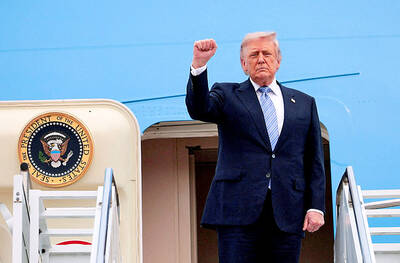
US-CHINA SUMMIT: MOFA welcomed US reassurance of no change in its Taiwan policy; Trump said he did not comment when Xi talked of opposing independence US President Donald Trump yesterday said he has not made a decision on whether to move forward with a major arms package for Taiwan after hearing concerns about it from Chinese President Xi Jinping (習近平). Trump’s comments on Taiwan came as he flew back to Washington after wrapping up critical talks in which both leaders said important progress was made in stabilizing US-China relations even as deep differences persist between the world’s two biggest powers on Iran and Taiwan. “I will make a determination,” Trump said, adding: “I’ll be making decisions. But, you know, I think the last thing we need right

TAIWAN ISSUE: US treasury secretary Scott Bessent said on the first day of meetings that ‘it wouldn’t be a US-China summit without the Taiwan issue coming up’ There were no surprises on the first day of the summit between US President Donald Trump and Chinese President Xi Jinping (習近平), the Mainland Affairs Council (MAC) said yesterday, as the government reiterated that cross-strait stability is crucial to the Asia-Pacific region, as well as the world. As the two presidents met for a highly anticipated summit yesterday, Chinese state media reported that Xi warned Trump that missteps regarding Taiwan could push their two countries into “conflict.” Trump arrived in China with accolades for his host, calling Xi a “great leader” and “friend,” and extending an invitation to visit the White House


 RSS
RSS